Technical Specifications
| Brand | Mazda |
| Model | CX-5 |
| Generation | CX-5 (KE) |
| Type (Engine) | 2.2 SKYACTIV-D (150 Hp) Automatic |
| Start of production | 2012 |
| End of production | 2015 |
| Powertrain Architecture | Internal Combustion engine |
| Body type | SUV |
| Seats | 5 |
| Doors | 5 |
| Fuel consumption (urban) | 6.2 l/100 km (37.9 US mpg, 45.6 UK mpg, 16.1 km/l) |
| Fuel consumption (extra urban) | 4.7 l/100 km (50 US mpg, 60.1 UK mpg, 21.3 km/l) |
| Fuel consumption (combined) | 5.3 l/100 km (44.4 US mpg, 53.3 UK mpg, 18.9 km/l) |
| CO2 emissions | 139 g/km |
| Fuel Type | Diesel |
| Acceleration 0 – 100 km/h | 10 sec |
| Acceleration 0 – 62 mph | 10 sec |
| Acceleration 0 – 60 mph | 9.5 sec |
| Maximum speed | 198 km/h (123.03 mph) |
| Emission standard | Euro 6 |
| Weight-to-power ratio | 9.5 kg/Hp, 105.3 Hp/tonne |
| Weight-to-torque ratio | 3.8 kg/Nm, 266.7 Nm/tonne |
| Power | 150 Hp @ 4500 rpm |
| Torque | 380 Nm @ 1800-2600 rpm (280.27 lb.-ft. @ 1800-2600 rpm) |
| Engine layout | Front, Transverse |
| Engine Model/Code | SHY1 |
| Engine displacement | 2191 cm3 (133.7 cu. in.) |
| Number of cylinders | 4 |
| Engine configuration | Inline |
| Cylinder Bore | 86 mm (3.39 in.) |
| Piston Stroke | 94.3 mm (3.71 in.) |
| Compression ratio | 14:1 |
| Number of valves per cylinder | 4 |
| Fuel injection system | Diesel Commonrail |
| Engine aspiration | Twin-Turbo, Intercooler |
| Valvetrain | DOHC |
| Engine oil capacity | 5.1 l (5.39 US qt | 4.49 UK qt) |
| Coolant | 8.6 l (9.09 US qt | 7.57 UK qt) |
| Kerb Weight | 1425 kg (3141.59 lbs.) |
| Max. weight | 2050 kg (4519.48 lbs.) |
| Max load | 625 kg (1377.89 lbs.) |
| Trunk (boot) space – minimum | 503 l (17.76 cu. ft.) |
| Trunk (boot) space – maximum | 1620 l (57.21 cu. ft.) |
| Fuel tank capacity | 56 l (14.79 US gal | 12.32 UK gal) |
| Max. roof load | 50 kg (110.23 lbs.) |
| Permitted trailer load with brakes (8%) | 2000 kg (4409.25 lbs.) |
| Permitted trailer load with brakes (12%) | 2000 kg (4409.25 lbs.) |
| Permitted trailer load without brakes | 750 kg (1653.47 lbs.) |
| Permitted towbar download | 88 kg (194.01 lbs.) |
| Length | 4555 mm (179.33 in.) |
| Width | 1840 mm (72.44 in.) |
| Height | 1710 mm (67.32 in.) |
| Wheelbase | 2700 mm (106.3 in.) |
| Front track | 1585 mm (62.4 in.) |
| Rear (Back) track | 1590 mm (62.6 in.) |
| Drag coefficient (Cd) | 0.33 |
| Minimum turning circle (turning diameter) | 11.7 m (38.39 ft.) |
| Drivetrain Architecture | The Internal combustion engine (ICE) drives the front wheels of the vehicle. |
| Drive wheel | Front wheel drive |
| Number of gears and type of gearbox | 6 gears, automatic transmission |
| Front suspension | Independent type McPherson |
| Rear suspension | Independent multi-link suspension |
| Front brakes | Ventilated discs, 297 mm |
| Rear brakes | Disc, 303 mm |
| Assisting systems | ABS (Anti-lock braking system) |
| Steering type | Steering rack and pinion |
| Power steering | Electric Steering |
| Tires size | 225/65 R17; 225/55 R19 |
| Wheel rims size | 7J x 17; 7J x 19 |
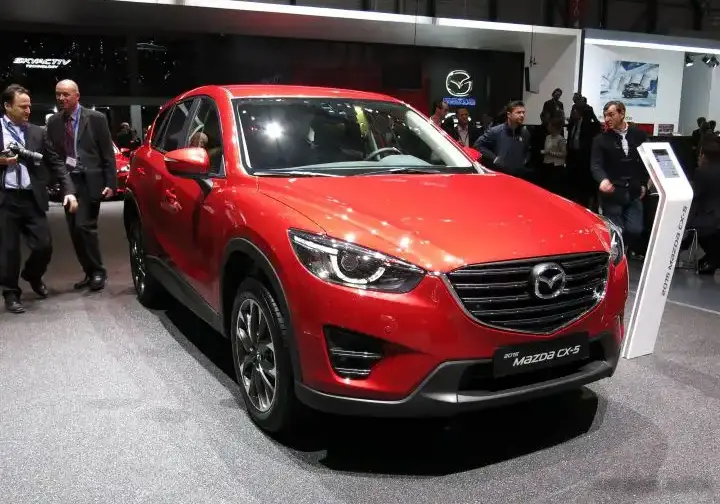
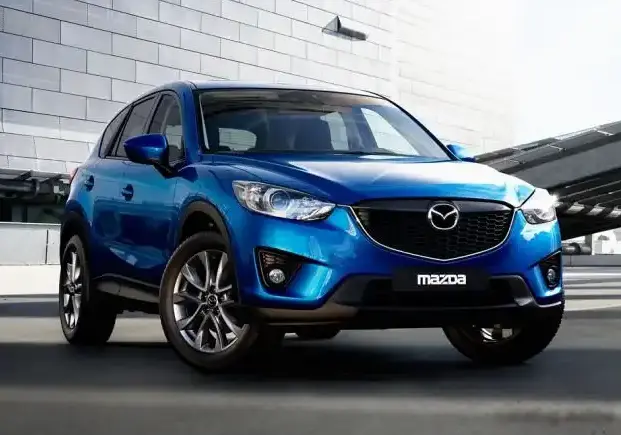
The Mazda CX-5 2.2 SKYACTIV-D (150 hp) Automatic, produced between 2012 and 2015, marked a significant addition to Mazda’s growing SUV lineup. Positioned as a mid-range offering within the first generation (KE series) CX-5, this variant combined Mazda’s innovative SKYACTIV technology with a fuel-efficient diesel engine and a convenient automatic transmission. It was primarily targeted towards the European and Asian markets, where diesel-powered SUVs were – and remain – popular due to their fuel economy and torque characteristics. The CX-5, as a whole, aimed to deliver a more engaging driving experience than many competitors in the compact SUV segment, and the 2.2 SKYACTIV-D Automatic sought to balance that with practicality and efficiency.
Powertrain & Engine Architecture
The core of this CX-5 variant is the 2.2-liter SKYACTIV-D diesel engine, internally designated SHY1. This engine features a four-cylinder, inline configuration and a relatively high compression ratio of 14:1, contributing to its thermal efficiency. It employs a common-rail direct injection system and is equipped with a twin-turbocharger setup incorporating an intercooler. The twin-turbo design was implemented to minimize turbo lag and deliver a wider, more usable torque curve. The engine generates 150 horsepower at 4500 rpm and a substantial 380 Nm (280 lb-ft) of torque between 1800 and 2600 rpm. This torque output, readily available at lower engine speeds, is a characteristic of diesel engines and provides robust pulling power. The engine is coupled with a six-speed automatic transmission, engineered to complement the engine’s characteristics. The transmission’s programming emphasizes fuel efficiency and smooth gear changes, rather than aggressive performance.
Driving Characteristics
The 150 hp SKYACTIV-D Automatic CX-5 offered a comfortable and refined driving experience. While not particularly sporty, it provided sufficient acceleration for everyday driving, achieving 0-60 mph in approximately 9.5 seconds. The automatic transmission, while generally smooth, could occasionally feel hesitant during quick overtaking maneuvers, necessitating a deliberate downshift. Compared to the 2.5-liter gasoline engine option or the higher-output diesel variants, this version prioritized fuel economy over outright performance. The strong low-end torque made it well-suited for highway cruising and towing light loads. The gear ratios were optimized for efficiency, resulting in the engine frequently operating at lower RPMs during steady-state driving.
Equipment & Trim Levels
The 2.2 SKYACTIV-D Automatic trim typically included standard features such as air conditioning, power windows and locks, a basic audio system with USB connectivity, and alloy wheels. Higher trim levels added features like leather upholstery, a sunroof, a navigation system, and advanced safety technologies like lane departure warning and blind-spot monitoring. Interior upholstery was generally cloth on the base models, with leather options available on higher trims. The dashboard configuration remained consistent across the range, featuring a simple and functional layout.
Chassis & Braking
The CX-5 utilized a front-engine, front-wheel-drive layout. The suspension system consisted of independent McPherson struts at the front and an independent multi-link setup at the rear, providing a good balance between ride comfort and handling. Braking was handled by ventilated discs at the front and solid discs at the rear. An Anti-lock Braking System (ABS) was standard equipment. The suspension tuning prioritized comfort, focusing on absorbing road imperfections and delivering a stable ride. Stabilizer bars were fitted to both the front and rear axles to minimize body roll during cornering.
Market Reception & Comparison
The Mazda CX-5 2.2 SKYACTIV-D Automatic was generally well-received by automotive critics. It was praised for its fuel efficiency, comfortable ride, and spacious interior. However, some reviewers noted that the automatic transmission could occasionally feel sluggish, and the engine lacked the power of some competitors. Compared to the gasoline-powered CX-5, the diesel version offered significantly better fuel economy, but at a higher purchase price. Against rivals like the Nissan Qashqai and Hyundai ix35, the CX-5 distinguished itself with its more engaging driving dynamics and a more upscale interior feel.
Legacy
The 2.2 SKYACTIV-D engine proved to be a reliable unit, although, as with all diesel engines, it requires regular maintenance, including oil changes and diesel particulate filter (DPF) regeneration. The automatic transmission, when properly maintained, also demonstrated good durability. In the used car market, these CX-5s are often sought after for their fuel efficiency and practicality. However, prospective buyers should be aware of the potential costs associated with diesel engine maintenance and the importance of ensuring the DPF is functioning correctly. The SKYACTIV technology introduced in the CX-5 laid the groundwork for Mazda’s future engine development and solidified its reputation for building efficient and enjoyable-to-drive vehicles.