
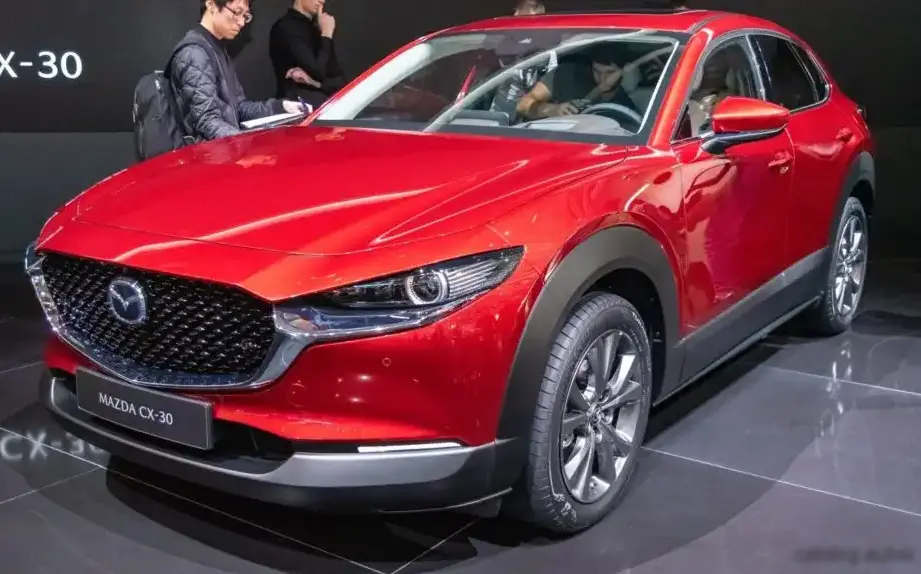
The Mazda CX-30 2.5 e-Skyactiv G, producing 140 horsepower, represents a key variant within the CX-30 lineup, introduced in June 2024. Positioned as a mainstream offering, it balances performance and efficiency for the compact SUV market. This model is primarily targeted towards consumers seeking a stylish and practical vehicle with Mazda’s signature driving dynamics, incorporating mild-hybrid technology for improved fuel economy. It slots into the CX-30 range alongside other engine options, offering a more accessible price point than the higher-output turbocharged variants.
Technical Specifications
| Brand | Mazda |
| Model | CX-30 |
| Generation | CX-30 |
| Type (Engine) | 2.5 e-Skyactiv G (140 Hp) |
| Start of production | June, 2024 |
| Powertrain Architecture | MHEV (Mild Hybrid Electric Vehicle) |
| Body type | SUV |
| Seats | 5 |
| Doors | 5 |
| Fuel consumption at Low speed (WLTP) | 7.8 l/100 km (30.2 US mpg) |
| Fuel consumption at Medium speed (WLTP) | 5.7 l/100 km (41.3 US mpg) |
| Fuel consumption at high speed (WLTP) | 5.1 l/100 km (46.1 US mpg) |
| Fuel consumption at very high speed (WLTP) | 6.3 l/100 km (37.3 US mpg) |
| Combined fuel consumption (WLTP) | 6 l/100 km (39.2 US mpg) |
| CO2 emissions (WLTP) | 135-136 g/km |
| Fuel Type | Petrol (Gasoline) |
| Acceleration 0 – 100 km/h | 9.7 sec |
| Acceleration 0 – 62 mph | 9.7 sec |
| Acceleration 0 – 60 mph | 9.2 sec |
| Maximum speed | 194 km/h (120.55 mph) |
| Emission standard | Euro 6e |
| Weight-to-power ratio | 9.9 kg/Hp |
| Weight-to-torque ratio | 5.8 kg/Nm |
| Battery voltage | 24 V |
| Battery technology | Lithium-ion (Li-Ion) |
| Power | 140 Hp @ 5000 rpm |
| Torque | 238 Nm @ 3300 rpm (175.54 lb.-ft. @ 3300 rpm) |
| Engine layout | Front, Transverse |
| Engine displacement | 2488 cm3 (151.83 cu. in.) |
| Number of cylinders | 4 |
| Engine configuration | Inline |
| Cylinder Bore | 89 mm (3.5 in.) |
| Piston Stroke | 100 mm (3.94 in.) |
| Compression ratio | 13:1 |
| Number of valves per cylinder | 4 |
| Fuel injection system | Direct injection |
| Engine aspiration | Naturally aspirated engine |
| Valvetrain | DOHC, VVT |
| Engine oil capacity | 4.5 l (4.76 US qt | 3.96 UK qt) |
| Coolant | 6.9 l (7.29 US qt | 6.07 UK qt) |
| Kerb Weight | 1380-1433 kg (3042.38 – 3159.22 lbs.) |
| Max. weight | 1950 kg (4299.01 lbs.) |
| Max load | 517-570 kg (1139.79 – 1256.63 lbs.) |
| Trunk (boot) space – minimum | 422 l (14.9 cu. ft.) |
| Trunk (boot) space – maximum | 1406 l (49.65 cu. ft.) |
| Fuel tank capacity | 51 l (13.47 US gal | 11.22 UK gal) |
| Permitted trailer load with brakes (8%) | 1300 kg (2866.01 lbs.) |
| Permitted trailer load with brakes (12%) | 1300 kg (2866.01 lbs.) |
| Permitted trailer load without brakes | 600 kg (1322.77 lbs.) |
| Length | 4395 mm (173.03 in.) |
| Width | 1795 mm (70.67 in.) |
| Width including mirrors | 2040 mm (80.31 in.) |
| Height | 1540 mm (60.63 in.) |
| Wheelbase | 2655 mm (104.53 in.) |
| Front track | 1565 mm (61.61 in.) |
| Rear (Back) track | 1565 mm (61.61 in.) |
| Ride height (ground clearance) | 180 mm (7.09 in.) |
| Minimum turning circle (turning diameter) | 10.6 m (34.78 ft.) |
| Drivetrain Architecture | ICE and electric motor drive front wheels |
| Drive wheel | Front wheel drive |
| Number of gears and type of gearbox | 6 gears, manual transmission |
| Front suspension | Independent, McPherson with coil spring and anti-roll bar |
| Rear suspension | Torsion |
| Front brakes | Ventilated discs |
| Rear brakes | Disc |
| Assisting systems | ABS (Anti-lock braking system) |
| Steering type | Steering rack and pinion |
| Power steering | Electric Steering |
| Tires size | 215/65 R16; 215/55 R18 |
| Wheel rims size | 6.5J x 16; 7J x 18 |
Powertrain & Engine Architecture
The CX-30 2.5 e-Skyactiv G utilizes Mazda’s 2.5-liter inline-four cylinder engine, designated as the PY-VPS. This engine is part of the e-Skyactiv G series, incorporating Mazda’s mild-hybrid technology. The mild-hybrid system employs a 24V lithium-ion battery and an integrated starter generator (ISG) to provide a small amount of electric assistance during acceleration and enable smoother start-stop functionality. The engine features direct injection, a high 13:1 compression ratio, and dual overhead camshafts (DOHC) with variable valve timing (VVT) on both intake and exhaust valves. This configuration optimizes both power delivery and fuel efficiency. The engine produces 140 horsepower at 5,000 rpm and 238 Nm (175.54 lb-ft) of torque at 3,300 rpm. The engine is transversely mounted at the front of the vehicle. The six-speed manual transmission is standard, delivering power to the front wheels.
Driving Characteristics
The 140 hp engine paired with the six-speed manual transmission provides adequate performance for everyday driving. Acceleration from 0-60 mph takes approximately 9.2 seconds, and the top speed is 194 km/h (120.55 mph). While not as brisk as the turbocharged variants, the naturally aspirated engine offers a linear power delivery and a responsive feel. The manual transmission provides drivers with greater control, but the gear ratios are tuned for fuel efficiency rather than outright performance. Compared to higher-output versions, this variant prioritizes fuel economy and a more relaxed driving experience. The mild-hybrid system contributes to smoother starts and improved responsiveness at lower speeds.
Equipment & Trim Levels
The CX-30 2.5 e-Skyactiv G typically comes standard with features such as Mazda’s infotainment system with an 8.8-inch display, Apple CarPlay and Android Auto integration, LED headlights, and a suite of safety features including adaptive cruise control, lane departure warning, and automatic emergency braking. Interior upholstery is typically cloth, with options for leatherette or leather available on higher trim levels. Available options include a sunroof, premium audio system, and heated front seats. The specific trim levels and available options vary depending on the market.
Chassis & Braking
The CX-30 utilizes a front-wheel-drive platform with an independent McPherson strut suspension in the front and a torsion beam suspension in the rear. The front brakes are ventilated discs, while the rear brakes are solid discs. The suspension is tuned to provide a balance between comfort and handling, offering a relatively firm ride without being overly harsh. The electric power steering provides precise and responsive steering feel. The chassis is designed to minimize weight and maximize rigidity, contributing to improved handling and stability.
Market Reception & Comparison
The Mazda CX-30 2.5 e-Skyactiv G has been generally well-received by critics for its stylish design, engaging driving dynamics, and fuel efficiency. It offers a compelling alternative to other compact SUVs in its class, such as the Honda HR-V and Toyota Corolla Cross. Compared to the higher-output turbocharged variants, this model offers a more affordable entry point into the CX-30 lineup. Fuel economy is a strong point, with combined WLTP figures of 6 l/100 km (39.2 US mpg). Reliability is expected to be good, based on Mazda’s reputation for building durable vehicles.
Legacy
The Mazda PY-VPS engine, in its various iterations, has proven to be a reliable and durable powerplant. The addition of mild-hybrid technology in the CX-30 2.5 e-Skyactiv G further enhances its efficiency and longevity. As a used car, this variant is expected to hold its value well, thanks to Mazda’s strong brand reputation and the vehicle’s appealing combination of style, performance, and fuel economy. The 2.5-liter engine is known for its relatively simple design and ease of maintenance, making it a practical choice for long-term ownership.
