Technical Specifications
| Brand | Audi |
| Model | TT |
| Generation | TT Coupe (8N, facelift 2000) |
| Type (Engine) | 1.8 T (180 Hp) quattro |
| Start of production | 2000 |
| End of production | June, 2006 |
| Powertrain Architecture | Internal Combustion engine |
| Body type | Coupe |
| Seats | 4 |
| Doors | 3 |
| Fuel consumption (urban) | 13 l/100 km (18.1 US mpg, 21.7 UK mpg, 7.7 km/l) |
| Fuel consumption (extra urban) | 7.5 l/100 km (31.4 US mpg, 37.7 UK mpg, 13.3 km/l) |
| Fuel consumption (combined) | 9.4 l/100 km (25 US mpg, 30.1 UK mpg, 10.6 km/l) |
| CO2 emissions | 226 g/km |
| Fuel Type | Petrol (Gasoline) |
| Acceleration 0 – 100 km/h | 7.9 sec |
| Acceleration 0 – 62 mph | 7.9 sec |
| Acceleration 0 – 60 mph | 7.5 sec |
| Maximum speed | 226 km/h (140.43 mph) |
| Emission standard | Euro 3 |
| Weight-to-power ratio | 7.8 kg/Hp, 127.7 Hp/tonne |
| Weight-to-torque ratio | 6 kg/Nm, 166.7 Nm/tonne |
| Power | 180 Hp @ 5500 rpm |
| Power per litre | 101.1 Hp/l |
| Torque | 235 Nm @ 1950-5000 rpm (173.33 lb.-ft. @ 1950-5000 rpm) |
| Engine layout | Front, Transverse |
| Engine Model/Code | AJQ, APP, ATC, AUQ |
| Engine displacement | 1781 cm3 (108.68 cu. in.) |
| Number of cylinders | 4 |
| Engine configuration | Inline |
| Cylinder Bore | 81 mm (3.19 in.) |
| Piston Stroke | 86.4 mm (3.4 in.) |
| Compression ratio | 9.5:1 |
| Number of valves per cylinder | 5 |
| Fuel injection system | Multi-port manifold injection |
| Engine aspiration | Turbocharger |
| Valvetrain | DOHC |
| Engine oil capacity | 4.5 l (4.76 US qt | 3.96 UK qt) |
| Coolant | 5 l (5.28 US qt | 4.4 UK qt) |
| Kerb Weight | 1410 kg (3108.52 lbs.) |
| Max. weight | 1795 kg (3957.3 lbs.) |
| Max load | 385 kg (848.78 lbs.) |
| Trunk (boot) space – minimum | 220 l (7.77 cu. ft.) |
| Trunk (boot) space – maximum | 490 l (17.3 cu. ft.) |
| Fuel tank capacity | 62 l (16.38 US gal | 13.64 UK gal) |
| Max. roof load | 75 kg (165.35 lbs.) |
| Length | 4041 mm (159.09 in.) |
| Width | 1764 mm (69.45 in.) |
| Height | 1345 mm (52.95 in.) |
| Wheelbase | 2429 mm (95.63 in.) |
| Front track | 1528 mm (60.16 in.) |
| Rear (Back) track | 1505 mm (59.25 in.) |
| Drag coefficient (Cd) | 0.32 |
| Minimum turning circle | 10.6 m (34.78 ft.) |
| Drive wheel | All wheel drive (4×4) |
| Number of gears | 6 gears, manual transmission |
| Front suspension | Independent, type McPherson with coil spring and anti-roll bar |
| Rear suspension | Independent multi-link spring suspension with stabilizer |
| Front brakes | Ventilated discs |
| Rear brakes | Disc |
| Assisting systems | ABS (Anti-lock braking system) |
| Steering type | Steering rack and pinion |
| Power steering | Hydraulic Steering |
| Tires size | 205/55 R16 |
| Wheel rims size | 7J x 16 |
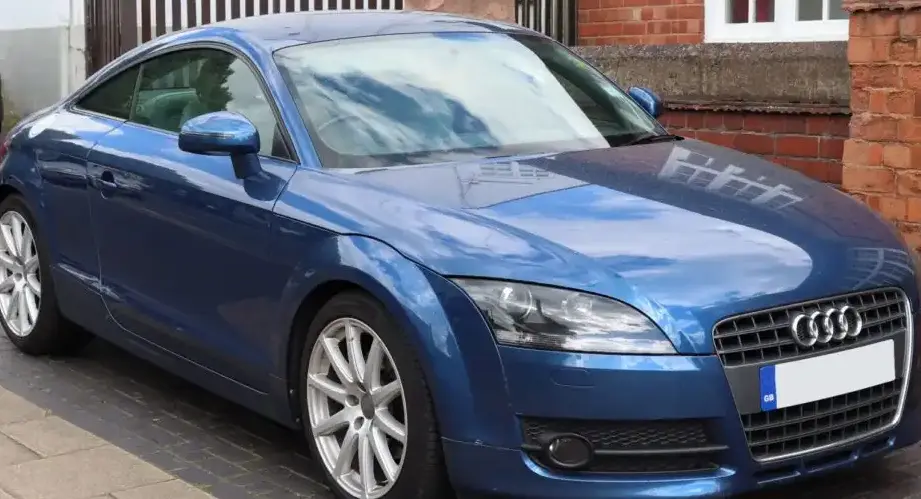
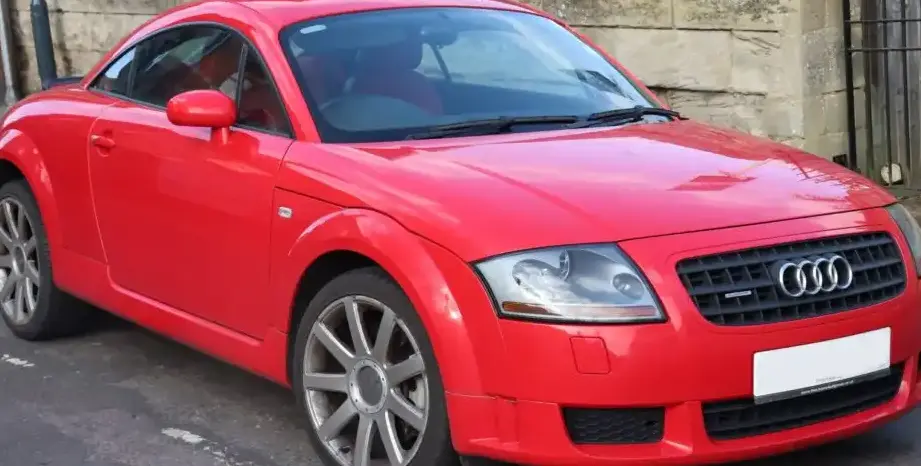
The Audi TT Coupe (8N facelift), specifically the 1.8T quattro produced from 2000 to 2006, represents a significant refinement of Audi’s groundbreaking sports coupe. Introduced as part of the 8N series’ mid-cycle refresh, this model combined the distinctive Bauhaus-inspired design of the original TT with improvements to both performance and interior quality. Positioned as a mid-range offering within the 8N lineup, it slotted between the base 1.8T front-wheel-drive model and the higher-performance TT 3.2 quattro. The facelift brought subtle but important changes to the exterior, most notably revised headlights and a redesigned grille, along with improvements to the interior and suspension. This variant played a key role in establishing the TT as a desirable and accessible entry point into the premium sports car market in both Europe and North America.
Powertrain & Engine Architecture
At the heart of the 1.8T quattro lies the Audi-developed 1.8-liter inline-four cylinder engine, utilizing engine codes AJQ, APP, ATC, or AUQ depending on the market and production date. This engine is a turbocharged, multi-point fuel-injected powerplant featuring a dual overhead camshaft (DOHC) valvetrain with five valves per cylinder (three intake, two exhaust). The turbocharger, typically a K03 variant, provides a significant boost in power output compared to naturally aspirated engines of similar displacement. The engine’s design prioritizes a broad torque curve, making it responsive in everyday driving situations. A 6-speed manual transmission was standard, offering precise shifts and contributing to the car’s sporty feel. The quattro all-wheel-drive system, a hallmark of Audi, utilizes a Torsen differential to distribute power between the front and rear axles, enhancing traction and stability, particularly in adverse weather conditions.
Driving Characteristics
The 180 hp and 235 Nm (173 lb-ft) of torque delivered by the 1.8T engine, combined with the quattro all-wheel-drive system, resulted in a balanced and engaging driving experience. Acceleration from 0-60 mph took approximately 7.5 to 7.9 seconds, making it competitive with other sports coupes of the era. While not as brutally fast as the TT 3.2 quattro, the 1.8T offered a more accessible and fuel-efficient alternative. The turbocharger provided a noticeable surge of power in the mid-range, making overtaking maneuvers effortless. The six-speed manual transmission allowed drivers to keep the engine in its optimal power band, while the quattro system provided confident handling and grip in all conditions. Compared to the front-wheel-drive 1.8T, the quattro version offered significantly improved traction and cornering ability.
Equipment & Trim Levels
The 1.8T quattro typically came well-equipped, though options allowed for further personalization. Standard features included air conditioning, power windows and locks, a multi-function steering wheel, and a basic audio system. Interior upholstery was typically cloth, though leather options were available. The facelifted models featured improved interior materials and a more refined dashboard design. Common optional extras included a premium audio system, sunroof, heated seats, and xenon headlights. The TT’s interior design was minimalist and driver-focused, with a distinctive aluminum trim that accentuated the car’s sporty character.
Chassis & Braking
The Audi TT 8N utilized a McPherson strut front suspension and a multi-link rear suspension, providing a comfortable yet controlled ride. Stabilizer bars were fitted front and rear to reduce body roll during cornering. The 1.8T quattro models typically featured ventilated disc brakes at the front and solid disc brakes at the rear. Anti-lock braking system (ABS) was standard. The chassis was designed to be lightweight and rigid, contributing to the car’s agile handling. The suspension tuning was geared towards providing a balance between comfort and performance, making the TT suitable for both daily commuting and spirited driving.
Market Reception & Comparison
The Audi TT 1.8T quattro was generally well-received by automotive critics. It was praised for its stylish design, engaging driving dynamics, and high-quality interior. The quattro all-wheel-drive system was a significant selling point, particularly in regions with inclement weather. Compared to the base 1.8T, the quattro version offered a noticeable improvement in handling and performance, justifying the higher price tag. Fuel economy was reasonable for a sports coupe, averaging around 25 mpg in combined driving. Reliability was generally good, although some owners reported issues with the turbocharger and the electronic systems.
Legacy
The Audi TT 8N, including the 1.8T quattro variant, established a new benchmark for compact sports coupes. Its distinctive design and engaging driving dynamics helped to attract a new generation of buyers to the Audi brand. Today, the 8N TT remains a popular choice among enthusiasts, prized for its style, performance, and relative affordability. The 1.8T engine, while not the most powerful in the lineup, is known for its reliability and tunability. Well-maintained examples of the 1.8T quattro are increasingly sought after by collectors and enthusiasts, representing a significant piece of Audi’s design and engineering history. The car’s enduring appeal is a testament to its timeless design and balanced driving experience.