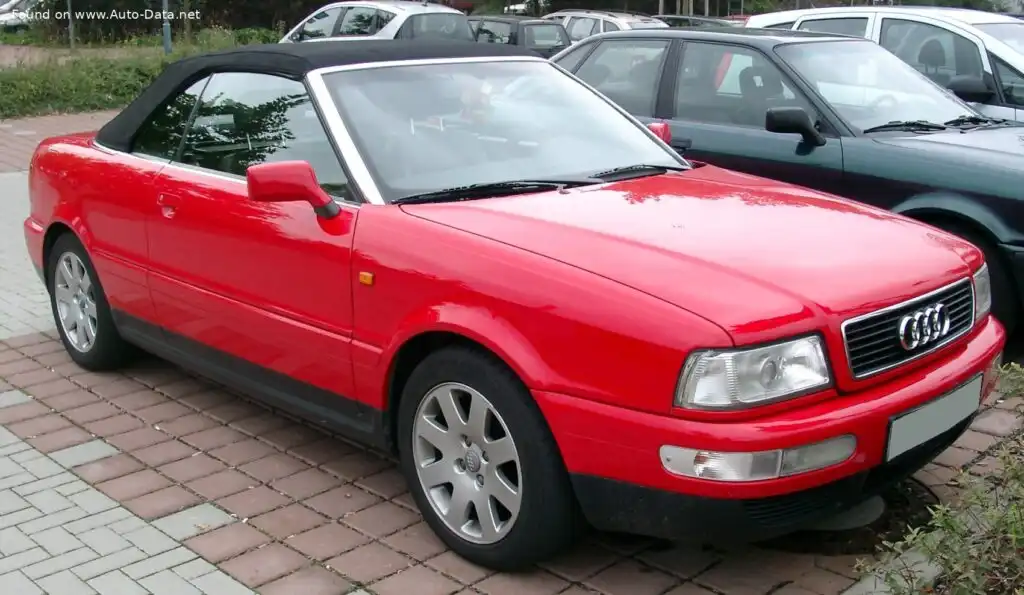
The Audi Cabriolet (B3 8G) 2.0 E, producing 115 horsepower, was a key variant in the first generation of Audi’s open-top offering. Produced between January 1993 and 1996, it occupied a middle ground in the Cabriolet lineup, offering a balance between performance and affordability. This model was built on the Audi B3 platform (internally designated 8G), which was also shared with the Audi 80 and 90 sedans. The 2.0 E represented a popular choice for buyers seeking a more refined and powerful alternative to the base 1.8-liter models, while remaining more accessible than the flagship 2.3-liter and later 2.6-liter variants.
Technical Specifications
| Brand | Audi |
| Model | Cabriolet |
| Generation | Cabriolet (B3 8G) |
| Type (Engine) | 2.0 E (115 Hp) |
| Start of production | January, 1993 |
| End of production | 1996 |
| Powertrain Architecture | Internal Combustion engine |
| Body type | Cabriolet |
| Seats | 4 |
| Doors | 2 |
| Fuel consumption (urban) | 12.9 l/100 km (18.2 US mpg, 21.9 UK mpg, 7.8 km/l) |
| Fuel consumption (extra urban) | 7.8 l/100 km (30.2 US mpg, 36.2 UK mpg, 12.8 km/l) |
| Fuel consumption (combined) | 9.7 l/100 km (24.2 US mpg, 29.1 UK mpg, 10.3 km/l) |
| Fuel Type | Petrol (Gasoline) |
| Acceleration 0 – 100 km/h | 12.9 sec |
| Acceleration 0 – 62 mph | 12.9 sec |
| Acceleration 0 – 60 mph | 12.3 sec |
| Maximum speed | 187 km/h (116.2 mph) |
| Weight-to-power ratio | 11.7 kg/Hp, 85.2 Hp/tonne |
| Weight-to-torque ratio | 8.2 kg/Nm, 122.2 Nm/tonne |
| Power | 115 Hp @ 5400 rpm |
| Power per litre | 58 Hp/l |
| Torque | 165 Nm @ 3200 rpm (121.7 lb.-ft. @ 3200 rpm) |
| Engine layout | Front, Longitudinal |
| Engine Model/Code | ABK |
| Engine displacement | 1984 cm3 (121.07 cu. in.) |
| Number of cylinders | 4 |
| Engine configuration | Inline |
| Cylinder Bore | 82.5 mm (3.25 in.) |
| Piston Stroke | 92.8 mm (3.65 in.) |
| Compression ratio | 10.4:1 |
| Number of valves per cylinder | 2 |
| Fuel injection system | Multi-port manifold injection |
| Engine aspiration | Naturally aspirated engine |
| Valvetrain | OHC |
| Engine oil capacity | 3 l (3.17 US qt | 2.64 UK qt) |
| Coolant | 7 l (7.4 US qt | 6.16 UK qt) |
| Kerb Weight | 1350 kg (2976.24 lbs.) |
| Max. weight | 1750 kg (3858.09 lbs.) |
| Max load | 400 kg (881.85 lbs.) |
| Trunk (boot) space – minimum | 230 l (8.12 cu. ft.) |
| Fuel tank capacity | 70 l (18.49 US gal | 15.4 UK gal) |
| Permitted trailer load with brakes (8%) | 1000 kg (2204.62 lbs.) |
| Permitted trailer load with brakes (12%) | 1000 kg (2204.62 lbs.) |
| Permitted trailer load without brakes | 640 kg (1410.96 lbs.) |
| Permitted towbar download | 50 kg (110.23 lbs.) |
| Length | 4366 mm (171.89 in.) |
| Width | 1716 mm (67.56 in.) |
| Height | 1379 mm (54.29 in.) |
| Wheelbase | 2556 mm (100.63 in.) |
| Front track | 1453 mm (57.2 in.) |
| Rear (Back) track | 1447 mm (56.97 in.) |
| Ride height (ground clearance) | 127 mm (5 in.) |
| Drag coefficient (Cd) | 0.36 |
| Minimum turning circle (turning diameter) | 11.2 m (36.75 ft.) |
| Drivetrain Architecture | The Internal combustion engine (ICE) drives the front wheels of the vehicle. |
| Drive wheel | Front wheel drive |
| Number of gears and type of gearbox | 5 gears, manual transmission |
| Front suspension | Independent, type McPherson with coil spring and anti-roll bar |
| Rear suspension | Semi-independent, coil spring |
| Front brakes | Ventilated discs |
| Rear brakes | Disc |
| Assisting systems | ABS (Anti-lock braking system) |
| Steering type | Steering rack and pinion |
| Power steering | Hydraulic Steering |
| Tires size | 195/65 R15 |
| Wheel rims size | 6J x 15 |
Powertrain & Engine Architecture
The 2.0 E variant of the Audi Cabriolet B3 utilized the ABK engine code, a 1984cc inline-four cylinder gasoline engine. This engine was a naturally aspirated unit featuring multi-port fuel injection and an overhead camshaft (OHC) valvetrain with two valves per cylinder. The ABK engine was known for its relative simplicity and durability. The engine’s design prioritized smooth power delivery over outright performance. The 5-speed manual transmission was standard, offering a reasonably well-spaced gear ratio for everyday driving. The engine’s longitudinal mounting within the front-wheel-drive chassis contributed to a balanced weight distribution, though it also presented packaging challenges.
Driving Characteristics
The 115 hp and 165 Nm (121.7 lb-ft) of torque provided by the 2.0 E engine delivered adequate, but not exhilarating, performance. Acceleration from 0-60 mph took around 12.3 seconds, and top speed was approximately 116 mph. Compared to the more powerful 2.3 and 2.6-liter versions, the 2.0 E felt noticeably less responsive, particularly during overtaking maneuvers. However, the 2.0 E offered a more forgiving driving experience, with a broader torque curve that made it easier to drive in everyday traffic. The manual transmission, while not particularly sporty, was precise and easy to operate. The Cabriolet’s relatively lightweight construction (1350 kg) helped to mitigate the engine’s modest power output.
Equipment & Trim Levels
The 2.0 E Cabriolet typically came equipped with a reasonable level of standard features, including power windows, central locking, and a basic stereo system. Interior upholstery was usually cloth, though leather was available as an option. The dashboard layout was typical of early 1990s Audis, with a functional and understated design. Optional extras included alloy wheels, a more sophisticated stereo system, and a wind deflector for improved open-top comfort. The trim level was generally considered mid-range, positioned above the base 1.8-liter models but below the more luxurious 2.3 and 2.6-liter variants.
Chassis & Braking
The Audi Cabriolet B3 featured an independent McPherson strut front suspension and a semi-independent coil spring rear suspension. This setup provided a comfortable ride, though it wasn’t particularly sporty. The front brakes were ventilated discs, while the rear brakes were solid discs. ABS (Anti-lock Braking System) was standard, enhancing safety. The steering was a hydraulic power-assisted rack and pinion system, offering light and precise control. The relatively narrow 195/65 R15 tires provided adequate grip for everyday driving, but were not optimized for high-performance handling.
Market Reception & Comparison
The 2.0 E Cabriolet was generally well-received by automotive critics as a sensible and well-rounded open-top car. It offered a good balance of performance, comfort, and affordability. Compared to the 1.8-liter models, the 2.0 E provided a noticeable improvement in performance, making it a more enjoyable car to drive. However, it was more expensive to purchase and operate. Fuel economy was reasonable for the time, averaging around 24.2 US mpg in combined driving. Reliability was generally good, though regular maintenance was essential to prevent issues with the fuel injection system and cooling system.
Legacy
The Audi Cabriolet B3 2.0 E remains a popular choice among classic car enthusiasts today. The ABK engine is known for its durability, and parts availability is generally good. However, like all older cars, it requires regular maintenance to keep it in good condition. The Cabriolet’s timeless design and open-top driving experience continue to appeal to a wide range of buyers. While not a high-performance machine, the 2.0 E offers a charming and enjoyable driving experience that captures the spirit of early 1990s Audi engineering. The car’s relative affordability and ease of maintenance make it a practical and rewarding classic car ownership experience.