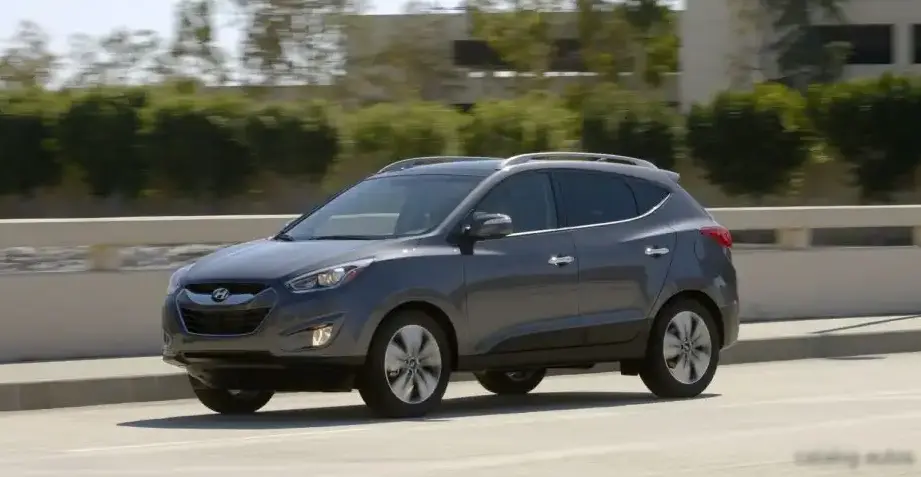
The Hyundai Tucson II (facelift, introduced in September 2013 and produced through 2015) represented a significant refresh of Hyundai’s popular compact SUV. The 2.0 GDI (Gasoline Direct Injection) variant, producing 164 horsepower, occupied a middle ground in the Tucson II lineup, positioned between the base 1.6L engine and the more powerful 2.4L options. This version aimed to balance fuel efficiency with adequate performance for everyday driving, appealing to a broad segment of the family SUV market. It was primarily sold in markets outside of North America, where the Tucson (badged as the ix35 in some regions) was a key model in Hyundai’s global portfolio.
Technical Specifications
| Brand | Hyundai |
| Model | Tucson |
| Generation | Tucson II (facelift 2013) |
| Type (Engine) | 2.0 GDI (164 Hp) |
| Start of production | September, 2013 |
| End of production | 2015 |
| Powertrain Architecture | Internal Combustion engine |
| Body type | SUV |
| Seats | 5 |
| Doors | 5 |
| Fuel consumption (urban) | 10 l/100 km (23.5 US mpg) |
| Fuel consumption (extra urban) | 7.2 l/100 km (32.7 US mpg) |
| Fuel consumption (combined) | 8.7 l/100 km (27 US mpg) |
| Fuel Type | Petrol (Gasoline) |
| Emission standard | ULEV |
| Weight-to-power ratio | 8.8 kg/Hp |
| Weight-to-torque ratio | 7 kg/Nm |
| Power | 164 Hp @ 6200 rpm |
| Power per litre | 82 Hp/l |
| Torque | 205 Nm @ 4000 rpm (151.2 lb.-ft. @ 4000 rpm) |
| Engine layout | Front, Transverse |
| Engine Model/Code | Nu / G4NC |
| Engine displacement | 1999 cm3 (121.99 cu. in.) |
| Number of cylinders | 4 |
| Engine configuration | Inline |
| Cylinder Bore | 81 mm (3.19 in.) |
| Piston Stroke | 97 mm (3.82 in.) |
| Compression ratio | 11.5:1 |
| Number of valves per cylinder | 4 |
| Fuel injection system | Direct injection |
| Engine aspiration | Naturally aspirated engine |
| Valvetrain | DOHC, D-CVVT |
| Engine oil capacity | 4 l (4.23 US qt | 3.52 UK qt) |
| Coolant capacity | 6.7 l (7.08 US qt | 5.9 UK qt) |
| Kerb Weight | 1443 kg (3181.27 lbs.) |
| Max. weight | 2040 kg (4497.43 lbs.) |
| Max load | 597 kg (1316.16 lbs.) |
| Trunk (boot) space – minimum | 728 l (25.71 cu. ft.) |
| Trunk (boot) space – maximum | 1580 l (55.8 cu. ft.) |
| Fuel tank capacity | 58 l (15.32 US gal | 12.76 UK gal) |
| Permitted trailer load with brakes (12%) | 907 kg (1999.59 lbs.) |
| Permitted trailer load without brakes | 454 kg (1000.9 lbs.) |
| Length | 4400 mm (173.23 in.) |
| Width | 1820 mm (71.65 in.) |
| Height | 1655 mm (65.16 in.) |
| Wheelbase | 2640 mm (103.94 in.) |
| Front track | 1585 mm (62.4 in.) |
| Rear (Back) track | 1586 mm (62.44 in.) |
| Ride height (ground clearance) | 170 mm (6.69 in.) |
| Drag coefficient (Cd) | 0.37 |
| Minimum turning circle (turning diameter) | 10.6 m (34.78 ft.) |
| Drivetrain Architecture | Front wheel drive |
| Drive wheel | Front wheel drive |
| Number of gears and type of gearbox | 6 gears, manual transmission |
| Front suspension | Independent, type McPherson with coil spring and anti-roll bar |
| Rear suspension | Independent multi-link spring suspension with stabilizer |
| Front brakes | Ventilated discs |
| Rear brakes | Disc |
| Assisting systems | ABS (Anti-lock braking system) |
| Steering type | Steering rack and pinion |
| Power steering | Electric Steering |
| Tires size | 225/60 R17 |
| Wheel rims size | 6.5J x 17 |
Powertrain & Engine Architecture
The heart of the 2.0 GDI Tucson II is the Hyundai Nu engine family, specifically the G4NC code. This 1999cc inline-four cylinder engine utilizes direct fuel injection (GDI) technology, a key feature for improving both power and fuel economy. Direct injection allows fuel to be sprayed directly into the combustion chamber, resulting in a more complete burn and increased efficiency. The engine employs a double overhead camshaft (DOHC) valvetrain with Hyundai’s D-CVVT (Dual Continuous Variable Valve Timing) system, optimizing valve timing for improved performance across the rev range. The 6-speed manual transmission was standard, providing drivers with full control over gear selection. The G4NC engine is a naturally aspirated design, meaning it doesn’t rely on turbocharging or supercharging for power.
Driving Characteristics
The 164 hp and 151 lb-ft of torque offered by the 2.0 GDI engine provided adequate, but not exhilarating, performance. Acceleration was reasonable for everyday driving, but overtaking maneuvers required planning. The manual transmission allowed for precise control, but the gear ratios were tuned for fuel efficiency rather than outright speed. Compared to the higher-output 2.4L engine option, the 2.0 GDI felt noticeably less powerful, particularly when fully loaded with passengers and cargo. However, it offered a more engaging driving experience than the automatic transmission options available with other engines in the lineup. The relatively light weight of the Tucson II helped mitigate the lower power output, making it feel nimble around town.
Equipment & Trim Levels
The 2.0 GDI trim level typically included standard features such as air conditioning, power windows and locks, a basic audio system with USB connectivity, and steel wheels with wheel covers. Higher trim levels added features like alloy wheels, a touchscreen infotainment system, rear parking sensors, and a sunroof. Interior upholstery was typically cloth, with options for leather available on higher-spec models. Safety features included ABS, airbags, and stability control. The specific equipment levels varied depending on the regional market.
Chassis & Braking
The Tucson II utilized a McPherson strut front suspension and a multi-link rear suspension, providing a comfortable ride quality. The front suspension incorporated a stabilizer bar to reduce body roll during cornering. Braking duties were handled by ventilated discs at the front and solid discs at the rear. The ABS (Anti-lock Braking System) was standard, enhancing safety during emergency braking situations. The suspension tuning was geared towards comfort rather than sporty handling, making it well-suited for everyday driving conditions.
Market Reception & Comparison
The 2.0 GDI Tucson II was generally well-received by automotive critics as a practical and fuel-efficient SUV. It offered a good balance of features and affordability. Compared to the 1.6L base model, the 2.0 GDI provided a noticeable performance upgrade. However, it lagged behind the 2.4L engine in terms of outright power and acceleration. Fuel economy was a strong point, with combined figures around 27 US mpg. Reliability was generally good, although some owners reported minor issues with the GDI fuel injection system over the long term.
Legacy
The Hyundai Tucson II 2.0 GDI remains a relatively common sight on the used car market. The Nu engine family proved to be generally reliable, although regular maintenance, including fuel injector cleaning, is recommended to prevent potential issues. The 2.0 GDI variant offers a good value proposition for buyers seeking a practical and fuel-efficient compact SUV. Its relatively simple mechanical design makes it easier and less expensive to maintain compared to more complex, turbocharged engines. While not the most powerful or luxurious option in its class, the Tucson II 2.0 GDI represents a solid and dependable choice for everyday transportation.