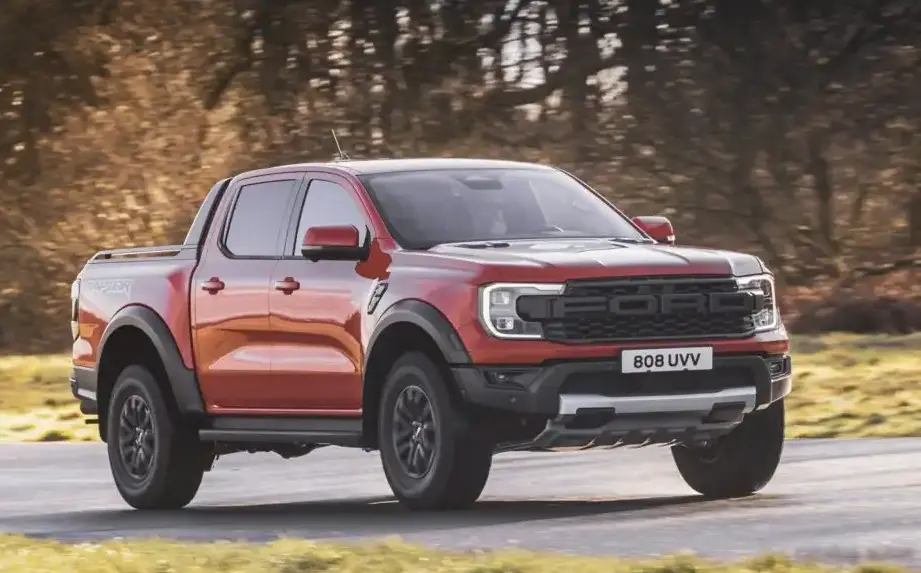
The Ford Ranger IV Double Cab 3.0 EcoBlue V6 (240 Hp) e-4WD Automatic, introduced in March 2023, represents a significant evolution of Ford’s mid-size pickup truck. This variant sits at the higher end of the Ranger IV lineup, offering a blend of robust performance, advanced technology, and enhanced capability. It’s positioned as a premium option for buyers seeking a versatile vehicle suitable for both work and recreational purposes. The “e-4WD” designation indicates an electronically controlled four-wheel-drive system, adding to its all-terrain prowess. This generation Ranger, built on the T6 platform, is primarily marketed in Europe, Australia, New Zealand, and South Africa, with a distinct focus on providing a globally competitive pickup truck.
Technical Specifications
| Brand | Ford |
| Model | Ranger |
| Generation | Ranger IV Double Cab |
| Type (Engine) | 3.0 EcoBlue V6 (240 Hp) e-4WD Automatic |
| Start of production | March, 2023 |
| Powertrain Architecture | Internal Combustion engine |
| Body type | Pick-up |
| Seats | 5 |
| Doors | 4 |
| Combined fuel consumption (WLTP) | 10.0-10.2 l/100 km (23.5 – 23.1 US mpg, 28.2 – 27.7 UK mpg, 10 – 9.8 km/l) |
| CO2 emissions (WLTP) | 262-266 g/km |
| Fuel Type | Diesel |
| Acceleration 0 – 100 km/h | 9.7 sec |
| Acceleration 0 – 62 mph | 9.7 sec |
| Acceleration 0 – 60 mph | 9.2 sec |
| Maximum speed | 180 km/h (111.85 mph) |
| Weight-to-power ratio | 10.4 kg/Hp, 96.5 Hp/tonne |
| Weight-to-torque ratio | 4.1 kg/Nm, 241.4 Nm/tonne |
| Power | 240 Hp |
| Power per litre | 80.2 Hp/l |
| Torque | 600 Nm (442.54 lb.-ft.) |
| Engine layout | Front, Longitudinal |
| Engine Model/Code | BF2X |
| Engine displacement | 2993 cm3 (182.64 cu. in.) |
| Number of cylinders | 6 |
| Engine configuration | V-engine |
| Number of valves per cylinder | 4 |
| Fuel injection system | Diesel Commonrail |
| Engine aspiration | Turbocharger, Intercooler |
| Engine systems | Start & Stop System, Particulate filter |
| Kerb Weight | 2486 kg (5480.69 lbs.) |
| Max. weight | 3300 kg (7275.25 lbs.) |
| Max load | 814 kg (1794.56 lbs.) |
| Permitted trailer load with brakes (12%) | 3500 kg (7716.18 lbs.) |
| Permitted trailer load without brakes | 750 kg (1653.47 lbs.) |
| Length | 5370 mm (211.42 in.) |
| Width | 2015 mm (79.33 in.) |
| Width including mirrors | 2208 mm (86.93 in.) |
| Height | 1884-1914 mm (74.17 – 75.35 in.) |
| Wheelbase | 3270 mm (128.74 in.) |
| Front track | 1620 mm (63.78 in.) |
| Rear (Back) track | 1620 mm (63.78 in.) |
| Ride height (ground clearance) | 235-261 mm (9.25 – 10.28 in.) |
| Minimum turning circle (turning diameter) | 12.9 m (42.32 ft.) |
| Approach angle | 30-32° |
| Departure angle | 25.6-27° |
| Ramp-over (brakeover) angle | 21-24° |
| Wading depth | 800 mm (31.5 in.) |
| Drivetrain Architecture | The Internal combustion engine (ICE) drives the rear wheels permanently, and the front wheels are driven through an electrically or mechanically operated clutch if necessary. |
| Drive wheel | All wheel drive (4×4) |
| Number of gears and type of gearbox | 10 gears, automatic transmission |
| Front brakes | Ventilated discs |
| Rear brakes | Disc |
| Assisting systems | ABS (Anti-lock braking system) |
| Steering type | Steering rack and pinion |
| Power steering | Electric Steering |
| Tires size | 255/55 R20 |
| Wheel rims size | 20 |
Powertrain & Engine Architecture
The heart of this Ranger variant is the 3.0-liter EcoBlue V6 turbocharged diesel engine, designated BF2X. This engine is part of Ford’s EcoBlue family, known for its focus on efficiency and reduced emissions. The engine utilizes a common-rail direct fuel injection system, delivering fuel directly into the cylinders at extremely high pressure for optimized combustion. It features a variable geometry turbocharger (VGT) and an intercooler to enhance power and torque output. The V6 configuration provides inherent smoothness and refinement compared to inline engines. The engine produces 240 horsepower and a substantial 600 Nm (442.54 lb.-ft.) of torque. This torque figure is particularly noteworthy, providing ample pulling power for towing and hauling. The engine is paired with a sophisticated 10-speed automatic transmission, which contributes to both fuel efficiency and responsive performance. This transmission offers a wide range of gear ratios, allowing the engine to operate in its optimal power band more frequently.
Driving Characteristics
The 3.0 EcoBlue V6 with the 10-speed automatic delivers a noticeably more refined and powerful driving experience compared to lower-spec Ranger models equipped with smaller engines. The abundance of torque makes it exceptionally capable for towing and hauling heavy loads. The 10-speed transmission shifts smoothly and efficiently, providing quick acceleration and maintaining optimal engine speed for various driving conditions. While not a sports truck, the Ranger IV Double Cab 3.0 EcoBlue offers brisk acceleration, achieving 0-60 mph in approximately 9.2 seconds. The e-4WD system provides excellent traction in a variety of terrains, making it suitable for both on-road and off-road adventures. The automatic transmission is well-tuned for both everyday driving and more demanding tasks, offering a balance of comfort and capability.
Equipment & Trim Levels
The Ranger IV Double Cab 3.0 EcoBlue V6 e-4WD Automatic typically comes with a high level of standard equipment. This includes features such as a touchscreen infotainment system with Apple CarPlay and Android Auto compatibility, a digital instrument cluster, automatic climate control, and a suite of advanced driver-assistance systems (ADAS) like adaptive cruise control, lane-keeping assist, and automatic emergency braking. Interior upholstery is typically a combination of cloth and leather, with higher trims offering full leather options. Optional extras can include a premium sound system, a sunroof, and upgraded wheels and tires. The Double Cab configuration provides ample space for five passengers, making it a practical choice for families or crews.
Chassis & Braking
The Ranger IV utilizes a robust ladder-frame chassis, providing a solid foundation for its load-carrying and towing capabilities. The suspension system consists of independent double wishbones at the front and leaf springs at the rear. The front brakes are ventilated discs, while the rear brakes are discs, providing adequate stopping power for the vehicle’s weight. The steering system is a rack-and-pinion setup with electric power assistance, offering precise and responsive steering feel. The e-4WD system allows the driver to select between 2H (two-wheel drive), 4H (four-wheel drive high), 4L (four-wheel drive low), and an automatic mode that seamlessly switches between two and four-wheel drive as needed.
Market Reception & Comparison
The Ford Ranger IV Double Cab 3.0 EcoBlue V6 e-4WD Automatic has been generally well-received by automotive critics. It’s praised for its powerful engine, refined driving experience, and advanced technology. Compared to other trims in the Ranger lineup, such as the 2.0-liter single-turbo diesel, the V6 offers significantly more power and torque, making it a better choice for those who frequently tow or haul heavy loads. Fuel economy is slightly lower than the 2.0-liter engine, but the added performance is often considered a worthwhile trade-off. Compared to competitors like the Toyota Hilux and Isuzu D-Max, the Ranger IV offers a more modern interior and a wider range of technology features.
Legacy
The 3.0 EcoBlue V6 engine is expected to be a reliable and durable powertrain, benefiting from Ford’s extensive experience in diesel engine technology. Early reports suggest good long-term reliability, although ongoing monitoring will be necessary to assess its long-term durability. In the used car market, this variant is likely to hold its value well due to its desirable combination of performance, capability, and features. The Ranger IV Double Cab 3.0 EcoBlue V6 e-4WD Automatic represents a significant step forward for Ford’s mid-size pickup truck, offering a compelling package for buyers seeking a versatile and capable vehicle.