
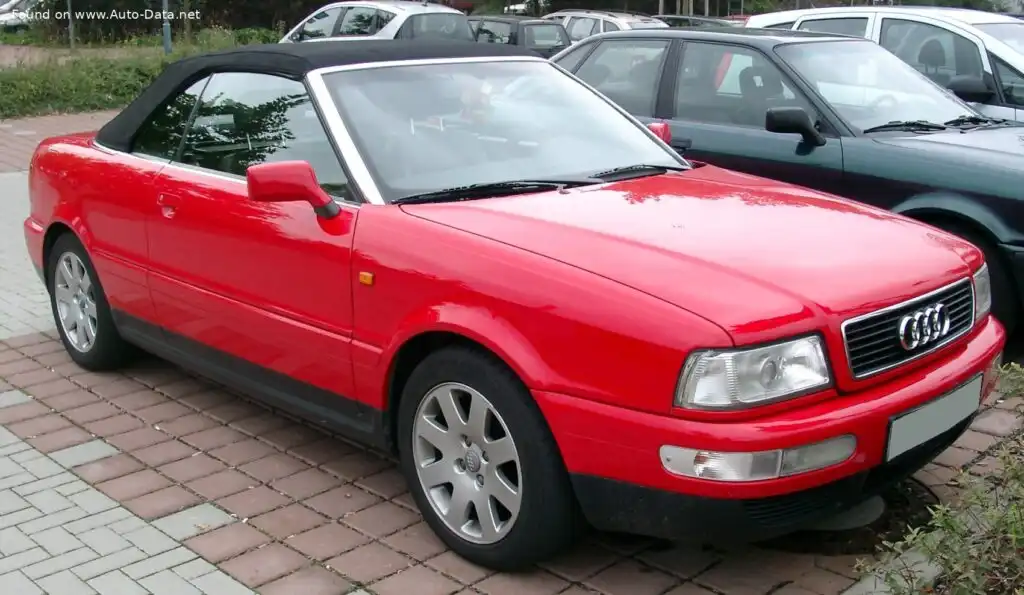
The Audi Cabriolet, specifically the B3 8G facelift model produced from 1995 to 2000, represented a significant step forward for Audi in the open-top luxury segment. The 1.9 TDI variant, equipped with a 90 horsepower diesel engine, was introduced as a fuel-efficient and practical option within the Cabriolet range. This model aimed to broaden the Cabriolet’s appeal, offering a more economical alternative to the gasoline-powered engines while still retaining the Audi hallmarks of build quality and refinement. It sat as an entry-level offering, appealing to buyers prioritizing fuel economy and lower running costs over outright performance.
Technical Specifications
| Brand | Audi |
| Model | Cabriolet |
| Generation | Cabriolet (B3 8G, facelift 1997) |
| Type (Engine) | 1.9 TDI (90 Hp) |
| Start of production | July, 1995 |
| End of production | August, 2000 |
| Powertrain Architecture | Internal Combustion engine |
| Body type | Cabriolet |
| Seats | 4 |
| Doors | 2 |
| Fuel consumption (urban) | 7.5 l/100 km (31.4 US mpg, 37.7 UK mpg, 13.3 km/l) |
| Fuel consumption (extra urban) | 5.2 l/100 km (45.2 US mpg, 54.3 UK mpg, 19.2 km/l) |
| Fuel consumption (combined) | 6 l/100 km (39.2 US mpg, 47.1 UK mpg, 16.7 km/l) |
| CO2 emissions | 162 g/km |
| Fuel Type | Diesel |
| Acceleration 0 – 100 km/h | 14.7 sec |
| Acceleration 0 – 62 mph | 14.7 sec |
| Acceleration 0 – 60 mph | 14 sec |
| Maximum speed | 175 km/h (108.74 mph) |
| Weight-to-power ratio | 15.4 kg/Hp, 64.7 Hp/tonne |
| Weight-to-torque ratio | 6.9 kg/Nm, 145.3 Nm/tonne |
| Power | 90 Hp @ 4000 rpm |
| Power per litre | 47.5 Hp/l |
| Torque | 202 Nm @ 1900 rpm (148.99 lb.-ft. @ 1900 rpm) |
| Engine layout | Front, Longitudinal |
| Engine Model/Code | 1Z |
| Engine displacement | 1896 cm3 (115.7 cu. in.) |
| Number of cylinders | 4 |
| Engine configuration | Inline |
| Cylinder Bore | 79.5 mm (3.13 in.) |
| Piston Stroke | 95.5 mm (3.76 in.) |
| Compression ratio | 19.5:1 |
| Number of valves per cylinder | 2 |
| Fuel injection system | Direct injection |
| Engine aspiration | Turbocharger, Intercooler |
| Valvetrain | OHC |
| Engine oil capacity | 3.5 l (3.7 US qt | 3.08 UK qt) |
| Coolant | 6.5 l (6.87 US qt | 5.72 UK qt) |
| Kerb Weight | 1390 kg (3064.43 lbs.) |
| Max. weight | 1790 kg (3946.27 lbs.) |
| Max load | 400 kg (881.85 lbs.) |
| Trunk (boot) space – minimum | 230 l (8.12 cu. ft.) |
| Fuel tank capacity | 70 l (18.49 US gal | 15.4 UK gal) |
| Permitted trailer load with brakes (8%) | 1000 kg (2204.62 lbs.) |
| Permitted trailer load with brakes (12%) | 1000 kg (2204.62 lbs.) |
| Permitted trailer load without brakes | 730 kg (1609.37 lbs.) |
| Permitted towbar download | 40 kg (88.18 lbs.) |
| Length | 4366 mm (171.89 in.) |
| Width | 1716 mm (67.56 in.) |
| Height | 1379 mm (54.29 in.) |
| Wheelbase | 2556 mm (100.63 in.) |
| Front track | 1453 mm (57.2 in.) |
| Rear (Back) track | 1447 mm (56.97 in.) |
| Drag coefficient (Cd) | 0.36 |
| Minimum turning circle (turning diameter) | 11.1 m (36.42 ft.) |
| Drivetrain Architecture | The Internal combustion engine (ICE) drives the front wheels of the vehicle. |
| Drive wheel | Front wheel drive |
| Number of gears and type of gearbox | 5 gears, manual transmission |
| Front suspension | Independent, type McPherson with coil spring and anti-roll bar |
| Rear suspension | Semi-independent, coil spring |
| Front brakes | Ventilated discs |
| Rear brakes | Disc |
| Assisting systems | ABS (Anti-lock braking system) |
| Steering type | Steering rack and pinion |
| Power steering | Hydraulic Steering |
| Tires size | 195/65 R15 |
| Wheel rims size | 6J x 15 |
Powertrain & Engine Architecture
The heart of the 1.9 TDI Cabriolet is the 1Z engine, a 1.9-liter inline-four cylinder diesel engine. This engine utilizes direct injection technology, a key feature for maximizing fuel efficiency and reducing emissions. The 1Z engine is a robust and relatively simple design, known for its durability. It features an overhead camshaft (OHC) valvetrain operating two valves per cylinder. A turbocharger with an intercooler is employed to boost power output, providing increased torque and improved acceleration compared to naturally aspirated diesel engines. The engine’s 19.5:1 compression ratio is typical for a direct injection diesel, contributing to its efficiency. The 5-speed manual transmission was standard, chosen for its efficiency and suitability for the engine’s torque characteristics.
Driving Characteristics
The 1.9 TDI Cabriolet offered a distinctly different driving experience compared to its gasoline-powered siblings. While lacking the outright acceleration of the 1.8-liter petrol versions, the TDI provided a substantial amount of low-end torque, making it surprisingly capable in everyday driving situations. The 202 Nm (148.99 lb-ft) of torque available from 1900 rpm allowed for relaxed cruising and effortless overtaking. The 5-speed manual transmission was well-matched to the engine, with gear ratios optimized for fuel economy and usability. The 0-60 mph time of around 14 seconds and a top speed of 175 km/h (108.74 mph) were respectable for the time, but the focus was more on practicality and efficiency than outright performance. The front-wheel-drive configuration provided predictable handling, although it wasn’t as engaging as the more powerful, and often quattro-equipped, Audi models.
Equipment & Trim Levels
The 1.9 TDI Cabriolet typically came with a reasonably well-equipped specification, though it was generally positioned as the entry-level model. Standard features included power steering, ABS brakes, and a basic audio system. Interior upholstery was typically cloth, with a functional and durable design. Optional extras included leather upholstery, alloy wheels, a more advanced audio system, and climate control. The dashboard layout was typical of Audi’s B3-generation cars, characterized by a clean and functional design. The Cabriolet’s soft top was manually operated, adding to the car’s simplicity and reducing weight.
Chassis & Braking
The Audi Cabriolet B3 utilized a McPherson strut front suspension and a semi-independent coil spring rear suspension. This setup provided a comfortable ride, although it wasn’t particularly sporty. The front brakes were ventilated discs, offering good stopping power, while the rear brakes were solid discs. The chassis was reinforced to compensate for the lack of a fixed roof, providing adequate torsional rigidity. Stabilizer bars were fitted to both the front and rear axles to reduce body roll during cornering.
Market Reception & Comparison
The 1.9 TDI Cabriolet was generally well-received by critics and buyers who prioritized fuel economy and practicality. It offered a compelling alternative to the more expensive gasoline-powered models, particularly in Europe where diesel fuel was more affordable and readily available. Compared to the 1.8-liter petrol versions, the TDI offered significantly better fuel economy, but at the expense of performance. The TDI was also considered to be more reliable than some of the earlier gasoline engines, thanks to its simpler design and robust construction.
Legacy
The 1.9 TDI engine, in various iterations, became a mainstay of the Volkswagen Group for many years, renowned for its durability and fuel efficiency. The 1Z engine found in the Cabriolet is still regarded as a reliable unit, and well-maintained examples can continue to provide years of service. Today, the 1.9 TDI Cabriolet represents an affordable entry point into Audi ownership, offering a classic open-top experience with the added benefit of reasonable running costs. While not the fastest or most luxurious version of the Cabriolet, it remains a popular choice among enthusiasts who appreciate its practicality and understated charm.

