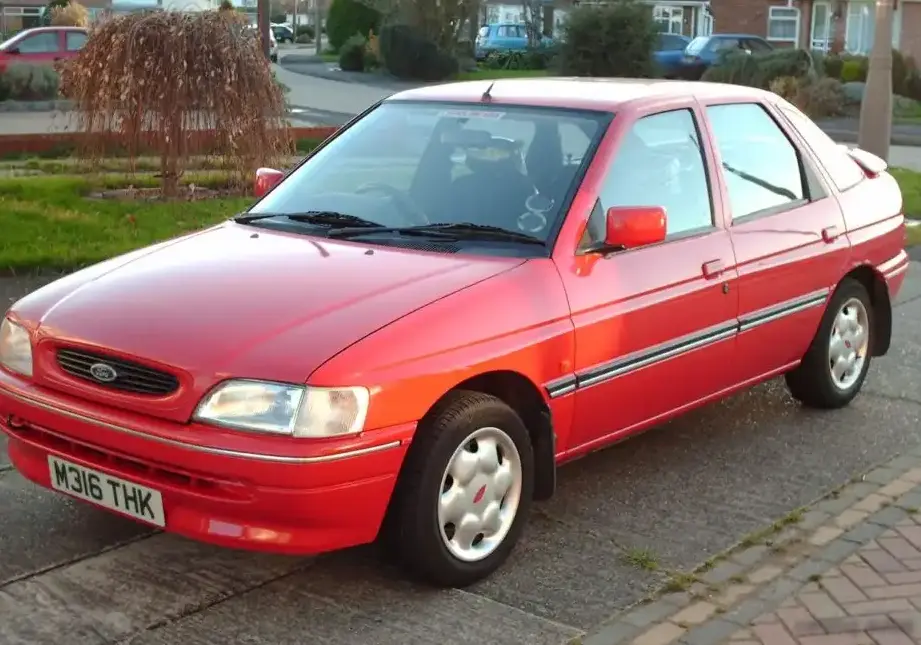
The Ford Escort VI Hatch (GAL) 1.6 L (76 hp) was a mainstay of the Ford lineup in Europe from 1991 to 1995. Representing the sixth generation of the long-running Escort series, the GAL model was a crucial vehicle for Ford, offering affordable and practical transportation to a broad customer base. This particular variant, powered by a 1.6-liter engine producing 76 horsepower, occupied a middle ground in the Escort VI range, positioned as a sensible and economical choice for families and commuters. It was a key player in the competitive small family car segment, facing rivals like the Vauxhall/Opel Astra, Volkswagen Golf, and Peugeot 305.
Technical Specifications
| Brand | Ford |
| Model | Escort |
| Generation | Escort VI Hatch (GAL) |
| Type (Engine) | 1.6 L (76 Hp) |
| Start of production | 1991 |
| End of production | 1995 |
| Powertrain Architecture | Internal Combustion engine |
| Body type | Hatchback |
| Seats | 5 |
| Doors | 3 |
| Fuel Type | Petrol (Gasoline) |
| Acceleration 0 – 100 km/h | 14 sec |
| Acceleration 0 – 62 mph | 14 sec |
| Acceleration 0 – 60 mph | 13.3 sec |
| Maximum speed | 162 km/h (100.66 mph) |
| Weight-to-power ratio | 13.4 kg/Hp, 74.9 Hp/tonne |
| Weight-to-torque ratio | 8.5 kg/Nm, 118.2 Nm/tonne |
| Power | 76 Hp @ 5400 rpm |
| Power per litre | 48.9 Hp/l |
| Torque | 120 Nm @ 3400 rpm (88.51 lb.-ft. @ 3400 rpm) |
| Engine layout | Front, Transverse |
| Engine displacement | 1555 cm3 (94.89 cu. in.) |
| Number of cylinders | 4 |
| Engine configuration | Inline |
| Cylinder Bore | 77 mm (3.03 in.) |
| Piston Stroke | 83.5 mm (3.29 in.) |
| Compression ratio | 9:1 |
| Number of valves per cylinder | 2 |
| Fuel injection system | Carburettor |
| Engine aspiration | Naturally aspirated engine |
| Kerb Weight | 1015 kg (2237.69 lbs.) |
| Max. weight | 1450 kg (3196.7 lbs.) |
| Max load | 435 kg (959.01 lbs.) |
| Trunk (boot) space – minimum | 366 l (12.93 cu. ft.) |
| Trunk (boot) space – maximum | 751 l (26.52 cu. ft.) |
| Fuel tank capacity | 64 l (16.91 US gal | 14.08 UK gal) |
| Length | 4036 mm (158.9 in.) |
| Width | 1692 mm (66.61 in.) |
| Height | 1450 mm (57.09 in.) |
| Wheelbase | 2525 mm (99.41 in.) |
| Front track | 1440 mm (56.69 in.) |
| Rear (Back) track | 1455 mm (57.28 in.) |
| Drivetrain Architecture | The Internal combustion engine (ICE) drives the front wheels of the vehicle. |
| Drive wheel | Front wheel drive |
| Number of gears and type of gearbox | 5 gears, manual transmission |
| Front suspension | Wishbone |
| Rear suspension | Coil spring |
| Front brakes | Ventilated discs |
| Rear brakes | Drum |
| Assisting systems | ABS (Anti-lock braking system) |
| Steering type | Steering rack and pinion |
| Tires size | 175/70 R13 S |
Powertrain & Engine Architecture
The heart of the Escort VI 1.6 L was the Ford Sigma series engine, specifically the 1555cc inline-four cylinder unit. This engine, while not particularly powerful by modern standards, was known for its reliability and relatively simple construction. The 76 hp output was achieved through a single overhead camshaft (SOHC) design with two valves per cylinder. Notably, this version utilized a carburettor fuel delivery system, a cost-saving measure compared to the fuel injection systems found in higher-spec Escort models. This carburettor setup, while less efficient and precise than injection, contributed to the engine’s straightforward maintenance. The engine’s 120 Nm of torque was delivered at 3400 rpm, providing adequate, if not exhilarating, performance for everyday driving. The engine was transversely mounted, driving the front wheels. The standard transmission was a five-speed manual gearbox, offering a reasonable spread of ratios for both urban and highway driving.
Driving Characteristics
The 1.6L Escort VI with the manual transmission offered a practical and undemanding driving experience. Acceleration was modest, taking around 14 seconds to reach 62 mph (100 km/h). The engine felt relatively responsive in the mid-range, making it suitable for overtaking on country roads, but lacked the punch of the larger 1.8 or 2.0-liter engines available in the Escort range. The five-speed gearbox was well-matched to the engine’s characteristics, allowing drivers to keep the engine in its optimal power band. Handling was typical of front-wheel-drive cars of the era – safe and predictable, but not particularly sporty. The suspension provided a comfortable ride, absorbing bumps and imperfections in the road surface reasonably well.
Equipment & Trim Levels
The 1.6L Escort VI typically came equipped with basic, but functional, features. Standard equipment included central locking, power steering, and an AM/FM radio. Interior trim was generally simple, with cloth upholstery and a plastic dashboard. Optional extras included electric front windows, a sunroof, and upgraded audio systems. The trim level often dictated the level of interior finish and exterior detailing, with higher trims featuring more luxurious upholstery and body-colored bumpers. This variant was often seen as the entry-level or mid-range option, appealing to buyers prioritizing value and practicality over luxury.
Chassis & Braking
The Escort VI utilized a relatively conventional chassis design. Front suspension consisted of independent wishbones, while the rear employed a coil spring setup. This configuration provided a good balance between ride comfort and handling. Braking was handled by ventilated discs on the front wheels and drum brakes on the rear. Anti-lock Braking System (ABS) was available as an option, enhancing safety by preventing wheel lock-up during hard braking. The steering was a rack and pinion system, providing precise and responsive steering feel.
Market Reception & Comparison
The Escort VI 1.6L was generally well-received by automotive critics as a sensible and affordable family car. It was praised for its reliability, fuel economy, and practicality. However, it was often criticized for its lack of power and somewhat dated interior. Compared to the higher-spec Escort models, such as the 1.8L or 2.0L versions, the 1.6L offered less performance but significantly better fuel economy. Against rivals like the Astra and Golf, the Escort VI 1.6L offered a competitive package, often undercutting them on price. The 1.6L was a popular choice for fleet buyers and private individuals looking for a reliable and economical mode of transport.
Legacy
The Ford Escort VI 1.6L has proven to be a remarkably durable vehicle. Many examples are still on the road today, testament to the engine’s robustness and the overall build quality of the car. In the used car market, these Escorts are often sought after by enthusiasts and those looking for a classic, affordable vehicle. While maintenance costs can increase with age, parts availability remains relatively good. The 1.6L engine, while not a performance powerhouse, is known for its longevity and relatively simple repair procedures. The Escort VI 1.6L remains a fondly remembered and practical classic, representing a significant era in Ford’s history.