
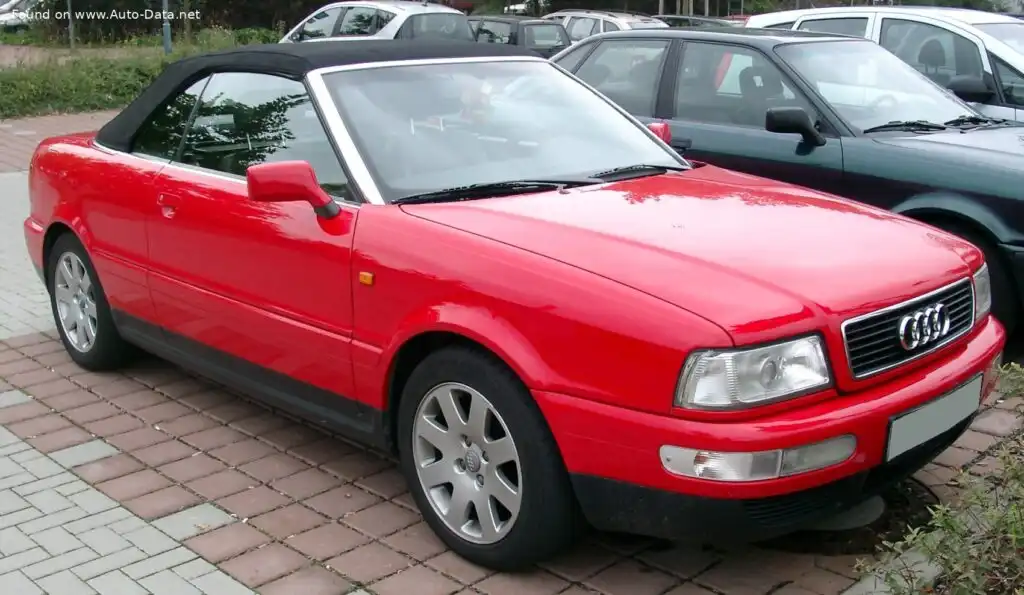
The Audi Cabriolet, specifically the B3 8G facelift model produced from 1998 to 2000, represented a significant step forward for Audi in the premium open-top market. This iteration, featuring the 2.6-liter V6 engine paired with a four-speed automatic transmission, occupied a mid-range position within the Cabriolet lineup, offering a balance of performance and comfort. It built upon the success of the original B3 Cabriolet (introduced in 1991), addressing earlier criticisms and refining the overall driving experience. The facelift brought subtle styling updates and improvements to interior materials, solidifying its appeal to buyers seeking a sophisticated and enjoyable convertible.
Technical Specifications
| Brand | Audi |
| Model | Cabriolet |
| Generation | Cabriolet (B3 8G, facelift 1997) |
| Type (Engine) | 2.6 V6 (150 Hp) Automatic |
| Start of production | 1998 |
| End of production | August, 2000 |
| Powertrain Architecture | Internal Combustion engine |
| Body type | Cabriolet |
| Seats | 4 |
| Doors | 2 |
| Fuel consumption (urban) | 16.2 l/100 km (14.5 US mpg, 17.4 UK mpg, 6.2 km/l) |
| Fuel consumption (extra urban) | 8.4 l/100 km (28 US mpg, 33.6 UK mpg, 11.9 km/l) |
| Fuel consumption (combined) | 11.2 l/100 km (21 US mpg, 25.2 UK mpg, 8.9 km/l) |
| CO2 emissions | 268 g/km |
| Fuel Type | Petrol (Gasoline) |
| Acceleration 0 – 100 km/h | 11.4 sec |
| Acceleration 0 – 62 mph | 11.4 sec |
| Acceleration 0 – 60 mph | 10.8 sec |
| Maximum speed | 207 km/h (128.62 mph) |
| Emission standard | Euro 2 |
| Weight-to-power ratio | 9.5 kg/Hp, 104.9 Hp/tonne |
| Weight-to-torque ratio | 6.4 kg/Nm, 157.3 Nm/tonne |
| Power | 150 Hp @ 5500 rpm |
| Power per litre | 57.7 Hp/l |
| Torque | 225 Nm @ 3500 rpm (165.95 lb.-ft. @ 3500 rpm) |
| Engine layout | Front, Longitudinal |
| Engine Model/Code | ABC |
| Engine displacement | 2598 cm3 (158.54 cu. in.) |
| Number of cylinders | 6 |
| Engine configuration | V-engine |
| Cylinder Bore | 82.5 mm (3.25 in.) |
| Piston Stroke | 81 mm (3.19 in.) |
| Compression ratio | 10:1 |
| Number of valves per cylinder | 2 |
| Fuel injection system | Multi-port manifold injection |
| Engine aspiration | Naturally aspirated engine |
| Valvetrain | OHC |
| Engine oil capacity | 5 l (5.28 US qt | 4.4 UK qt) |
| Coolant | 11 l (11.62 US qt | 9.68 UK qt) |
| Kerb Weight | 1430 kg (3152.61 lbs.) |
| Max. weight | 1830 kg (4034.46 lbs.) |
| Max load | 400 kg (881.85 lbs.) |
| Trunk (boot) space – minimum | 230 l (8.12 cu. ft.) |
| Fuel tank capacity | 70 l (18.49 US gal | 15.4 UK gal) |
| Permitted trailer load with brakes (8%) | 1000 kg (2204.62 lbs.) |
| Permitted trailer load with brakes (12%) | 1000 kg (2204.62 lbs.) |
| Permitted trailer load without brakes | 750 kg (1653.47 lbs.) |
| Permitted towbar download | 40 kg (88.18 lbs.) |
| Length | 4366 mm (171.89 in.) |
| Width | 1716 mm (67.56 in.) |
| Height | 1379 mm (54.29 in.) |
| Wheelbase | 2556 mm (100.63 in.) |
| Front track | 1453 mm (57.2 in.) |
| Rear (Back) track | 1447 mm (56.97 in.) |
| Drag coefficient (Cd) | 0.36 |
| Minimum turning circle (turning diameter) | 11.1 m (36.42 ft.) |
| Drivetrain Architecture | The Internal combustion engine (ICE) drives the front wheels of the vehicle. |
| Drive wheel | Front wheel drive |
| Number of gears and type of gearbox | 4 gears, automatic transmission |
| Front suspension | Independent, type McPherson with coil spring and anti-roll bar |
| Rear suspension | Semi-independent, coil spring |
| Front brakes | Ventilated discs |
| Rear brakes | Disc |
| Assisting systems | ABS (Anti-lock braking system) |
| Steering type | Steering rack and pinion |
| Power steering | Hydraulic Steering |
| Tires size | 205/60 R15 |
| Wheel rims size | 7J x 15 |
Powertrain & Engine Architecture
The heart of this Cabriolet variant is the Audi ABC engine, a 2.6-liter V6. This engine, part of Audi’s long-running V6 family, features a 90-degree V-angle for inherent smoothness. It utilizes a cast iron block with an aluminum cylinder head, incorporating dual overhead camshafts (DOHC) operating two valves per cylinder. Fuel delivery is managed by a Bosch Motronic multi-port fuel injection system, optimizing air-fuel mixture for efficiency and performance. The engine’s 150 horsepower at 5500 rpm and 225 Nm (166 lb-ft) of torque at 3500 rpm provided adequate power for comfortable cruising and spirited driving. The four-speed automatic transmission, while not offering the responsiveness of a manual, was chosen for its ease of use and suitability for the target demographic. This transmission featured electronic control for smoother shifts and adaptive learning to suit driving style.
Driving Characteristics
The 2.6 V6 automatic Cabriolet offered a relaxed and refined driving experience. Acceleration to 60 mph took around 10.8 seconds, and top speed was approximately 129 mph. While not a sports car, the engine provided sufficient power for overtaking maneuvers and maintaining highway speeds. The automatic transmission, while smooth, could feel somewhat sluggish compared to the available five-speed manual. Gear ratios were optimized for fuel economy and comfort rather than outright performance. The front-wheel-drive configuration provided predictable handling, but lacked the dynamic capabilities of Audi’s quattro all-wheel-drive system found in other models.
Equipment & Trim Levels
The 2.6 V6 automatic typically came well-equipped, reflecting its position as a mid-range offering. Standard features included power windows, central locking, power steering, and an anti-lock braking system (ABS). Interior upholstery was typically cloth, with leather options available as an upgrade. The dashboard featured a classic Audi design with clear instrumentation. Optional extras included a sunroof, upgraded audio system, and heated front seats. The Cabriolet’s electrically operated soft top was a key feature, providing open-air enjoyment with reasonable noise insulation.
Chassis & Braking
The B3 Cabriolet utilized a McPherson strut front suspension and a semi-independent rear suspension with coil springs. This setup provided a comfortable ride, absorbing bumps and imperfections in the road. Front brakes were ventilated discs, offering good stopping power, while rear brakes were solid discs. The steering was a rack-and-pinion system with hydraulic power assistance, providing light and precise steering feel. The car’s weight distribution, favoring the front, contributed to its predictable handling characteristics.
Market Reception & Comparison
The 2.6 V6 automatic Cabriolet was generally well-received by critics as a comfortable and stylish convertible. It offered a good balance of performance, features, and price. Compared to the more powerful 2.8 V6 models, it was less expensive and offered better fuel economy, but at the cost of some performance. The 1.8L four-cylinder models were more affordable but lacked the refinement and power of the V6. Fuel economy was rated at around 21 mpg combined, which was typical for a vehicle of its class at the time. Reliability was generally good, although regular maintenance was essential to prevent issues with the soft top mechanism and electrical components.
Legacy
Today, the Audi B3 8G Cabriolet 2.6 V6 automatic is considered a desirable classic. The ABC engine, while not known for being particularly high-strung, is generally reliable if properly maintained. Parts availability is reasonable, although some specific components may be difficult to find. The car’s timeless design and open-air driving experience continue to appeal to enthusiasts. Well-maintained examples command a premium in the used car market, representing a piece of Audi’s convertible heritage.

