
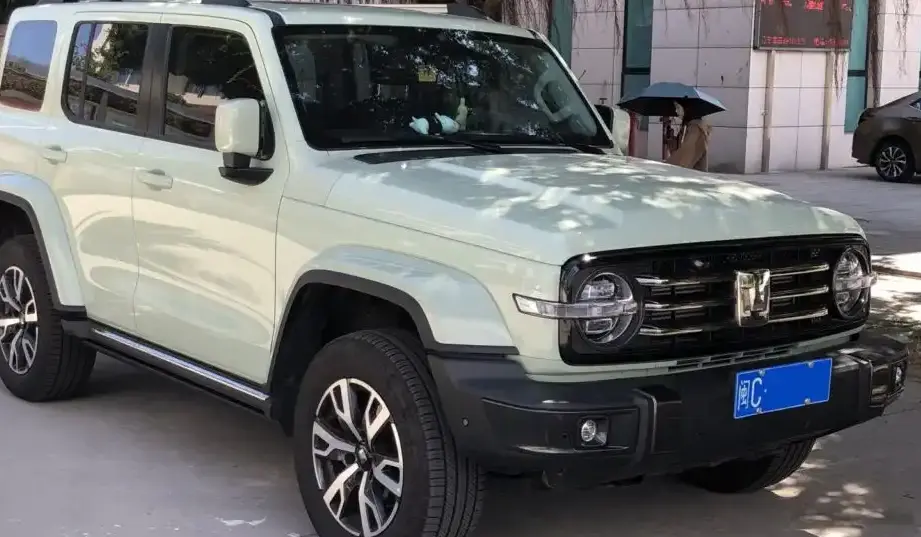
The Tank 300 2.0T, equipped with a 227 horsepower turbocharged four-cylinder engine and an eight-speed automatic transmission, represents a significant entry into the increasingly popular mid-size SUV segment. Introduced in 2021, the Tank 300 is produced by Tank, a sub-brand of Great Wall Motors, specifically targeting the Chinese domestic market with a focus on off-road capability and rugged styling. While not initially intended for widespread global distribution, the vehicle has garnered attention for its blend of modern technology and traditional body-on-frame construction. Production continued through March 2025, establishing a relatively short but impactful production run for this initial configuration. This particular 2.0T variant occupies a mid-range position within the Tank 300 lineup, offering a balance between performance, fuel efficiency, and price point.
Technical Specifications
| Brand | Tank |
| Model | 300 |
| Generation | 300 |
| Type (Engine) | 2.0T (227 Hp) 4WD Automatic 8-speed |
| Start of production | 2021 |
| End of production | March, 2025 |
| Powertrain Architecture | Internal Combustion engine |
| Body type | SUV |
| Seats | 5 |
| Doors | 5 |
| Fuel consumption (combined) | 9.78-10.26 l/100 km (24.1 – 22.9 US mpg, 28.9 – 27.5 UK mpg, 10.2 – 9.7 km/l) |
| Fuel Type | Petrol (Gasoline) |
| Acceleration 0 – 100 km/h | 9.5 sec |
| Acceleration 0 – 62 mph | 9.5 sec |
| Acceleration 0 – 60 mph | 9 sec |
| Maximum speed | 170 km/h (105.63 mph) |
| Emission standard | China VI |
| Weight-to-power ratio | 9 kg/Hp, 110.7 Hp/tonne |
| Weight-to-torque ratio | 5.3 kg/Nm, 188.8 Nm/tonne |
| Power | 227 Hp @ 5500 rpm |
| Power per litre | 115.4 Hp/l |
| Torque | 387 Nm @ 1800-3600 rpm (285.44 lb.-ft. @ 1800-3600 rpm) |
| Engine layout | Front, Longitudinal |
| Engine Model/Code | E20CB |
| Engine displacement | 1967 cm3 (120.03 cu. in.) |
| Number of cylinders | 4 |
| Engine configuration | Inline |
| Compression ratio | 9.6:1 |
| Number of valves per cylinder | 4 |
| Fuel injection system | Direct injection |
| Engine aspiration | Turbocharger, Intercooler |
| Valvetrain | DOHC |
| Engine oil capacity | 5.5 l (5.81 US qt | 4.84 UK qt) |
| Coolant capacity | 7.9 l (8.35 US qt | 6.95 UK qt) |
| Kerb Weight | 2050-2187 kg (4519.48 – 4821.51 lbs.) |
| Max. weight | 2552-2585 kg (5626.2 – 5698.95 lbs.) |
| Max load | 398-502 kg (877.44 – 1106.72 lbs.) |
| Trunk (boot) space – minimum | 400 l (14.13 cu. ft.) |
| Trunk (boot) space – maximum | 1635 l (57.74 cu. ft.) |
| Fuel tank capacity | 80 l (21.13 US gal | 17.6 UK gal) |
| Permitted trailer load with brakes (12%) | 2000 kg (4409.25 lbs.) |
| Length | 4760 mm (187.4 in.) |
| Width | 1930 mm (75.98 in.) |
| Height | 1903 mm (74.92 in.) |
| Wheelbase | 2750 mm (108.27 in.) |
| Front track | 1608 mm (63.31 in.) |
| Rear track | 1608 mm (63.31 in.) |
| Ride height (ground clearance) | 224 mm (8.82 in.) |
| Minimum turning circle | 12 m (39.37 ft.) |
| Approach angle | 33° |
| Departure angle | 34° |
| Ramp-over angle | 23.1° |
| Climb angle | 35° |
| Wading depth | 700 mm (27.56 in.) |
| Drivetrain Architecture | The Internal combustion engine (ICE) drives the rear wheels permanently, and the front wheels are driven through an electrically or mechanically operated clutch if necessary. |
| Drive wheel | All wheel drive (4×4) |
| Number of gears | 8 gears, automatic transmission |
| Front suspension | Double wishbone, Independent coil spring, Transverse stabilizer |
| Rear suspension | dependent spring suspension, Transverse stabilizer |
| Front brakes | Ventilated discs |
| Rear brakes | Ventilated discs |
| Assisting systems | ABS (Anti-lock braking system) |
| Steering type | Steering rack and pinion |
| Power steering | Electric Steering |
| Tires size | 245/70 R17; 265/65 R17; 265/60 R18 |
| Wheel rims size | 17; 18 |
Powertrain & Engine Architecture
The Tank 300 2.0T is powered by the E20CB, a 1.999-liter (2.0-liter) inline-four cylinder turbocharged gasoline engine. This engine utilizes direct fuel injection and a double overhead camshaft (DOHC) valvetrain with four valves per cylinder. The turbocharger, coupled with an intercooler, helps to boost power output and improve efficiency. The engine produces 227 horsepower at 5500 rpm and 387 Nm (285.44 lb-ft) of torque between 1800 and 3600 rpm. This torque curve provides good low-end grunt, beneficial for off-road driving. The engine is paired with a ZF-sourced eight-speed automatic transmission, known for its smooth shifting and wide gear ratio spread. This transmission is crucial for balancing performance with fuel economy and providing adequate gearing for both on-road cruising and challenging off-road conditions.
Driving Characteristics
The 2.0T engine and eight-speed automatic combination delivers a respectable driving experience. Acceleration from 0 to 100 km/h (0-62 mph) takes approximately 9.5 seconds. While not exceptionally quick, the readily available torque makes the vehicle feel responsive in everyday driving situations. The automatic transmission generally shifts smoothly, although some drivers have noted a slight hesitation during downshifts. Compared to potential higher-output variants (if offered), the 2.0T prioritizes fuel efficiency and a more relaxed driving experience. The eight-speed transmission helps keep engine speeds relatively low at highway speeds, contributing to reduced noise and improved fuel economy. The all-wheel-drive system provides enhanced traction, particularly useful in slippery conditions or off-road scenarios.
Equipment & Trim Levels
The Tank 300 2.0T typically comes standard with a comprehensive suite of features, reflecting its positioning as a modern SUV. Standard equipment generally includes automatic climate control, a touchscreen infotainment system with smartphone integration, power windows and locks, and a rearview camera. Higher trim levels add features such as leather upholstery, heated front seats, a panoramic sunroof, and advanced driver-assistance systems (ADAS) like adaptive cruise control and lane departure warning. Interior materials are generally durable and well-assembled, with a focus on practicality rather than outright luxury. The dashboard layout is functional and straightforward, prioritizing ease of use.
Chassis & Braking
The Tank 300 utilizes a traditional body-on-frame construction, providing robust durability and off-road capability. The front suspension consists of a double wishbone independent setup with coil springs and a transverse stabilizer bar. The rear suspension employs a dependent spring suspension, also with a transverse stabilizer bar. This configuration is designed to handle rough terrain and provide a comfortable ride. Braking duties are handled by ventilated discs on all four wheels, coupled with an anti-lock braking system (ABS). The braking performance is adequate for the vehicle’s weight and intended use, although it may not be as sharp as some more performance-oriented SUVs.
Market Reception & Comparison
The Tank 300 2.0T has been well-received in the Chinese market, particularly among consumers seeking a rugged and capable SUV with a distinctive design. Critics have praised its off-road performance, spacious interior, and comprehensive feature set. Fuel economy, rated at 9.78-10.26 l/100 km (24.1 – 22.9 US mpg), is competitive within its class. Compared to other SUVs in the same segment, the Tank 300 stands out with its body-on-frame construction and emphasis on off-road capability. While some competitors may offer more refined on-road handling or more luxurious interiors, the Tank 300 provides a unique combination of ruggedness, practicality, and value.
Legacy
The Tank 300 2.0T, despite its relatively short production run, has established itself as a noteworthy contender in the mid-size SUV market. The E20CB engine and eight-speed automatic transmission have proven to be a reliable combination, with few widespread reports of major mechanical issues. As the vehicle enters the used car market, it is expected to hold its value reasonably well, particularly among enthusiasts seeking a capable and distinctive off-road vehicle. The Tank 300’s success has paved the way for further expansion of the Tank brand and the development of additional models, solidifying its position as a key player in the Chinese automotive landscape.
