
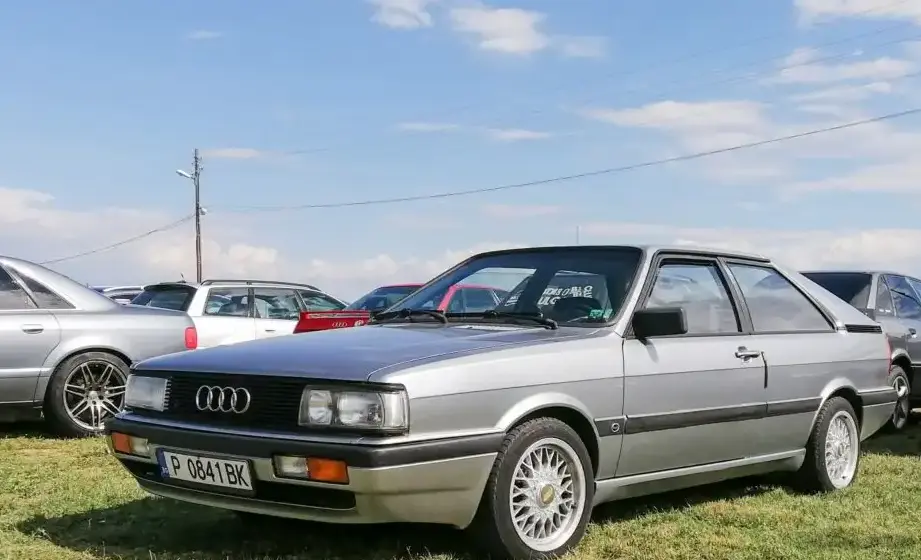
The Audi Coupe (B2), produced between 1980 and 1986, represented a significant step forward for Audi in the realm of sporty, yet practical, grand tourers. The facelifted version introduced in 1984 brought subtle but important refinements to the original design. Among the various engine options available, the 2.0i variant, producing 115 horsepower, occupied a middle ground in the lineup, offering a balance between performance and affordability. Production of this specific configuration ran from 1984 until July 1986, finding a niche among buyers seeking a stylish coupe with reasonable running costs.
Technical Specifications
| Brand | Audi |
| Model | Coupe |
| Generation | Coupe (B2 81, 85, facelift 1984) |
| Type (Engine) | 2.0i (115 Hp) |
| Start of production | 1984 |
| End of production | July, 1986 |
| Powertrain Architecture | Internal Combustion engine |
| Body type | Coupe |
| Seats | 5 |
| Doors | 2 |
| Fuel consumption (combined) | 8.5 l/100 km |
| Fuel consumption (US mpg) | 27.7 US mpg |
| Fuel consumption (UK mpg) | 33.2 UK mpg |
| Fuel consumption (km/l) | 11.8 km/l |
| Fuel Type | Petrol (Gasoline) |
| Acceleration 0 – 100 km/h | 9.5 sec |
| Acceleration 0 – 62 mph | 9.5 sec |
| Acceleration 0 – 60 mph | 9 sec |
| Maximum speed | 189 km/h (117.44 mph) |
| Weight-to-power ratio | 9.2 kg/Hp |
| Weight-to-torque ratio | 6.4 kg/Nm |
| Power | 115 Hp @ 5400 rpm |
| Power per litre | 57.7 Hp/l |
| Torque | 165 Nm @ 3200 rpm (121.7 lb.-ft. @ 3200 rpm) |
| Engine layout | Front, Longitudinal |
| Engine Model/Code | HP, JS |
| Engine displacement | 1994 cm3 (121.68 cu. in.) |
| Number of cylinders | 5 |
| Engine configuration | Inline |
| Cylinder Bore | 81 mm (3.19 in.) |
| Piston Stroke | 77.4 mm (3.05 in.) |
| Compression ratio | 10:1 |
| Number of valves per cylinder | 2 |
| Fuel injection system | Multi-port manifold injection |
| Engine aspiration | Naturally aspirated engine |
| Valvetrain | OHC |
| Engine oil capacity | 4.5 l (4.76 US qt | 3.96 UK qt) |
| Coolant capacity | 8 l (8.45 US qt | 7.04 UK qt) |
| Kerb Weight | 1060 kg (2336.9 lbs.) |
| Max. weight | 1520 kg (3351.03 lbs.) |
| Max load | 460 kg (1014.13 lbs.) |
| Trunk (boot) space – minimum | 443 l (15.64 cu. ft.) |
| Fuel tank capacity | 68 l (17.96 US gal | 14.96 UK gal) |
| Permitted trailer load with brakes (8%) | 1400 kg (3086.47 lbs.) |
| Permitted trailer load without brakes | 560 kg (1234.59 lbs.) |
| Length | 4421 mm (174.06 in.) |
| Width | 1682 mm (66.22 in.) |
| Height | 1350 mm (53.15 in.) |
| Wheelbase | 2538 mm (99.92 in.) |
| Front track | 1400 mm (55.12 in.) |
| Rear (Back) track | 1420 mm (55.91 in.) |
| Ride height (ground clearance) | 110 mm (4.33 in.) |
| Drag coefficient (Cd) | 0.36 |
| Minimum turning circle (turning diameter) | 11 m (36.09 ft.) |
| Drivetrain Architecture | The Internal combustion engine (ICE) drives the front wheels of the vehicle. |
| Drive wheel | Front wheel drive |
| Number of gears and type of gearbox | 5 gears, manual transmission |
| Front brakes | Disc |
| Rear brakes | Drum |
| Tires size | 185/60 R14 |
| Wheel rims size | 14 |
INTRODUCTION
The Audi Coupe B2, launched in 1980, was a pivotal model for Audi, establishing the brand’s reputation for building sophisticated and sporty coupes. The 1984 facelift brought subtle styling updates and mechanical improvements. The 2.0i variant, powered by the HP or JS engine code, was positioned as a mid-range offering, bridging the gap between the base 1.8-liter models and the more potent 2.1 and 2.3-liter versions. This engine provided a good balance of performance and fuel economy, making it a popular choice for drivers who wanted a stylish and comfortable coupe for everyday use. The B2 Coupe was a key player in Audi’s success in the European market, and a limited number were imported to the United States as grey market vehicles.
Powertrain & Engine Architecture
The heart of the 2.0i Coupe is Audi’s inline-five cylinder engine, designated HP or JS depending on minor variations. This engine, displacing 1994cc, was a hallmark of Audi engineering during the 1980s. It featured a single overhead camshaft (OHC) operating two valves per cylinder. Fuel delivery was handled by Bosch K-Jetronic multi-port fuel injection, a sophisticated system for its time that contributed to improved fuel efficiency and reduced emissions. The engine produced 115 horsepower at 5400 rpm and 165 Nm (121.7 lb-ft) of torque at 3200 rpm. The engine’s longitudinal mounting and front-wheel drive configuration were typical of Audi’s engineering philosophy. The 2.0i was typically paired with a 5-speed manual transmission, although a 3-speed automatic transmission was also available, albeit less common. The automatic transmission, while offering convenience, did impact acceleration and fuel economy.
Driving Characteristics
The 2.0i Coupe with the 5-speed manual transmission offered a reasonably engaging driving experience. Acceleration from 0 to 60 mph took around 9 seconds, and the top speed was approximately 117 mph. The inline-five engine provided a distinctive sound and a smooth power delivery. The automatic transmission version, however, felt noticeably slower, with a 0-60 mph time closer to 10.5 seconds. The gear ratios in the automatic were optimized for fuel economy rather than performance. Handling was generally good, thanks to the Coupe’s well-tuned suspension and front-wheel drive layout. However, it wasn’t as sharp or responsive as some of its rear-wheel drive competitors.
Equipment & Trim Levels
The 2.0i Coupe came reasonably well-equipped for its time. Standard features included power-assisted steering, front disc brakes, and cloth upholstery. Optional extras included a sunroof, alloy wheels, upgraded audio systems, and leather upholstery. The interior design was typically German – functional, well-built, and understated. The dashboard layout was clean and straightforward, with easy-to-read gauges. The 2.0i trim level generally sat between the base models and the more luxurious versions, offering a good balance of features and price.
Chassis & Braking
The B2 Coupe utilized a MacPherson strut front suspension and a semi-trailing arm rear suspension. The front suspension incorporated a stabilizer bar to reduce body roll. The braking system consisted of disc brakes at the front and drum brakes at the rear. This configuration was adequate for the car’s weight and performance, but more powerful versions of the Coupe benefited from rear disc brakes. The chassis was relatively lightweight, contributing to the car’s nimble handling. The 185/60 R14 tires provided a good compromise between grip and ride comfort.
Market Reception & Comparison
The Audi Coupe B2 2.0i was generally well-received by automotive critics. It was praised for its stylish design, comfortable interior, and refined engine. However, some critics noted that the performance wasn’t as exhilarating as some of its rivals. Compared to the more powerful 2.1 and 2.3-liter versions, the 2.0i offered less outright speed. However, it was more fuel-efficient and less expensive to maintain. The 1.8-liter models were even more affordable but lacked the 2.0i’s extra power. The 2.0i automatic was often criticized for its sluggish performance compared to the manual version.
Legacy
The Audi Coupe B2 2.0i remains a popular classic car today. The inline-five engine is known for its durability and reliability, although regular maintenance is essential. Parts availability is generally good, although some specific components can be difficult to find. The 2.0i variant is often considered a sweet spot in the B2 Coupe lineup, offering a good balance of performance, affordability, and reliability. Well-maintained examples are increasingly sought after by collectors and enthusiasts, and continue to provide a stylish and enjoyable driving experience.
