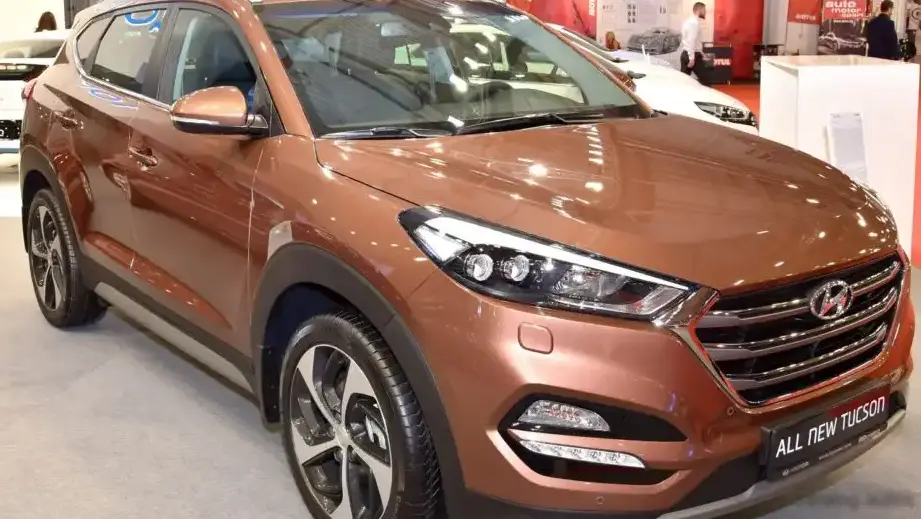
The Hyundai Tucson III 2.0 CRDI (136 Hp) 4WD Automatic, produced between 2015 and 2018, represents a significant iteration of Hyundai’s popular compact SUV. Positioned as a mid-range offering within the Tucson III lineup (codenamed HM), this variant combined a diesel engine with an all-wheel-drive system and a six-speed automatic transmission, appealing to buyers seeking fuel efficiency, all-weather capability, and ease of driving. It was a key model for Hyundai in the European and Asian markets, where diesel-powered SUVs with automatic transmissions were in high demand. This version aimed to bridge the gap between the more affordable base models and the higher-specification trims.
Technical Specifications
| Brand | Hyundai |
| Model | Tucson |
| Generation | Tucson III |
| Type (Engine) | 2.0 CRDI (136 Hp) 4WD Automatic |
| Start of production | 2015 |
| End of production | 2018 |
| Powertrain Architecture | Internal Combustion engine |
| Body type | SUV |
| Seats | 5 |
| Doors | 5 |
| Fuel consumption (economy) – urban | 7.4 l/100 km (31.8 US mpg) |
| Fuel consumption (economy) – extra urban | 5.4 l/100 km (43.6 US mpg) |
| Fuel consumption (economy) – combined | 6.1 l/100 km (38.6 US mpg) |
| CO2 emissions | 160 g/km |
| Fuel Type | Diesel |
| Acceleration 0 – 100 km/h | 12 sec |
| Acceleration 0 – 62 mph | 12 sec |
| Acceleration 0 – 60 mph | 11.4 sec |
| Maximum speed | 184 km/h (114.33 mph) |
| Emission standard | Euro 6 |
| Weight-to-power ratio | 11.9 kg/Hp |
| Weight-to-torque ratio | 4.3 kg/Nm |
| Power | 136 Hp @ 2750-4000 rpm |
| Torque | 373 Nm @ 1500-2500 rpm (275.11 lb.-ft.) |
| Engine layout | Front, Transverse |
| Engine Model/Code | D4HA |
| Engine displacement | 1995 cm3 (121.74 cu. in.) |
| Number of cylinders | 4 |
| Engine configuration | Inline |
| Cylinder Bore | 84 mm (3.31 in.) |
| Piston Stroke | 90 mm (3.54 in.) |
| Compression ratio | 16:1 |
| Number of valves per cylinder | 4 |
| Fuel injection system | Diesel Commonrail |
| Engine aspiration | Turbocharger, Intercooler |
| Valvetrain | DOHC |
| Engine oil capacity | 7.6 l (8.03 US qt | 6.69 UK qt) |
| Coolant | 8.8 l (9.3 US qt | 7.74 UK qt) |
| Kerb Weight | 1615 kg (3560.47 lbs.) |
| Max. weight | 2250 kg (4960.4 lbs.) |
| Max load | 635 kg (1399.94 lbs.) |
| Trunk (boot) space – minimum | 513 l (18.12 cu. ft.) |
| Trunk (boot) space – maximum | 1503 l (53.08 cu. ft.) |
| Fuel tank capacity | 62 l (16.38 US gal | 13.64 UK gal) |
| Max. roof load | 100 kg (220.46 lbs.) |
| Permitted trailer load with brakes (12%) | 1900 kg (4188.78 lbs.) |
| Permitted trailer load without brakes | 750 kg (1653.47 lbs.) |
| Length | 4475 mm (176.18 in.) |
| Width | 1850 mm (72.83 in.) |
| Height | 1655 mm (65.16 in.) |
| Wheelbase | 2670 mm (105.12 in.) |
| Front track | 1604-1608 mm (63.15 – 63.31 in.) |
| Rear (Back) track | 1615-1620 mm (63.58 – 63.78 in.) |
| Ride height (ground clearance) | 172 mm (6.77 in.) |
| Minimum turning circle (turning diameter) | 10.6 m (34.78 ft.) |
| Drive wheel | All wheel drive (4×4) |
| Number of gears and type of gearbox | 6 gears, automatic transmission |
| Front suspension | Independent type McPherson |
| Rear suspension | Independent multi-link suspension |
| Front brakes | Ventilated discs |
| Rear brakes | Disc |
| Assisting systems | ABS (Anti-lock braking system) |
| Steering type | Steering rack and pinion |
| Tires size | 215/70 R16; 225/60 R17; 245/45 R19 |
| Wheel rims size | 6.5J x 16; 7.0J x 17; 7.5J x 19 |
Powertrain & Engine Architecture
At the heart of the Tucson III 2.0 CRDI 4WD Automatic lies the Hyundai D4HA engine, a 1995cc inline-four cylinder diesel. This engine utilizes a second-generation common-rail direct injection system, delivering fuel at extremely high pressures for optimized combustion. The D4HA features a variable geometry turbocharger (VGT) and an intercooler, enhancing both power and torque output. The engine’s double overhead camshaft (DOHC) valvetrain, with four valves per cylinder, contributes to its efficient operation. The six-speed automatic transmission, sourced from Hyundai’s own development, was chosen for its smooth shifting and suitability for both urban and highway driving. This transmission featured a torque converter and electronically controlled gear changes.
Driving Characteristics
The 136 horsepower and 275 lb-ft of torque produced by the 2.0 CRDI engine, when paired with the six-speed automatic, provided adequate, though not exhilarating, performance. Acceleration from 0-60 mph took around 11.4 seconds, and top speed was approximately 114 mph. The automatic transmission was tuned for fuel efficiency, resulting in relatively conservative gear ratios. While this contributed to good fuel economy, it also meant that the engine sometimes felt strained during quick acceleration or when fully loaded. Compared to the more powerful 2.4L gasoline engine option or the higher-output diesel variants, this version prioritized fuel economy and relaxed cruising over outright performance. The all-wheel-drive system provided enhanced traction in slippery conditions, making it a capable vehicle for all-season use.
Equipment & Trim Levels
The 2.0 CRDI 4WD Automatic trim typically included standard features such as air conditioning, power windows and locks, a touchscreen infotainment system with Bluetooth connectivity, and alloy wheels. Safety features included ABS, electronic stability control, and multiple airbags. Higher trim levels offered upgrades like leather upholstery, a panoramic sunroof, heated seats, and a more advanced infotainment system with navigation. Interior materials were generally of good quality for the price point, with a focus on practicality and durability. The dashboard layout was functional and user-friendly, though not particularly luxurious.
Chassis & Braking
The Tucson III utilized a McPherson strut front suspension and a multi-link rear suspension, providing a comfortable ride quality. The suspension was tuned to balance handling and comfort, offering a stable and predictable driving experience. Braking duties were handled by ventilated discs at the front and solid discs at the rear. The ABS system helped to prevent wheel lockup during hard braking, enhancing safety. The all-wheel-drive system employed a multi-plate clutch to distribute torque between the front and rear axles, providing optimal traction in various driving conditions.
Market Reception & Comparison
The Hyundai Tucson III 2.0 CRDI 4WD Automatic was generally well-received by automotive critics. It was praised for its fuel efficiency, comfortable ride, and spacious interior. However, some reviewers noted that the engine lacked the punch of its competitors and that the automatic transmission could be slow to respond at times. Compared to other diesel-powered SUVs in its class, such as the Volkswagen Tiguan or the Kia Sportage, the Tucson offered a competitive price point and a generous warranty. Fuel economy figures of around 38.6 US mpg combined were considered excellent for a vehicle of its size and capability.
Legacy
The Hyundai Tucson III 2.0 CRDI 4WD Automatic has proven to be a relatively reliable vehicle in the long term. The D4HA engine is known for its durability, and the automatic transmission has generally held up well. Common issues include wear and tear on suspension components and occasional problems with the diesel particulate filter (DPF). On the used car market, these Tucsons represent a good value proposition, offering a blend of practicality, fuel efficiency, and all-weather capability. They remain a popular choice for buyers seeking a dependable and affordable compact SUV.