Technical Specifications
| Brand | Mazda |
| Model | CX-5 |
| Generation | CX-5 II |
| Type (Engine) | 2.2 SKYACTIV-D (150 Hp) |
| Start of production | 2017 |
| End of production | 2018 |
| Powertrain Architecture | Internal Combustion engine |
| Body type | SUV |
| Seats | 5 |
| Doors | 5 |
| Fuel consumption (urban) | 5.9 l/100 km (39.9 US mpg, 47.9 UK mpg, 16.9 km/l) |
| Fuel consumption (extra urban) | 4.6 l/100 km (51.1 US mpg, 61.4 UK mpg, 21.7 km/l) |
| Fuel consumption (combined) | 5 l/100 km (47 US mpg, 56.5 UK mpg, 20 km/l) |
| CO2 emissions | 132 g/km |
| Fuel Type | Diesel |
| Acceleration 0 – 100 km/h | 9.4 sec |
| Acceleration 0 – 62 mph | 9.4 sec |
| Acceleration 0 – 60 mph | 8.9 sec |
| Maximum speed | 204 km/h (126.76 mph) |
| Emission standard | Euro 6 |
| Weight-to-power ratio | 10.2 kg/Hp, 97.7 Hp/tonne |
| Weight-to-torque ratio | 4 kg/Nm, 247.6 Nm/tonne |
| Power | 150 Hp @ 4500 rpm |
| Power per litre | 68.5 Hp/l |
| Torque | 380 Nm @ 1800-2600 rpm (280.27 lb.-ft. @ 1800-2600 rpm) |
| Engine layout | Front, Transverse |
| Engine Model/Code | SHY6 |
| Engine displacement | 2191 cm3 (133.7 cu. in.) |
| Number of cylinders | 4 |
| Engine configuration | Inline |
| Cylinder Bore | 86 mm (3.39 in.) |
| Piston Stroke | 94.3 mm (3.71 in.) |
| Compression ratio | 14:1 |
| Number of valves per cylinder | 4 |
| Fuel injection system | Diesel Commonrail |
| Engine aspiration | Turbocharger, Intercooler |
| Engine oil capacity | 5.1 l (5.39 US qt | 4.49 UK qt) |
| Coolant | 8.5 l (8.98 US qt | 7.48 UK qt) |
| Kerb Weight | 1535 kg (3384.1 lbs.) |
| Max. weight | 2110 kg (4651.75 lbs.) |
| Max load | 575 kg (1267.66 lbs.) |
| Trunk (boot) space – minimum | 506 l (17.87 cu. ft.) |
| Trunk (boot) space – maximum | 1620 l (57.21 cu. ft.) |
| Fuel tank capacity | 56 l (14.79 US gal | 12.32 UK gal) |
| Max. roof load | 50 kg (110.23 lbs.) |
| Permitted trailer load with brakes (8%) | 2000 kg (4409.25 lbs.) |
| Permitted trailer load with brakes (12%) | 2000 kg (4409.25 lbs.) |
| Permitted trailer load without brakes | 750 kg (1653.47 lbs.) |
| Permitted towbar download | 75 kg (165.35 lbs.) |
| Length | 4550 mm (179.13 in.) |
| Width | 1840 mm (72.44 in.) |
| Width including mirrors | 2115 mm (83.27 in.) |
| Height | 1680 mm (66.14 in.) |
| Wheelbase | 2700 mm (106.3 in.) |
| Front track | 1586 mm (62.44 in.) |
| Rear (Back) track | 1586 mm (62.44 in.) |
| Ride height (ground clearance) | 185-193 mm (7.28 – 7.6 in.) |
| Minimum turning circle (turning diameter) | 11.0 m (36.09 ft.) |
| Drivetrain Architecture | The Internal combustion engine (ICE) drives the front wheels of the vehicle. |
| Drive wheel | Front wheel drive |
| Number of gears and type of gearbox | 6 gears, manual transmission |
| Front brakes | Ventilated discs |
| Rear brakes | Disc |
| Assisting systems | ABS (Anti-lock braking system) |
| Steering type | Steering rack and pinion |
| Power steering | Electric Steering |
| Tires size | 225/65 R17 |
| Wheel rims size | 17 |
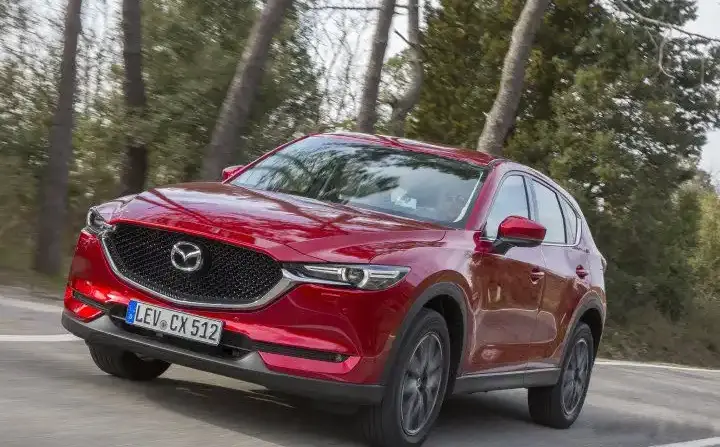
The Mazda CX-5 II 2.2 SKYACTIV-D (150 hp) represented a key offering in Mazda’s compact SUV lineup. Introduced as part of the second-generation CX-5 (KF series) in 2017, it aimed to provide a fuel-efficient and practical option for buyers seeking a versatile vehicle. Built on the 1HX0/A3 platform, the CX-5 II brought refinements to the original model, including updated styling, improved interior materials, and enhanced safety features. The 2.2-liter SKYACTIV-D engine was a central component of this update, offering a balance between power and economy.
Powertrain & Engine Architecture
The heart of this variant is the 2.191-liter (133.7 cu. in.) SKYACTIV-D four-cylinder diesel engine, designated as SHY6. This engine is characterized by its high compression ratio of 14:1, contributing to its thermal efficiency. It utilizes a common-rail direct injection system, delivering fuel directly into the combustion chamber at extremely high pressure. A turbocharger with an intercooler is employed to boost power output and improve torque across a wider rev range. The engine produces 150 horsepower at 4500 rpm and 380 Nm (280.27 lb.-ft.) of torque between 1800 and 2600 rpm. The engine’s design prioritizes lean combustion and reduced pumping losses. The 6-speed manual transmission was standard, providing a direct connection between the engine and the front wheels.
Driving Characteristics
The CX-5 II 2.2 SKYACTIV-D (150 hp) offered a composed and refined driving experience. While not overtly sporty, the engine provided ample torque for everyday driving and overtaking maneuvers. The 6-speed manual transmission allowed for precise gear selection, and the engine’s broad torque curve meant that frequent downshifting wasn’t necessary. Compared to higher-output versions of the CX-5, such as those with more powerful diesel engines or the 2.5-liter gasoline engine, this variant felt less urgent in its acceleration. However, it excelled in fuel economy, making it a practical choice for long-distance journeys. The gear ratios were tuned for efficiency, prioritizing comfortable cruising over outright performance.
Equipment & Trim Levels
The 2.2 SKYACTIV-D (150 hp) trim typically included standard features such as air conditioning, power windows and mirrors, a touchscreen infotainment system with Bluetooth connectivity, and a suite of safety features including ABS, stability control, and multiple airbags. Interior upholstery was generally cloth, with options for leather available as upgrades. Higher trim levels added features like a sunroof, heated seats, a premium sound system, and advanced driver-assistance systems such as lane departure warning and automatic emergency braking. The dashboard layout was clean and functional, with a focus on ergonomics.
Chassis & Braking
The CX-5 II featured a MacPherson strut front suspension and a multi-link rear suspension, providing a comfortable ride and predictable handling. The suspension was tuned to balance ride comfort with body control. The braking system consisted of ventilated discs at the front and solid discs at the rear. ABS (Anti-lock Braking System) was standard, enhancing braking performance and stability. The steering was an electric power-assisted rack and pinion system, offering light and precise steering feel. The vehicle’s weight of 1535 kg (3384.1 lbs) contributed to its stable and planted feel on the road.
Market Reception & Comparison
The Mazda CX-5 II 2.2 SKYACTIV-D (150 hp) was generally well-received by automotive critics. It was praised for its fuel efficiency, comfortable ride, and refined interior. However, some reviewers noted that the engine could feel slightly underpowered, particularly when fully loaded or driving uphill. Compared to the more powerful diesel variants, this trim offered a more affordable entry point into the CX-5 range. Its fuel economy was competitive with other diesel SUVs in its class, and its reliability was generally considered to be good.
Legacy
The SHY6 2.2 SKYACTIV-D engine has proven to be a relatively reliable powertrain, with few widespread issues reported. The CX-5 II, in general, has maintained a good reputation for build quality and durability. In the used car market, this variant represents a good value proposition for buyers seeking a fuel-efficient and practical SUV. While newer models offer more advanced technology and features, the CX-5 II 2.2 SKYACTIV-D (150 hp) remains a capable and well-rounded vehicle.