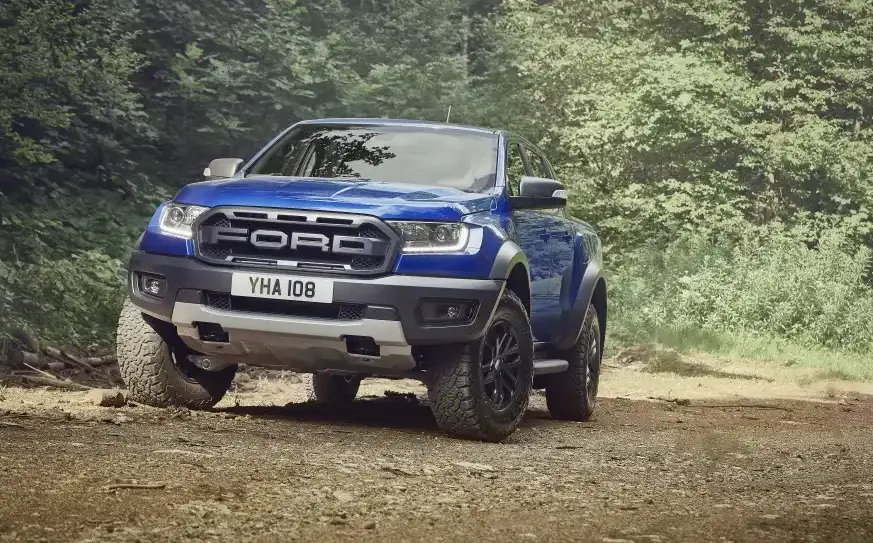
The Ford Ranger IV SuperCrew Raptor 2.0d Automatic, produced from 2019 to May 2023, represents a significant offering in the mid-size pickup truck segment for the Americas market. Positioned as a performance-oriented variant within the fourth generation Ranger (T6 platform), the Raptor 2.0d aimed to deliver a blend of off-road capability, modern technology, and a more fuel-efficient diesel powertrain compared to its gasoline-powered siblings. This model filled a niche for buyers seeking a rugged, capable truck with a focus on torque and practicality, without the higher price tag of the larger F-150 Raptor.
Technical Specifications
| Brand | Ford |
| Model | Ranger |
| Generation | Ranger IV SuperCrew (Americas) |
| Type (Engine) | Raptor 2.0d (214 Hp) Automatic |
| Start of production | 2019 |
| End of production | May, 2023 |
| Powertrain Architecture | Internal Combustion engine |
| Body type | Pick-up |
| Seats | 5 |
| Doors | 4 |
| Fuel consumption (combined) | 8.2 l/100 km (28.7 US mpg, 34.4 UK mpg, 12.2 km/l) |
| CO2 emissions | 212 g/km |
| Fuel Type | Diesel |
| Weight-to-power ratio | 10.9 kg/Hp, 91.8 Hp/tonne |
| Weight-to-torque ratio | 4.7 kg/Nm, 214.4 Nm/tonne |
| Power | 214 Hp @ 3750 rpm |
| Power per litre | 107.2 Hp/l |
| Torque | 500 Nm @ 1750-2000 rpm (368.78 lb.-ft. @ 1750-2000 rpm) |
| Engine layout | Front, Longitudinal |
| Engine displacement | 1996 cm3 (121.8 cu. in.) |
| Number of cylinders | 4 |
| Engine configuration | Inline |
| Number of valves per cylinder | 4 |
| Fuel injection system | Diesel Commonrail |
| Engine aspiration | Turbocharger, Intercooler |
| Engine oil capacity | 7.1 l (7.5 US qt | 6.25 UK qt) |
| Coolant | 11 l (11.62 US qt | 9.68 UK qt) |
| Kerb Weight | 2332 kg (5141.18 lbs.) |
| Max. weight | 3090 kg (6812.28 lbs.) |
| Max load | 758 kg (1671.1 lbs.) |
| Fuel tank capacity | 80 l (21.13 US gal | 17.6 UK gal) |
| Permitted trailer load with brakes (12%) | 2500 kg (5511.56 lbs.) |
| Length | 5398 mm (212.52 in.) |
| Width | 2028 mm (79.84 in.) |
| Width with mirrors folded | 2028 mm (79.84 in.) |
| Width including mirrors | 2180 mm (85.83 in.) |
| Height | 1873 mm (73.74 in.) |
| Wheelbase | 3220 mm (126.77 in.) |
| Front track | 1710 mm (67.32 in.) |
| Rear (Back) track | 1710 mm (67.32 in.) |
| Front overhang | 908 mm (35.75 in.) |
| Rear overhang | 1270 mm (50 in.) |
| Ride height (ground clearance) | 283 mm (11.14 in.) |
| Minimum turning circle (turning diameter) | 12.9 m (42.32 ft.) |
| Approach angle | 32.5° |
| Departure angle | 24.0° |
| Ramp-over (brakeover) angle | 24.0° |
| Wading depth | 850 mm (33.46 in.) |
| Drivetrain Architecture | Rear wheel drive |
| Number of gears and type of gearbox | 10 gears, automatic transmission |
| Front suspension | Independent coil spring |
| Rear suspension | Independent multi-link suspension |
| Front brakes | Ventilated discs |
| Rear brakes | Ventilated discs |
| Assisting systems | ABS (Anti-lock braking system) |
| Tires size | 285/70 R17 |
| Wheel rims size | 17 |
Powertrain & Engine Architecture
The heart of the Ranger Raptor 2.0d is the Ford Puma 2.0-liter inline-four cylinder diesel engine. This engine, part of the Puma family, utilizes a sophisticated common-rail direct injection system and a sequential twin-turbocharger setup. The twin-turbo configuration is crucial for delivering both low-end torque for off-road crawling and sufficient power for highway cruising. The engine produces 214 horsepower at 3750 rpm and a substantial 500 Nm (368.78 lb-ft) of torque between 1750 and 2000 rpm. This torque output is a key characteristic, providing strong pulling power and responsiveness. The engine is longitudinally mounted within the chassis.
The transmission is a 10-speed automatic, co-developed with General Motors. This transmission offers a wide range of gear ratios, optimizing both fuel efficiency and performance. The close ratios allow the engine to stay within its peak torque band more frequently, enhancing acceleration and towing capability. The automatic transmission was specifically tuned for the Raptor’s off-road focus, with features like selectable drive modes influencing shift points.
Driving Characteristics
The Ranger Raptor 2.0d Automatic delivers a driving experience that prioritizes capability and comfort. While not as overtly powerful as the gasoline-powered Ranger Raptor variants, the 2.0d offers ample torque for most driving situations. The 10-speed automatic transmission contributes to smooth shifts and efficient power delivery. In real-world conditions, the truck feels responsive in everyday driving, with the torque making overtaking maneuvers relatively effortless. Off-road, the combination of the diesel engine’s low-end grunt and the transmission’s gearing provides excellent control and traction. Compared to a manual transmission, the automatic offers ease of use, particularly in challenging terrain. However, some drivers may prefer the more direct control of a manual gearbox.
Equipment & Trim Levels
The Ranger Raptor 2.0d Automatic came well-equipped, reflecting its positioning as a premium trim level. Standard features typically included a unique exterior styling package with flared wheel arches, a distinctive grille, and off-road-focused tires. Inside, the Raptor featured sport seats with unique upholstery, a leather-wrapped steering wheel, and a modern infotainment system with touchscreen display. Available options included a premium sound system, navigation, and various driver-assistance technologies. The interior design emphasized durability and functionality, with materials chosen to withstand the rigors of off-road use.
Chassis & Braking
The Ranger Raptor 2.0d features a robust chassis designed for both on- and off-road performance. The suspension utilizes independent coil springs in the front and an independent multi-link setup in the rear, providing a comfortable ride and excellent wheel articulation. The Raptor also benefits from upgraded shock absorbers and a wider track width compared to standard Ranger models. Braking duties are handled by ventilated discs on all four wheels, providing ample stopping power. An Anti-lock Braking System (ABS) is standard, enhancing safety and control.
Market Reception & Comparison
The Ranger Raptor 2.0d Automatic was generally well-received by automotive critics. Reviewers praised its off-road capability, comfortable ride, and fuel efficiency. The diesel engine was noted for its strong torque output and responsiveness. Compared to the gasoline-powered Ranger Raptor, the 2.0d offered a more economical option, appealing to buyers who prioritized fuel costs and practicality. However, some critics noted that the 2.0d lacked the outright performance of its gasoline counterpart. In terms of reliability, the Puma 2.0-liter diesel engine has proven to be generally robust, although regular maintenance is essential.
Legacy
The Ford Ranger IV SuperCrew Raptor 2.0d Automatic has established itself as a desirable used vehicle. Its combination of capability, comfort, and fuel efficiency continues to appeal to buyers seeking a versatile mid-size pickup truck. The Puma 2.0-liter diesel engine, when properly maintained, is known for its longevity. As a result, well-maintained examples of the Raptor 2.0d command a premium in the used car market. The model represents a significant step forward in the evolution of the Ranger, demonstrating Ford’s commitment to delivering capable and technologically advanced trucks to the Americas market.