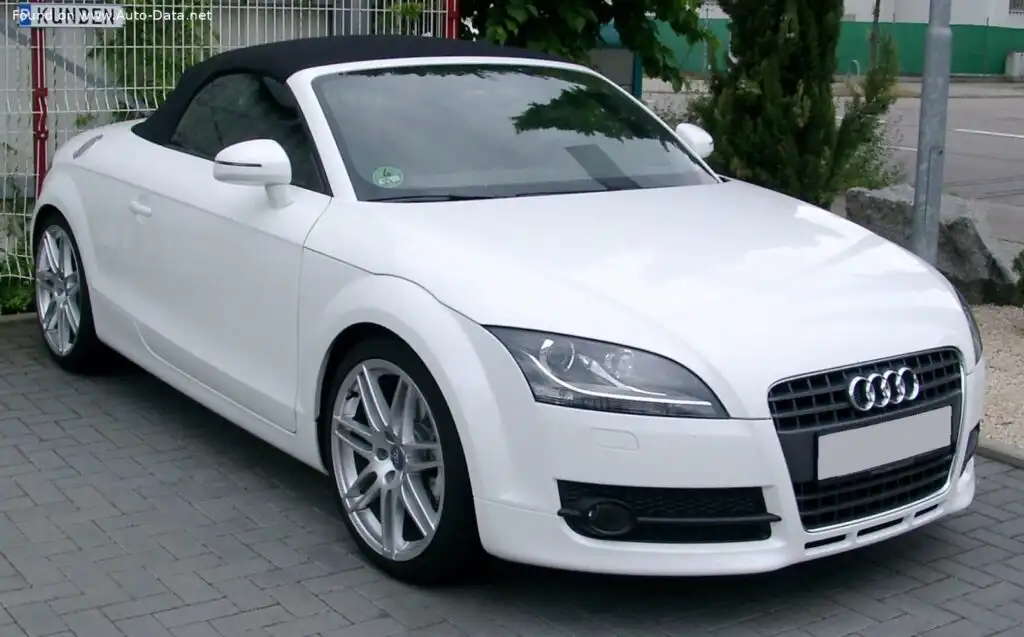
The Audi TT Roadster (8J) 2.0 TFSI quattro S tronic represents a compelling blend of performance and open-air driving enjoyment within the second generation (8J) TT lineup. Produced from 2009 to 2010, this variant occupied a mid-range position, offering a significant step up in power and handling compared to the base 1.8 TFSI models, while remaining more accessible than the range-topping 3.2 V6. It was a key offering in the European market, where compact roadsters were highly sought after, and gained a modest following in North America as a premium sports car alternative.
Technical Specifications
| Brand | Audi |
| Model | TT |
| Generation | TT Roadster (8J) |
| Type (Engine) | 2.0 TFSI (200 Hp) quattro S tronic |
| Start of production | 2009 |
| End of production | 2010 |
| Powertrain Architecture | Internal Combustion engine |
| Body type | Roadster |
| Seats | 2 |
| Doors | 2 |
| Fuel consumption (urban) | 10.5 l/100 km (22.4 US mpg, 26.9 UK mpg, 9.5 km/l) |
| Fuel consumption (extra urban) | 6.3 l/100 km (37.3 US mpg, 44.8 UK mpg, 15.9 km/l) |
| Fuel consumption (combined) | 7.8 l/100 km (30.2 US mpg, 36.2 UK mpg, 12.8 km/l) |
| Fuel Type | Petrol (Gasoline) |
| Acceleration 0 – 100 km/h | 6.4 sec |
| Acceleration 0 – 62 mph | 6.4 sec |
| Acceleration 0 – 60 mph | 6.1 sec |
| Maximum speed | 235 km/h (146.02 mph) |
| Emission standard | Euro 5 |
| Weight-to-power ratio | 7 kg/Hp, 142.3 Hp/tonne |
| Weight-to-torque ratio | 5 kg/Nm, 199.3 Nm/tonne |
| Power | 200 Hp @ 5100-6000 rpm |
| Power per litre | 100.8 Hp/l |
| Torque | 280 Nm @ 1700-5000 rpm (206.52 lb.-ft. @ 1700-5000 rpm) |
| Engine layout | Front, Transverse |
| Engine Model/Code | BWA, CCZA |
| Engine displacement | 1984 cm3 (121.07 cu. in.) |
| Number of cylinders | 4 |
| Engine configuration | Inline |
| Cylinder Bore | 82.5 mm (3.25 in.) |
| Piston Stroke | 92.8 mm (3.65 in.) |
| Compression ratio | 10.3:1 |
| Number of valves per cylinder | 4 |
| Fuel injection system | Direct injection |
| Engine aspiration | Turbocharger, Intercooler |
| Valvetrain | DOHC |
| Engine oil capacity | 4.6 l (4.86 US qt | 4.05 UK qt) |
| Kerb Weight | 1405 kg (3097.49 lbs.) |
| Max. weight | 1725 kg (3802.97 lbs.) |
| Max load | 320 kg (705.48 lbs.) |
| Trunk (boot) space – minimum | 250 l (8.83 cu. ft.) |
| Fuel tank capacity | 60 l (15.85 US gal | 13.2 UK gal) |
| Length | 4178 mm (164.49 in.) |
| Width | 1842 mm (72.52 in.) |
| Height | 1358 mm (53.46 in.) |
| Wheelbase | 2468 mm (97.17 in.) |
| Front track | 1572 mm (61.89 in.) |
| Rear (Back) track | 1558 mm (61.34 in.) |
| Drag coefficient (Cd) | 0.32 |
| Minimum turning circle | 10.96 m (35.96 ft.) |
| Drive wheel | All wheel drive (4×4) |
| Number of gears | 6 |
| Gearbox type | automatic transmission S tronic |
| Front suspension | Independent, type McPherson with coil spring and anti-roll bar |
| Rear suspension | Independent multi-link spring suspension with stabilizer |
| Front brakes | Ventilated discs |
| Rear brakes | Disc |
| Assisting systems | ABS (Anti-lock braking system) |
| Steering type | Steering rack and pinion |
| Power steering | Hydraulic Steering |
| Tires size | 225/55 R16 |
| Wheel rims size | 7.5J x 16 |
Powertrain & Engine Architecture
At the heart of the 2.0 TFSI quattro S tronic lies the EA888 engine family, specifically the BWA or CCZA engine code depending on the exact production date and market. This 1984cc, turbocharged inline-four engine utilizes direct fuel injection (FSI) and a sophisticated dual overhead camshaft (DOHC) valvetrain with four valves per cylinder. The turbocharger, coupled with an intercooler, provides a significant boost in power output. The engine’s electronic engine management system carefully controls fuel delivery and ignition timing to optimize performance and efficiency. The S tronic transmission is a six-speed dual-clutch transmission (DCT) offering rapid, seamless gear changes. This transmission contributes significantly to the car’s sporty driving experience and improved acceleration compared to a traditional automatic.
Driving Characteristics
The 200 horsepower and 280 Nm (206 lb-ft) of torque delivered by the 2.0 TFSI engine, combined with the quattro all-wheel-drive system and the S tronic transmission, resulted in a responsive and engaging driving experience. Acceleration from 0 to 60 mph took approximately 6.1 seconds, making it a genuinely quick roadster. The S tronic transmission’s quick shifts and the quattro system’s ability to distribute power effectively provided excellent traction and stability, particularly in challenging road conditions. Compared to the base 1.8 TFSI model, the 2.0 TFSI offered a noticeable improvement in acceleration and overall performance. While not as raw or visceral as the higher-output 3.2 V6, the 2.0 TFSI provided a more balanced and accessible performance profile for a wider range of drivers.
Equipment & Trim Levels
The 2.0 TFSI quattro S tronic typically came well-equipped, reflecting its mid-range positioning. Standard features included leather upholstery, automatic climate control, a multi-function steering wheel, and a premium audio system. Optional extras included navigation system, parking sensors, heated seats, and upgraded alloy wheels. The interior design was modern and driver-focused, with a clean dashboard layout and supportive seats. The Roadster configuration, with its folding soft top, added to the open-air driving experience, although it did slightly compromise trunk space.
Chassis & Braking
The TT Roadster’s chassis featured an independent McPherson strut suspension at the front and a multi-link suspension at the rear, providing a good balance between ride comfort and handling precision. Stabilizer bars were fitted front and rear to reduce body roll during cornering. The braking system consisted of ventilated discs at the front and solid discs at the rear, equipped with ABS (Anti-lock Braking System) for enhanced safety. The steering was a hydraulic power-assisted rack and pinion system, offering precise and responsive steering feel.
Market Reception & Comparison
The Audi TT Roadster (8J) 2.0 TFSI quattro S tronic was generally well-received by automotive critics. It was praised for its stylish design, engaging driving dynamics, and refined interior. Fuel economy was considered reasonable for a performance roadster, averaging around 30.2 US mpg in combined driving. Compared to rivals like the BMW Z4 and Porsche Boxster, the TT offered a more accessible price point and a more technologically advanced interior. However, some critics noted that the ride could be a bit firm on rough roads and that the engine lacked the character of some of its competitors.
Legacy
The 2.0 TFSI engine, in various iterations, has proven to be a reliable and durable powerplant. However, like all turbocharged engines, it requires regular maintenance, including oil changes and inspection of the turbocharger and intercooler. The S tronic transmission is generally reliable but can be expensive to repair if issues arise. Today, the 8J TT Roadster 2.0 TFSI quattro S tronic remains a desirable used car, offering a compelling combination of style, performance, and practicality. Its relatively strong build quality and readily available parts contribute to its continued appeal among enthusiasts.