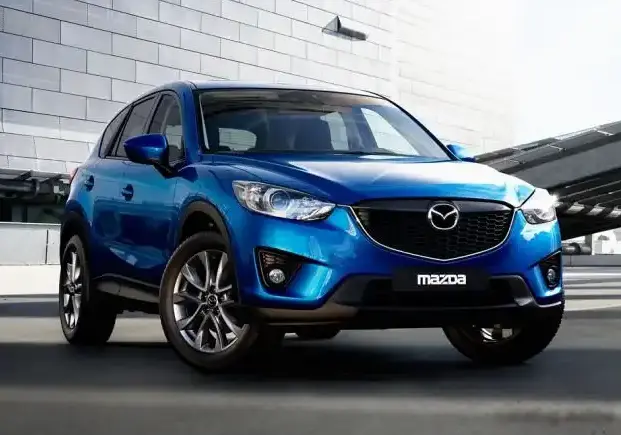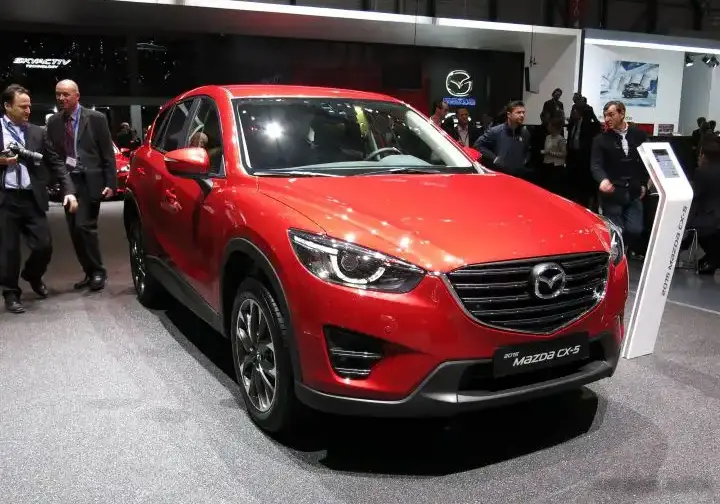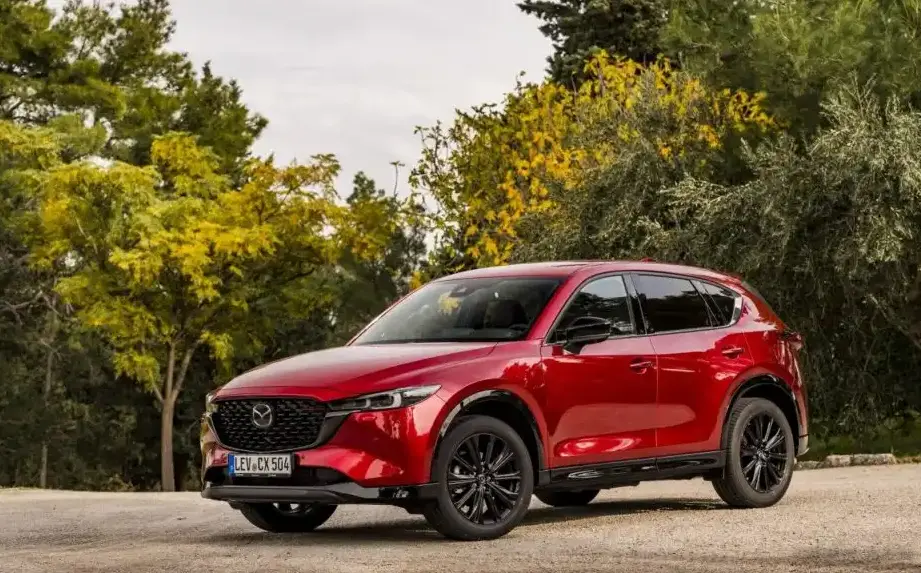
The Mazda CX-5 II (facelift 2021) 2.0 SKYACTIV-G (165 Hp) AWD Automatic represents a key variant within the second generation of Mazda’s popular compact SUV. Introduced in September 2021 and continuing through November 2022, this model served as an accessible entry point into the CX-5 range, offering all-wheel drive capability and the convenience of an automatic transmission. It’s positioned within the broader context of the KF series CX-5, which debuted in 2017 and received a significant refresh in 2021, incorporating styling updates, improved interior materials, and enhanced driving dynamics. This particular configuration aimed to balance affordability with Mazda’s signature driving experience and upscale features.
Technical Specifications
| Brand | Mazda |
| Model | CX-5 |
| Generation | CX-5 II (facelift 2021) |
| Type (Engine) | 2.0 SKYACTIV-G (165 Hp) AWD Automatic |
| Start of production | September, 2021 |
| End of production | November, 2022 |
| Powertrain Architecture | Internal Combustion engine |
| Body type | SUV |
| Seats | 5 |
| Doors | 5 |
| Fuel consumption at Low speed (WLTP) | 9.5 l/100 km (24.8 US mpg, 29.7 UK mpg, 10.5 km/l) |
| Fuel consumption at Medium speed (WLTP) | 7.3 l/100 km (32.2 US mpg, 38.7 UK mpg, 13.7 km/l) |
| Fuel consumption at high speed (WLTP) | 6.6-6.8 l/100 km (35.6 – 34.6 US mpg, 42.8 – 41.5 UK mpg, 15.2 – 14.7 km/l) |
| Fuel consumption at very high speed (WLTP) | 8.1-8.3 l/100 km (29 – 28.3 US mpg, 34.9 – 34 UK mpg, 12.3 – 12 km/l) |
| Combined fuel consumption (WLTP) | 7.7-7.8 l/100 km (30.5 – 30.2 US mpg, 36.7 – 36.2 UK mpg, 13 – 12.8 km/l) |
| CO2 emissions (WLTP) | 174-176 g/km |
| Fuel consumption (economy) – urban (NEDC) | 8.4 l/100 km (28 US mpg, 33.6 UK mpg, 11.9 km/l) |
| Fuel consumption (economy) – extra urban (NEDC) | 6.1 l/100 km (38.6 US mpg, 46.3 UK mpg, 16.4 km/l) |
| Fuel consumption (economy) – combined (NEDC) | 7 l/100 km (33.6 US mpg, 40.4 UK mpg, 14.3 km/l) |
| CO2 emissions (NEDC) | 159 g/km |
| Fuel Type | Petrol (Gasoline) |
| Acceleration 0 – 100 km/h | 10.4 sec |
| Acceleration 0 – 62 mph | 10.4 sec |
| Acceleration 0 – 60 mph | 9.9 sec |
| Maximum speed | 188 km/h (116.82 mph) |
| Emission standard | Euro 6d |
| Weight-to-power ratio | 9.3 kg/Hp, 107 Hp/tonne |
| Weight-to-torque ratio | 7.2 kg/Nm, 138.1 Nm/tonne |
| Power | 165 Hp @ 6000 rpm |
| Power per litre | 82.6 Hp/l |
| Torque | 213 Nm @ 4000 rpm (157.1 lb.-ft. @ 4000 rpm) |
| Engine layout | Front, Transverse |
| Engine Model/Code | PE |
| Engine displacement | 1998 cm3 (121.93 cu. in.) |
| Number of cylinders | 4 |
| Engine configuration | Inline |
| Cylinder Bore | 83.5 mm (3.29 in.) |
| Piston Stroke | 91.2 mm (3.59 in.) |
| Compression ratio | 13:1 |
| Number of valves per cylinder | 4 |
| Fuel injection system | Direct injection |
| Engine aspiration | Naturally aspirated engine |
| Valvetrain | DOHC |
| Engine oil capacity | 4.2 l (4.44 US qt | 3.7 UK qt) |
| Coolant | 7.1 l (7.5 US qt | 6.25 UK qt) |
| Kerb Weight | 1542-1592 kg (3399.53 – 3509.76 lbs.) |
| Max. weight | 2115 kg (4662.78 lbs.) |
| Max load | 523-573 kg (1153.02 – 1263.25 lbs.) |
| Trunk (boot) space – minimum | 522 l (18.43 cu. ft.) |
| Trunk (boot) space – maximum | 1638 l (57.85 cu. ft.) |
| Fuel tank capacity | 58 l (15.32 US gal | 12.76 UK gal) |
| Max. roof load | 75 kg (165.35 lbs.) |
| Permitted trailer load with brakes (8%) | 2000 kg (4409.25 lbs.) |
| Permitted trailer load with brakes (12%) | 2000 kg (4409.25 lbs.) |
| Permitted trailer load without brakes | 750 kg (1653.47 lbs.) |
| Length | 4575 mm (180.12 in.) |
| Width | 1845 mm (72.64 in.) |
| Width including mirrors | 2115 mm (83.27 in.) |
| Height | 1680-1685 mm (66.14 – 66.34 in.) |
| Wheelbase | 2700 mm (106.3 in.) |
| Front track | 1595 mm (62.8 in.) |
| Rear (Back) track | 1595 mm (62.8 in.) |
| Front overhang | 965 mm (37.99 in.) |
| Rear overhang | 910 mm (35.83 in.) |
| Ride height (ground clearance) | 192-200 mm (7.56 – 7.87 in.) |
| Minimum turning circle (turning diameter) | 11 m (36.09 ft.) |
| Drivetrain Architecture | The Internal combustion engine (ICE) drives the front wheels permanently, and the rear wheels are driven through an electrically or mechanically operated clutch if necessary. |
| Drive wheel | All wheel drive (4×4) |
| Number of gears and type of gearbox | 6 gears, automatic transmission |
| Front suspension | Independent type McPherson |
| Rear suspension | Independent multi-link suspension |
| Front brakes | Ventilated discs, 297 mm |
| Rear brakes | Disc, 303 mm |
| Assisting systems | ABS (Anti-lock braking system) |
| Steering type | Steering rack and pinion |
| Power steering | Electric Steering |
| Tires size | 225/65 R17; 225/55 R19 |
| Wheel rims size | 7J x 17; 7J x 19 |
INTRODUCTION
The Mazda CX-5 II facelift, specifically the 2.0 SKYACTIV-G 165 Hp AWD Automatic, was introduced as part of a mid-cycle refresh for the second-generation CX-5. Production spanned from September 2021 to November 2022. This variant occupied a crucial position in the lineup, serving as a more accessible option compared to the higher-output 2.5-liter engine choices. It targeted buyers seeking a well-equipped, comfortable, and capable SUV with the added security of all-wheel drive, but without the higher price tag associated with the more powerful trims. The CX-5, as a whole, played a significant role in establishing Mazda as a premium mainstream brand, challenging established competitors like the Honda CR-V and Toyota RAV4.
Powertrain & Engine Architecture
At the heart of this CX-5 variant lies Mazda’s PE-VPH 2.0-liter SKYACTIV-G four-cylinder gasoline engine. This engine is characterized by its high compression ratio of 13:1, achieved through careful engineering and precise fuel injection. The engine utilizes direct injection, optimizing fuel delivery and combustion efficiency. The DOHC (Double Overhead Camshaft) valvetrain further enhances breathing and performance. The engine’s output of 165 horsepower at 6000 rpm and 213 Nm (157.1 lb-ft) of torque at 4000 rpm is respectable for its displacement, but noticeably less than the 2.5-liter SKYACTIV-G offered in higher trims. Paired with this engine is a six-speed automatic transmission, designed to provide smooth and efficient gear changes. This transmission is not a traditional torque-converter automatic; it incorporates a torque converter lock-up clutch to minimize slippage and improve fuel economy.
Driving Characteristics
The 2.0-liter engine and six-speed automatic combination delivers a comfortable, if not particularly exhilarating, driving experience. Acceleration from 0-60 mph takes approximately 9.9 seconds, and 0-100 km/h in 10.4 seconds. The automatic transmission is tuned for fuel efficiency and smooth operation, prioritizing comfort over aggressive shifting. Compared to the manual transmission versions of the 2.0-liter engine, the automatic offers greater convenience, especially in urban driving. However, it does result in a slight reduction in responsiveness. Against the more powerful 2.5-liter variants, this engine feels noticeably less potent, particularly when fully loaded or tackling steep inclines. The all-wheel-drive system provides enhanced traction and stability in adverse weather conditions, making it a practical choice for drivers in regions with snow or rain.
Equipment & Trim Levels
The 2.0 SKYACTIV-G AWD Automatic trim typically included a generous array of standard features. These commonly included Mazda’s infotainment system with a 10.25-inch display, Apple CarPlay and Android Auto integration, Bluetooth connectivity, and a rearview camera. Safety features such as Mazda’s i-Activsense suite, encompassing adaptive cruise control, lane departure warning, lane-keep assist, and automatic emergency braking, were also standard. Interior upholstery was typically cloth, with options for leather upgrades available. Optional extras could include a power sunroof, premium audio system, heated front seats, and a power liftgate. Trim levels varied slightly by market, but generally, this engine/transmission combination represented a mid-range offering, bridging the gap between the base models and the more luxurious trims.
Chassis & Braking
The CX-5 II utilizes a robust chassis featuring independent suspension all around – a McPherson strut setup at the front and a multi-link system at the rear. This suspension configuration provides a good balance between ride comfort and handling precision. The 2.0-liter models typically featured ventilated discs on the front wheels and solid discs on the rear. Anti-lock braking system (ABS) was standard, along with electronic brake-force distribution (EBD) and brake assist. Stabilizer bars were fitted to both the front and rear axles to minimize body roll during cornering. The suspension tuning was generally softer than that of the higher-output trims, prioritizing ride comfort over sporty handling.
Market Reception & Comparison
Critics generally praised the CX-5 II for its refined interior, engaging driving dynamics, and stylish exterior design. The 2.0-liter engine, while not the most powerful in the lineup, was considered adequate for most driving situations. Fuel economy was a strong point, with combined WLTP figures ranging from 7.7 to 7.8 l/100 km (30.5 – 30.2 US mpg). Compared to the 2.5-liter models, the 2.0-liter offered a more affordable entry point into the CX-5 range, but at the expense of performance. The 2.0-liter was often seen as a sensible choice for buyers prioritizing fuel efficiency and value over outright speed. Reliability reports have generally been positive, with the SKYACTIV-G engines proving to be durable and relatively trouble-free.
Legacy
The Mazda CX-5 II 2.0 SKYACTIV-G AWD Automatic has established itself as a reliable and well-regarded used car option. The powertrain, while not groundbreaking in terms of performance, has proven to be durable and relatively inexpensive to maintain. The availability of all-wheel drive adds to its appeal in regions with inclement weather. As a used vehicle, it represents a good value proposition, offering a comfortable and well-equipped SUV at a competitive price point. The continued popularity of the CX-5 model line speaks to Mazda’s success in creating a compelling and desirable compact SUV.