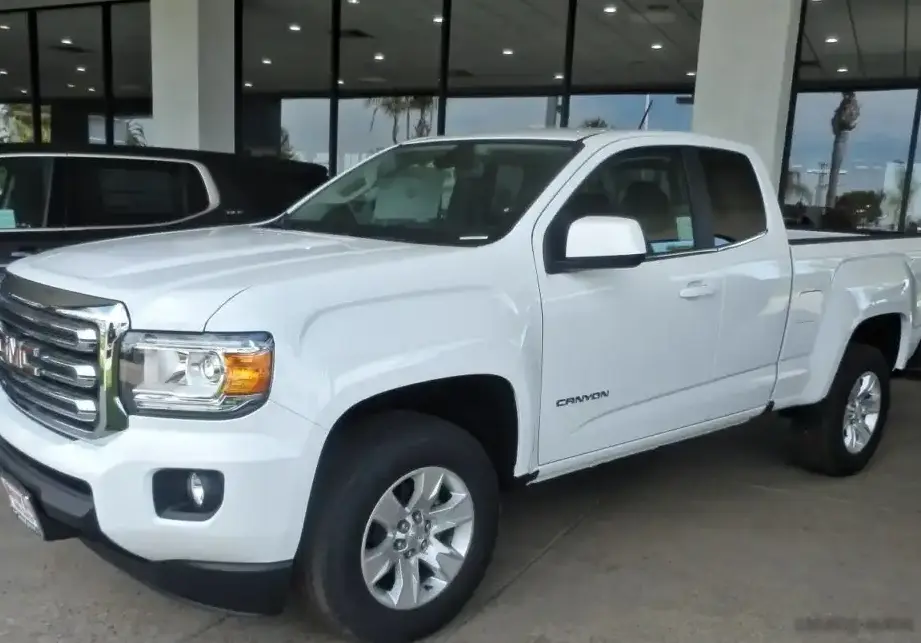
The GMC Canyon II, specifically the Extended Cab Long Box configuration with the 3.6-liter V6 engine producing 308 horsepower and paired with an 8-speed automatic transmission, was a mid-size pickup truck sold in the United States from 2018 to 2020. This variant occupied a significant position in the Canyon lineup, offering a balance between capability, comfort, and fuel efficiency for buyers seeking a versatile truck for both work and personal use. It represented GMC’s entry into the increasingly popular mid-size truck segment, competing with offerings from Toyota, Ford, and Chevrolet (with whom it shared a platform).
Technical Specifications
| Brand | GMC |
| Model | Canyon |
| Generation | Canyon II Extended Cab Long Box |
| Type (Engine) | 3.6 V6 (308 Hp) Automatic |
| Start of production | 2018 |
| End of production | 2020 |
| Powertrain Architecture | Internal Combustion engine |
| Body type | Pick-up |
| Seats | 4 |
| Doors | 2 |
| Fuel consumption (urban) | 13.1 l/100 km (18 US mpg, 21.6 UK mpg, 7.6 km/l) |
| Fuel consumption (extra urban) | 9.4 l/100 km (25 US mpg, 30.1 UK mpg, 10.6 km/l) |
| Fuel Type | Petrol (Gasoline) |
| Power | 308 Hp @ 6800 rpm |
| Power per litre | 86.4 Hp/l |
| Torque | 373 Nm @ 4000 rpm (275.11 lb.-ft. @ 4000 rpm) |
| Engine layout | Front, Longitudinal |
| Engine Model/Code | LGZ |
| Engine displacement | 3564 cm3 (217.49 cu. in.) |
| Number of cylinders | 6 |
| Engine configuration | V-engine |
| Cylinder Bore | 94 mm (3.7 in.) |
| Piston Stroke | 85.6 mm (3.37 in.) |
| Compression ratio | 11.5:1 |
| Number of valves per cylinder | 4 |
| Fuel injection system | Direct injection |
| Engine aspiration | Naturally aspirated engine |
| Valvetrain | DOHC, CVVT |
| Engine oil capacity | 5.7 l (6.02 US qt | 5.02 UK qt) |
| Coolant | 10.6 l (11.2 US qt | 9.33 UK qt) |
| Trunk (boot) space – maximum | 1414 l (49.93 cu. ft.) |
| Fuel tank capacity | 79.5 l (21 US gal | 17.49 UK gal) |
| Permitted trailer load with brakes (12%) | 3175 kg (6999.68 lbs.) |
| Length | 5395 mm (212.4 in.) |
| Width | 1886 mm (74.25 in.) |
| Height | 1788 mm (70.39 in.) |
| Wheelbase | 3258 mm (128.27 in.) |
| Front track | 1586 mm (62.44 in.) |
| Rear (Back) track | 1586 mm (62.44 in.) |
| Ride height (ground clearance) | 213 mm (8.39 in.) |
| Minimum turning circle (turning diameter) | 12.6 m (41.34 ft.) |
| Drivetrain Architecture | Rear wheel drive |
| Drive wheel | Rear wheel drive |
| Number of gears and type of gearbox | 8 gears, automatic transmission Hydra-Matic |
| Front suspension | Independent coil spring |
| Rear suspension | Rigid axle suspension, Leaf spring |
| Front brakes | Disc, 310×27 mm |
| Rear brakes | Disc, 324×18 mm |
| Assisting systems | ABS (Anti-lock braking system) |
| Steering type | Steering rack and pinion |
| Power steering | Electric Steering |
| Tires size | 265/70 R16; 255/65 R17; 265/60 R18 |
| Wheel rims size | 7J x 16; 8J x 17; 8.5J x 18 |
Introduction
The 2018-2020 GMC Canyon II Extended Cab Long Box with the 3.6L V6 and 8-speed automatic transmission represented a significant update to GMC’s mid-size truck offering. Built on the GM Colorado platform (often referred to as the 31XX platform), the Canyon aimed to provide a more refined and premium experience compared to its Chevrolet sibling. The Extended Cab configuration offered a compromise between passenger space and bed length, making it suitable for both daily driving and hauling needs. This particular powertrain combination was positioned as a strong all-rounder, appealing to buyers who wanted a capable truck without the higher cost and complexity of the available Duramax diesel engine.
Powertrain & Engine Architecture
At the heart of this Canyon variant lies the LGZ 3.6-liter V6 engine. This engine is a member of GM’s LFX family, known for its robust design and relatively smooth operation. It features direct fuel injection, a double overhead camshaft (DOHC) valvetrain with variable valve timing (CVVT), and a cast aluminum block with cast iron cylinder liners. The direct injection system optimizes fuel delivery for improved efficiency and power output. The 8-speed Hydra-Matic automatic transmission, designated 8L45, was a key component in maximizing the engine’s potential. This transmission offered close gear ratios for responsive acceleration and efficient cruising. The transmission’s electronic controls allowed for smooth shifting and adaptive learning, adjusting shift points based on driving conditions.
Driving Characteristics
The 308-horsepower V6 and 8-speed automatic combination delivered a respectable driving experience. While not as quick as some of its competitors with turbocharged engines, the Canyon offered ample power for everyday driving and towing. The 8-speed transmission helped keep the engine in its optimal power band, providing good acceleration in most situations. Compared to the available 2.5L four-cylinder engine, the V6 offered significantly more power and torque, making it a better choice for hauling and towing. The automatic transmission, while convenient, did result in a slight performance deficit compared to the available 6-speed manual transmission, which offered more driver control. The rear-wheel-drive configuration provided a traditional truck feel, while available four-wheel-drive systems enhanced traction in inclement weather or off-road conditions.
Equipment & Trim Levels
The Canyon II Extended Cab Long Box 3.6L Automatic was available in several trim levels, including SLE and SLT. The SLE trim typically included standard features such as air conditioning, power windows and locks, a basic infotainment system with a touchscreen display, and cloth upholstery. The SLT trim added features like leather upholstery, heated front seats, a more advanced infotainment system with navigation, and additional chrome exterior trim. Optional extras included a trailering package, a premium audio system, and various safety features like lane departure warning and forward collision alert.
Chassis & Braking
The Canyon II utilized a body-on-frame construction, providing a robust and durable platform. The front suspension featured independent coil springs, while the rear suspension employed a traditional leaf spring setup. This configuration balanced ride comfort with load-carrying capacity. Braking duties were handled by disc brakes on all four wheels, with the front discs measuring 310x27mm and the rear discs measuring 324x18mm. An anti-lock braking system (ABS) was standard, enhancing safety and control during emergency braking situations. The rear leaf spring suspension was tuned to handle the weight of typical payloads and towing loads.
Market Reception & Comparison
Critics generally praised the Canyon II for its comfortable ride, refined interior, and capable powertrain. The 3.6L V6 and 8-speed automatic combination was considered a good balance between performance and fuel efficiency. However, some reviewers noted that the Canyon’s fuel economy was not class-leading, and the interior, while well-appointed, lacked the sophistication of some competitors. Compared to the diesel-powered Canyon, the V6 offered lower fuel economy but a lower purchase price and simpler maintenance requirements. Against competitors like the Toyota Tacoma and Ford Ranger, the Canyon offered a more comfortable ride and a more spacious interior, but the Tacoma often held an edge in terms of resale value and off-road capability.
Legacy
The LGZ 3.6L V6 engine and 8L45 transmission have proven to be relatively reliable powertrains. While some owners have reported minor issues with the fuel system or transmission, these are generally infrequent. On the used car market, the 2018-2020 GMC Canyon II Extended Cab Long Box 3.6L Automatic remains a popular choice for buyers seeking a versatile and capable mid-size truck. Its combination of comfort, capability, and affordability makes it a compelling option in a competitive segment. Proper maintenance, including regular oil changes and transmission fluid services, is crucial for ensuring the long-term reliability of this powertrain.