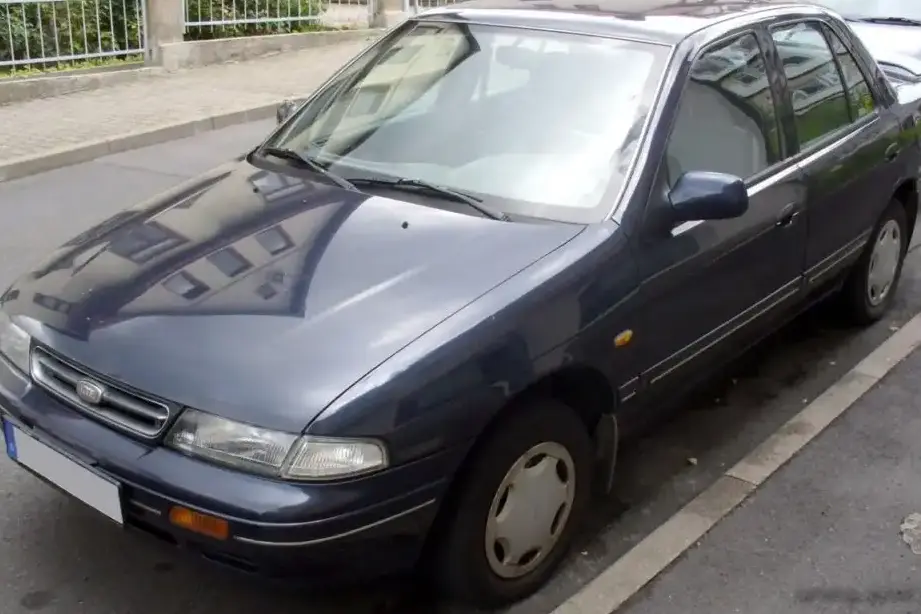
The Kia Sephia (FA) 1.6i with an 80 horsepower engine and automatic transmission represents a significant entry for Kia into the competitive compact sedan market of the mid-1990s. Produced between 1995 and 1998, this variant was positioned as an affordable and practical transportation option, primarily aimed at buyers seeking economy and ease of use. It was part of the first generation Sephia (FA) model range, built on Kia’s own platform, marking a step forward in the company’s independent design and manufacturing capabilities. This particular configuration – the 1.6L engine paired with a four-speed automatic – served as a base trim level, offering a balance between cost and convenience.
Technical Specifications
| Brand | Kia |
| Model | Sephia |
| Generation | Sephia (FA) |
| Type (Engine) | 1.6i (80 Hp) Automatic |
| Start of production | 1995 |
| End of production | 1998 |
| Powertrain Architecture | Internal Combustion engine |
| Body type | Sedan |
| Seats | 5 |
| Doors | 4 |
| Fuel consumption (combined) | 7.3 l/100 km |
| Fuel consumption (US mpg) | 32.2 |
| Fuel consumption (UK mpg) | 38.7 |
| Fuel consumption (km/l) | 13.7 |
| Fuel Type | Petrol (Gasoline) |
| Acceleration 0 – 100 km/h | 11.2 sec |
| Acceleration 0 – 62 mph | 11.2 sec |
| Acceleration 0 – 60 mph | 10.6 sec |
| Maximum speed | 172 km/h (106.88 mph) |
| Weight-to-power ratio | 13 kg/Hp |
| Weight-to-torque ratio | 8.7 kg/Nm |
| Power | 80 Hp @ 5000 rpm |
| Power per litre | 50.1 Hp/l |
| Torque | 120 Nm @ 3500 rpm (88.51 lb.-ft. @ 3500 rpm) |
| Engine layout | Front, Transverse |
| Engine Model/Code | B6E |
| Engine displacement | 1598 cm3 (97.52 cu. in.) |
| Number of cylinders | 4 |
| Engine configuration | Inline |
| Cylinder Bore | 78 mm (3.07 in.) |
| Piston Stroke | 83.6 mm (3.29 in.) |
| Compression ratio | 9.3:1 |
| Number of valves per cylinder | 2 |
| Fuel injection system | Multi-port manifold injection |
| Engine aspiration | Naturally aspirated |
| Valvetrain | OHC |
| Engine oil capacity | 3.2 l (3.38 US qt | 2.82 UK qt) |
| Coolant capacity | 6 l (6.34 US qt | 5.28 UK qt) |
| Kerb Weight | 1038 kg (2288.4 lbs.) |
| Max. weight | 1520 kg (3351.03 lbs.) |
| Max load | 482 kg (1062.63 lbs.) |
| Trunk (boot) space – minimum | 370 l (13.07 cu. ft.) |
| Trunk (boot) space – maximum | 692 l (24.44 cu. ft.) |
| Fuel tank capacity | 50 l (13.21 US gal | 11 UK gal) |
| Length | 4280 mm (168.5 in.) |
| Width | 1692 mm (66.61 in.) |
| Height | 1390 mm (54.72 in.) |
| Wheelbase | 2500 mm (98.43 in.) |
| Front track | 1440 mm (56.69 in.) |
| Rear track | 1435 mm (56.5 in.) |
| Drivetrain | Front wheel drive |
| Number of gears | 4 |
| Gearbox type | Automatic transmission |
| Front suspension | Wishbone |
| Rear suspension | Spring Strut |
| Front brakes | Ventilated discs |
| Rear brakes | Drum |
| Assisting systems | ABS (Anti-lock braking system) |
| Steering type | Steering rack and pinion |
| Power steering | Hydraulic |
| Tires size | 175/70 R13 |
| Wheel rims size | 13 |
INTRODUCTION
The Kia Sephia, launched in 1994, was a pivotal model for the South Korean automaker. The FA series, produced from 1995-1998, represented Kia’s ambition to establish itself as a serious player in the global automotive market. The 1.6i Automatic variant was a key component of this strategy, offering a comfortable and accessible option for buyers prioritizing practicality over outright performance. It was designed to compete with established compact sedans like the Honda Civic, Toyota Corolla, and Nissan Sentra, though typically at a lower price point. The Sephia aimed to provide a good value proposition, emphasizing affordability and a reasonable level of standard equipment.
Powertrain & Engine Architecture
At the heart of the Sephia 1.6i Automatic lies the B6E engine, a 1.6-liter inline-four cylinder gasoline engine. This engine utilizes a single overhead camshaft (OHC) valvetrain with two valves per cylinder. Fuel delivery is managed by a multi-port fuel injection system, providing a balance between efficiency and responsiveness. The engine produces 80 horsepower at 5000 rpm and 120 Nm (88.51 lb-ft) of torque at 3500 rpm. The four-speed automatic transmission was sourced from Mitsubishi, and was chosen for its simplicity and reliability. While not offering the most advanced gear ratios, it provided smooth and convenient shifting for everyday driving. The transmission’s programming prioritized fuel economy and comfortable cruising over sporty acceleration.
Driving Characteristics
The Sephia 1.6i Automatic’s driving experience is best described as comfortable and predictable. Acceleration is modest, with a 0-60 mph time of around 10.6 seconds. The automatic transmission contributes to a relaxed driving style, but can feel somewhat sluggish when attempting quicker maneuvers or overtaking. The gear ratios are spaced to favor fuel efficiency, meaning the engine often operates at lower rpm during normal cruising. Compared to the manual transmission version, the automatic sacrifices some responsiveness, but gains in ease of use. Higher trim levels with larger engines (though not offered in the US market) provided significantly more power, but at a higher cost. The suspension is tuned for comfort, absorbing bumps and road imperfections reasonably well, though it doesn’t offer particularly engaging handling.
Equipment & Trim Levels
The 1.6i Automatic trim level typically included basic amenities such as air conditioning, power steering, and an AM/FM radio. Interior upholstery was generally cloth, with a simple and functional dashboard layout. Optional extras, depending on the market and dealer, could include power windows, power door locks, and a cassette player. The Sephia aimed to provide essential features without excessive luxury, keeping the price competitive. Safety features were relatively basic for the time, typically including only a driver’s airbag and ABS (Anti-lock Braking System) on some models.
Chassis & Braking
The Sephia FA utilizes a front-wheel-drive layout with a wishbone front suspension and a spring strut rear suspension. The front brakes are ventilated discs, providing adequate stopping power, while the rear brakes are drums. The suspension setup prioritizes ride comfort over sporty handling. The steering is rack and pinion with hydraulic power assistance, offering reasonable steering feel. Tire size is typically 175/70 R13, mounted on 13-inch steel wheels. The chassis is relatively lightweight, contributing to the car’s fuel efficiency, but also limiting its handling capabilities.
Market Reception & Comparison
The Kia Sephia 1.6i Automatic was generally well-received as an affordable and practical compact sedan. Critics praised its value for money, but noted its lack of refinement compared to established Japanese competitors. Fuel economy was a strong point, averaging around 32.2 US mpg in combined driving. Reliability was generally considered acceptable, though not exceptional. Compared to other Sephia trims, the 1.6i Automatic offered the convenience of an automatic transmission at the lowest price point, making it attractive to buyers prioritizing ease of use over performance. However, the manual transmission version offered slightly better fuel economy and acceleration.
Legacy
The Kia Sephia played a crucial role in establishing Kia’s presence in the North American and European markets. While not known for exceptional performance or groundbreaking technology, the 1.6i Automatic variant proved to be a reliable and affordable transportation option for many buyers. Today, these vehicles are relatively rare and often found in well-maintained condition. The B6E engine is generally considered durable, but age and mileage can lead to issues such as oil leaks and worn engine mounts. Parts availability can be a challenge, but many components are still available through aftermarket suppliers. The Sephia 1.6i Automatic remains a testament to Kia’s early efforts to build a reputation for value and reliability.