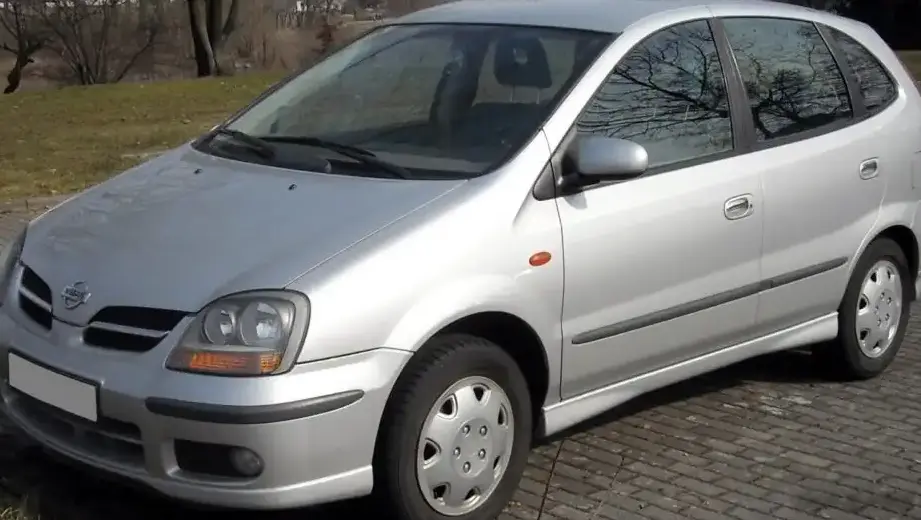
The Nissan Almera Tino 1.8 (114 hp) CVT, produced between 2000 and 2003, represents a specific configuration within the broader Almera Tino (also marketed as the Tino in some regions) compact minivan range. Positioned as a mid-range offering, this variant aimed to balance practicality, fuel efficiency, and a more relaxed driving experience through the use of a Continuously Variable Transmission (CVT). The Almera Tino, built on the Nissan S platform, was primarily targeted at the European market, offering a spacious and versatile alternative to traditional hatchback or small estate car options. It was never officially sold in the North American market.
Technical Specifications
| Brand | Nissan |
| Model | Almera |
| Generation | Almera Tino |
| Type (Engine) | 1.8 (114 Hp) CVT |
| Start of production | 2000 year |
| End of production | 2003 year |
| Powertrain Architecture | Internal Combustion engine |
| Body type | Minivan |
| Seats | 5 |
| Doors | 5 |
| Fuel Type | Petrol (Gasoline) |
| Power | 114 Hp @ 5600 rpm |
| Power per litre | 64.4 Hp/l |
| Torque | 158 Nm @ 2800 rpm |
| Torque (lb.-ft.) | 116.53 lb.-ft. @ 2800 rpm |
| Engine layout | Front, Transverse |
| Engine Model/Code | QG18DE |
| Engine displacement | 1769 cm3 |
| Engine displacement (cu. in.) | 107.95 cu. in. |
| Number of cylinders | 4 |
| Engine configuration | Inline |
| Cylinder Bore | 80 mm |
| Cylinder Bore (in.) | 3.15 in. |
| Piston Stroke | 88 mm |
| Piston Stroke (in.) | 3.46 in. |
| Compression ratio | 9.5:1 |
| Number of valves per cylinder | 4 |
| Fuel injection system | Multi-port manifold injection |
| Engine aspiration | Naturally aspirated engine |
| Valvetrain | DOHC |
| Engine oil capacity | 2.9 l |
| Engine oil capacity (US qt) | 3.06 US qt |
| Engine oil capacity (UK qt) | 2.55 UK qt |
| Coolant capacity | 6.7 l |
| Coolant capacity (US qt) | 7.08 US qt |
| Coolant capacity (UK qt) | 5.9 UK qt |
| Trunk (boot) space – minimum | 440 l |
| Trunk (boot) space – minimum (cu. ft.) | 15.54 cu. ft. |
| Trunk (boot) space – maximum | 1950 l |
| Trunk (boot) space – maximum (cu. ft.) | 68.86 cu. ft. |
| Fuel tank capacity | 60 l |
| Fuel tank capacity (US gal) | 15.85 US gal |
| Fuel tank capacity (UK gal) | 13.2 UK gal |
| Length | 4264 mm |
| Length (in.) | 167.87 in. |
| Width | 1758 mm |
| Width (in.) | 69.21 in. |
| Height | 1608 mm |
| Height (in.) | 63.31 in. |
| Wheelbase | 2535 mm |
| Wheelbase (in.) | 99.8 in. |
| Front track | 1535 mm |
| Front track (in.) | 60.43 in. |
| Rear (Back) track | 1510 mm |
| Rear (Back) track (in.) | 59.45 in. |
| Ride height (ground clearance) | 150 mm |
| Ride height (ground clearance) (in.) | 5.91 in. |
| Drivetrain Architecture | The Internal combustion engine (ICE) drives the front wheels of the vehicle. |
| Drive wheel | Front wheel drive |
| Number of gears and type of gearbox | 1 gears, automatic transmission CVT |
| Front brakes | Ventilated discs |
| Rear brakes | Disc |
Powertrain & Engine Architecture
The heart of the Almera Tino 1.8 CVT is the QG18DE engine, a 1.8-liter inline-four cylinder gasoline engine. This engine is part of Nissan’s QG engine family, known for its relatively simple design and decent reliability. The QG18DE features a dual overhead camshaft (DOHC) valvetrain with four valves per cylinder, and utilizes multi-port fuel injection. The engine produces 114 horsepower at 5600 rpm and 158 Nm (116.53 lb-ft) of torque at 2800 rpm. The key differentiating factor of this variant is the use of a Continuously Variable Transmission (CVT). Nissan’s early CVTs, while offering smooth acceleration, were not as robust as later iterations. This CVT aimed to provide a more fuel-efficient and comfortable driving experience compared to the available five-speed manual transmission in other Almera Tino trims.
Driving Characteristics
The 1.8L CVT combination in the Almera Tino delivers a noticeably different driving experience compared to the manual transmission or the higher-output engine options. Acceleration is smooth and linear, thanks to the CVT’s ability to keep the engine within its optimal power band. However, it lacks the responsiveness and direct feel of a traditional automatic or manual gearbox. The CVT tends to “rubber band” under hard acceleration, where engine revs climb but forward progress feels delayed. In real-world driving, the 114 hp engine provides adequate power for everyday commuting and highway cruising, but it’s not particularly sporty. The CVT’s gear ratios are optimized for fuel economy, resulting in a more relaxed driving style. Compared to the manual version, the CVT sacrifices some performance for increased convenience.
Equipment & Trim Levels
The 1.8 CVT trim of the Almera Tino typically included features such as air conditioning, power windows, central locking, and an integrated audio system. Interior upholstery was generally cloth, with a relatively simple dashboard layout. Optional extras included alloy wheels, a sunroof, and upgraded audio systems. Safety features were fairly standard for the time, including dual front airbags and ABS brakes. The specific trim level within the Almera Tino range varied depending on the market, but the 1.8 CVT generally represented a mid-range offering, bridging the gap between the base models and the more luxurious trims.
Chassis & Braking
The Almera Tino utilizes a front-wheel-drive layout with independent MacPherson strut suspension in the front and a torsion beam suspension in the rear. The front brakes are ventilated discs, providing adequate stopping power, while the rear brakes are solid discs. The suspension setup is tuned for comfort rather than sporty handling, resulting in a relatively soft ride quality. Stabilizer bars are present on both the front and rear axles to reduce body roll during cornering. The ride height is modest, providing reasonable ground clearance for navigating typical road conditions.
Market Reception & Comparison
The Almera Tino 1.8 CVT received mixed reviews from automotive critics. While the spacious interior and comfortable ride were praised, the CVT transmission was often criticized for its lack of responsiveness and “rubber band” effect. Fuel economy was generally considered good for its class. Compared to other compact minivans available in Europe at the time, such as the Renault Scenic and Citroën Xsara Picasso, the Almera Tino offered a competitive level of practicality and value. However, it didn’t quite match the refinement or driving dynamics of some of its rivals. The 1.8L engine offered a good balance between performance and fuel efficiency, but the manual transmission versions were often preferred by drivers seeking a more engaging driving experience.
Legacy
The Nissan Almera Tino, and specifically the 1.8 CVT variant, has become a relatively affordable and practical used car option. The QG18DE engine is generally considered reliable, although regular maintenance is crucial. The early Nissan CVTs, however, can be prone to issues if not properly maintained. Finding replacement parts can sometimes be challenging, as the Almera Tino is no longer in production. Despite its age, the Almera Tino remains a popular choice for families seeking a spacious and versatile vehicle at a reasonable price point. Its simple mechanical design and relatively low running costs contribute to its enduring appeal in the used car market.