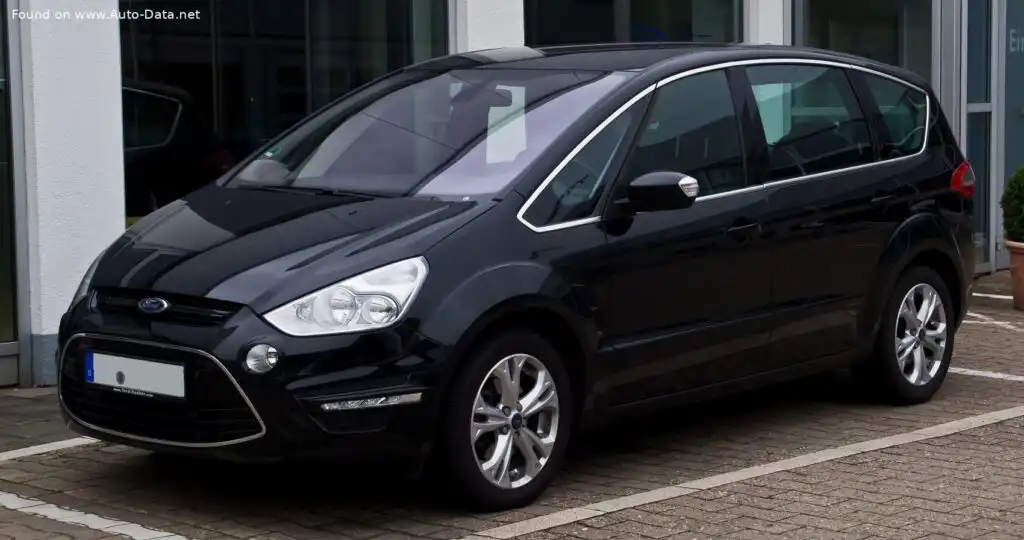
The Ford S-MAX 2.2 TDCi, producing 175 horsepower, was a significant variant within the first generation (2006-2014) of Ford’s multi-purpose vehicle (MPV). Introduced in 2006, the S-MAX aimed to provide a more dynamic and stylish alternative to traditional people carriers, appealing to families who desired both practicality and a degree of driving enjoyment. The 2.2 TDCi 175 hp model occupied a middle ground in the S-MAX lineup, offering a balance between performance, fuel economy, and price. It was positioned above the lower-powered 1.8 TDCi models and below the range-topping 2.0 TDCi variants.
Technical Specifications
| Brand | Ford |
| Model | S-MAX |
| Generation | S-MAX (First Generation) |
| Type (Engine) | 2.2 TDCi (175 Hp) |
| Start of production | 2006 |
| End of production | 2010 |
| Powertrain Architecture | Internal Combustion Engine |
| Body type | Minivan |
| Seats | 7 |
| Doors | 5 |
| Fuel consumption (urban) | 9 l/100 km (26.1 US mpg, 31.4 UK mpg, 11.1 km/l) |
| Fuel consumption (extra urban) | 5.2 l/100 km (45.2 US mpg, 54.3 UK mpg, 19.2 km/l) |
| Fuel consumption (combined) | 6.6 l/100 km (35.6 US mpg, 42.8 UK mpg, 15.2 km/l) |
| Fuel Type | Diesel |
| Acceleration 0 – 100 km/h | 9.4 sec |
| Acceleration 0 – 62 mph | 9.4 sec |
| Acceleration 0 – 60 mph | 8.9 sec |
| Maximum speed | 212 km/h (131.73 mph) |
| Emission standard | Euro 4 |
| Weight-to-power ratio | 9.9 kg/Hp, 100.8 Hp/tonne |
| Weight-to-torque ratio | 4.3 kg/Nm, 230.4 Nm/tonne |
| Power | 175 Hp @ 4000 rpm |
| Power per litre | 80.3 Hp/l |
| Torque | 400 Nm @ 1750 rpm (295.02 lb.-ft. @ 1750 rpm) |
| Engine layout | Front, Transverse |
| Engine Model/Code | Q4WA |
| Engine displacement | 2179 cm3 (132.97 cu. in.) |
| Number of cylinders | 4 |
| Engine configuration | Inline |
| Cylinder Bore | 86 mm (3.39 in.) |
| Compression ratio | 17.9:1 |
| Number of valves per cylinder | 4 |
| Fuel injection system | Diesel Commonrail |
| Engine aspiration | Turbocharger, Intercooler |
| Engine oil capacity | 6 l (6.34 US qt | 5.28 UK qt) |
| Coolant capacity | 8.4 l (8.88 US qt | 7.39 UK qt) |
| Kerb Weight | 1736 kg (3827.22 lbs.) |
| Max. weight | 2505 kg (5522.58 lbs.) |
| Max load | 769 kg (1695.35 lbs.) |
| Trunk (boot) space – minimum | 854 l (30.16 cu. ft.) |
| Trunk (boot) space – maximum | 2100 l (74.16 cu. ft.) |
| Fuel tank capacity | 70 l (18.49 US gal | 15.4 UK gal) |
| Length | 4768 mm (187.72 in.) |
| Width | 1884 mm (74.17 in.) |
| Height | 1658 mm (65.28 in.) |
| Wheelbase | 2850 mm (112.2 in.) |
| Front track | 1589 mm (62.56 in.) |
| Rear track | 1605 mm (63.19 in.) |
| Minimum turning circle | 11.6 m (38.06 ft.) |
| Drivetrain Architecture | Front Wheel Drive |
| Drive wheel | Front wheel drive |
| Number of gears | 6 gears, manual transmission |
| Front suspension | Spring Strut |
| Rear suspension | Transverse stabilizer |
| Front brakes | Ventilated discs |
| Rear brakes | Disc |
| Assisting systems | ABS (Anti-lock braking system) |
| Steering type | Steering rack and pinion |
| Tires size | 215/60 R16 |
| Wheel rims size | 6.5J x 16 5×10⁸ |
INTRODUCTION
The Ford S-MAX 2.2 TDCi 175 hp, produced between 2006 and 2010, was a key component of Ford of Europe’s strategy to redefine the MPV segment. Built on the Ford C1 platform (also known as the 1HX0/A3 platform, shared with the Ford Galaxy and, in some respects, the Volvo S80), the S-MAX distinguished itself with its more car-like handling and contemporary styling compared to boxier, more utilitarian MPVs. The 2.2-liter TDCi engine, a mainstay of Ford’s diesel lineup at the time, provided a good compromise between performance and fuel efficiency, making this variant a popular choice for families needing space and practicality without sacrificing driving dynamics.
Powertrain & Engine Architecture
The heart of the S-MAX 2.2 TDCi 175 was the Q4WA engine code, a 2.2-liter inline-four cylinder diesel engine. This engine utilized a common rail direct injection system, delivering fuel at extremely high pressure for improved combustion efficiency and reduced emissions. The engine featured a single turbocharger with an intercooler, boosting power output to 175 horsepower at 4000 rpm and a substantial 400 Nm (295 lb-ft) of torque at just 1750 rpm. The engine’s valvetrain employed four valves per cylinder, contributing to its responsive nature. The 2.2 TDCi was paired with a six-speed manual transmission as standard, providing a good spread of gears for both fuel economy and acceleration. While an automatic transmission was available on some S-MAX models, it wasn’t commonly paired with this specific engine output.
Driving Characteristics
The S-MAX 2.2 TDCi 175 hp offered a surprisingly engaging driving experience for an MPV. The 400 Nm of torque available from low engine speeds provided strong acceleration in everyday driving situations, making overtaking and merging onto highways effortless. The six-speed manual transmission allowed drivers to keep the engine in its optimal power band. While not a sports car, the S-MAX handled reasonably well, with decent body control and responsive steering. Compared to the lower-powered 1.8 TDCi versions, the 2.2 TDCi offered a noticeable performance improvement, reducing the 0-60 mph time to around 9.4 seconds. However, it didn’t quite match the outright pace of the 2.0 TDCi models, which offered higher horsepower figures. The gear ratios were well-chosen, providing a balance between acceleration and fuel efficiency.
Equipment & Trim Levels
The S-MAX 2.2 TDCi 175 hp was typically offered in mid-range trim levels, such as Zetec or Titanium. Standard equipment generally included air conditioning, alloy wheels, front and rear electric windows, a CD stereo, and ABS brakes. Higher trim levels added features like automatic climate control, rear parking sensors, cruise control, and upgraded interior trim. Interior upholstery was typically cloth, although leather options were available. The dashboard layout was functional and modern for its time, with a clear instrument cluster and logically arranged controls. Optional extras included a panoramic sunroof, satellite navigation, and a premium sound system.
Chassis & Braking
The S-MAX featured a MacPherson strut front suspension and a multi-link rear suspension, providing a comfortable ride and good handling characteristics. The suspension was tuned to balance ride comfort with body control, making it suitable for both long journeys and everyday driving. Braking duties were handled by ventilated discs on the front wheels and solid discs on the rear. ABS (Anti-lock Braking System) was standard, enhancing safety and stability during emergency braking. The S-MAX’s chassis was relatively lightweight for its size, contributing to its agile handling.
Market Reception & Comparison
The Ford S-MAX 2.2 TDCi 175 hp was generally well-received by automotive critics. It was praised for its stylish design, spacious interior, and engaging driving dynamics. The 2.2 TDCi engine was considered a good all-rounder, offering a balance between performance and fuel economy. Compared to the 1.8 TDCi models, the 2.2 TDCi provided a significant performance boost, making it a more suitable choice for drivers who frequently carried passengers or luggage. However, the 2.0 TDCi variants offered even more power, albeit at a higher price point. Fuel economy was competitive for its class, averaging around 35.6 US mpg on the combined cycle. Reliability was generally good, although some owners reported issues with the diesel particulate filter (DPF) and the dual-mass flywheel.
Legacy
The Ford S-MAX 2.2 TDCi 175 hp remains a popular choice in the used car market today. Its combination of practicality, style, and driving enjoyment has ensured its enduring appeal. The 2.2 TDCi engine, while not the most technologically advanced diesel engine available, has proven to be relatively durable and reliable when properly maintained. Common maintenance items include regular oil changes, filter replacements, and DPF cleaning. The S-MAX’s spacious interior and versatile seating configuration continue to make it a practical choice for families. While newer MPVs offer more advanced features and technologies, the first-generation S-MAX 2.2 TDCi 175 hp represents a significant step forward in the evolution of the MPV segment.