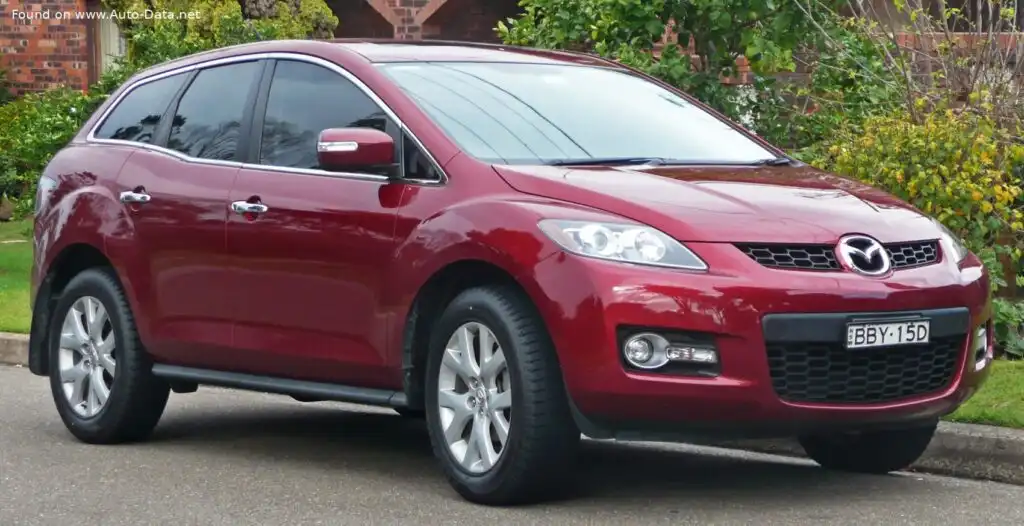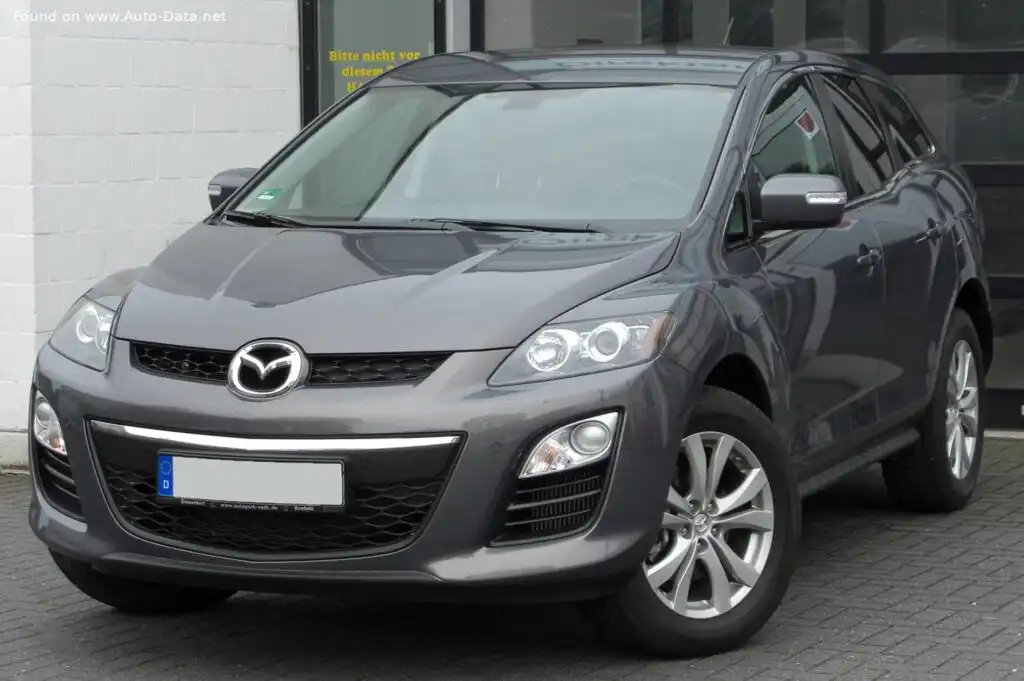
The Mazda CX-7, particularly the facelifted version introduced in 2009, represented Mazda’s entry into the burgeoning crossover SUV market. Produced from 2009 to 2012, this generation aimed to blend sporty handling with family-friendly practicality. The 2.3 DISI Turbo AWD Automatic variant occupied the upper echelon of the CX-7 lineup, offering a significant performance boost over the base models and targeting buyers who desired a more engaging driving experience without sacrificing the convenience of all-wheel drive and an automatic transmission. It was positioned as a premium offering, competing with vehicles like the Honda CR-V and Toyota RAV4, but with a more driver-focused character.
Technical Specifications
| Brand | Mazda |
| Model | CX-7 |
| Generation | CX-7 (facelift 2009) |
| Type (Engine) | 2.3 DISI Turbo (238 Hp) AWD Automatic |
| Start of production | 2009 |
| End of production | 2012 |
| Powertrain Architecture | Internal Combustion engine |
| Body type | SUV, Crossover |
| Seats | 5 |
| Doors | 5 |
| Fuel consumption (urban) | 15.3 l/100 km (18.5 UK mpg, 6.5 km/l) |
| Fuel consumption (extra urban) | 9.3 l/100 km (25.3 US mpg, 30.4 UK mpg, 10.8 km/l) |
| Fuel consumption (combined) | 11.5 l/100 km (20.5 US mpg, 24.6 UK mpg, 8.7 km/l) |
| Fuel Type | Petrol (Gasoline) |
| Acceleration 0 – 100 km/h | 8.3 sec |
| Acceleration 0 – 62 mph | 8.3 sec |
| Acceleration 0 – 60 mph | 7.9 sec |
| Maximum speed | 181 km/h (112.47 mph) |
| Emission standard | Euro 4 |
| Weight-to-power ratio | 7.4 kg/Hp, 134.3 Hp/tonne |
| Weight-to-torque ratio | 5.1 kg/Nm, 197.5 Nm/tonne |
| Power | 238 Hp @ 5000 rpm |
| Power per litre | 105.3 Hp/l |
| Torque | 350 Nm @ 2500 rpm (258.15 lb.-ft. @ 2500 rpm) |
| Engine layout | Front, Transverse |
| Engine Model/Code | L3-VDT |
| Engine displacement | 2261 cm3 (137.97 cu. in.) |
| Number of cylinders | 4 |
| Engine configuration | Inline |
| Cylinder Bore | 87.5 mm (3.44 in.) |
| Piston Stroke | 94 mm (3.7 in.) |
| Compression ratio | 9.5:1 |
| Number of valves per cylinder | 4 |
| Fuel injection system | Direct injection |
| Engine aspiration | Turbocharger, Intercooler |
| Valvetrain | DOHC |
| Engine oil capacity | 5.7 l (6.02 US qt | 5.02 UK qt) |
| Coolant | 9 l (9.51 US qt | 7.92 UK qt) |
| Kerb Weight | 1772 kg (3906.59 lbs.) |
| Trunk (boot) space – minimum | 400 l (14.13 cu. ft.) |
| Fuel tank capacity | 69 l (18.23 US gal | 15.18 UK gal) |
| Permitted trailer load with brakes (12%) | 1600 kg (3527.4 lbs.) |
| Permitted trailer load without brakes | 750 kg (1653.47 lbs.) |
| Length | 4693 mm (184.76 in.) |
| Width | 1872 mm (73.7 in.) |
| Height | 1645 mm (64.76 in.) |
| Wheelbase | 2750 mm (108.27 in.) |
| Front track | 1617 mm (63.66 in.) |
| Rear (Back) track | 1612 mm (63.46 in.) |
| Ride height (ground clearance) | 170 mm (6.69 in.) |
| Minimum turning circle (turning diameter) | 11.4 m (37.4 ft.) |
| Drivetrain Architecture | All wheel drive (4×4) |
| Number of gears and type of gearbox | 6 gears, automatic transmission |
| Front suspension | Independent, type McPherson with coil spring and anti-roll bar |
| Rear suspension | Independent multi-link spring suspension with stabilizer |
| Front brakes | Ventilated discs, 296 mm |
| Rear brakes | Ventilated discs, 302 mm |
| Assisting systems | ABS (Anti-lock braking system) |
| Steering type | Steering rack and pinion |
| Power steering | Electric Steering |
| Tires size | 235/55 R19 |
| Wheel rims size | 7.5J x 19 |
Powertrain & Engine Architecture
The heart of the 2009-2012 Mazda CX-7 2.3 DISI Turbo was the L3-VDT engine, a 2.3-liter turbocharged inline-four cylinder. “DISI” stands for Direct Injection Spark Ignition, highlighting the engine’s key technology. This direct injection system, combined with a twin-scroll turbocharger and intercooler, allowed for both increased power output and improved fuel efficiency. The engine produced 238 horsepower at 5000 rpm and 350 Nm (258 lb-ft) of torque at 2500 rpm. The engine featured a double overhead camshaft (DOHC) valvetrain with four valves per cylinder. The automatic transmission was a six-speed unit, designed to handle the engine’s torque output and provide smooth shifts. This transmission was specifically tuned for the turbocharged engine, with gear ratios optimized for both acceleration and highway cruising.
Driving Characteristics
The 2.3 DISI Turbo AWD Automatic CX-7 offered a noticeably more spirited driving experience than the base 2.5-liter naturally aspirated models. The turbocharger provided a surge of power in the mid-range, making overtaking and merging onto highways effortless. While not a sports car, the CX-7 handled surprisingly well for its size, thanks to its well-tuned suspension and all-wheel-drive system. The six-speed automatic transmission generally shifted smoothly, although some reviewers noted a slight hesitation during kickdown. Compared to the manual transmission versions, the automatic offered greater convenience, but at the expense of some driver engagement. The automatic’s gear ratios were geared towards providing a balance between acceleration and fuel economy, making it a suitable choice for daily commuting and long road trips.
Equipment & Trim Levels
The 2.3 DISI Turbo AWD Automatic trim typically came well-equipped. Standard features included leather upholstery, heated front seats, a premium sound system (often Bose), automatic climate control, and power-adjustable driver’s seat. Exterior features often included alloy wheels, fog lights, and a power liftgate. Optional extras included a navigation system, sunroof, and advanced safety features like blind-spot monitoring. The interior design was generally considered modern and functional, with a focus on ergonomics and ease of use. The dashboard layout was straightforward, with clearly labeled controls and a user-friendly infotainment system.
Chassis & Braking
The CX-7’s chassis featured an independent suspension setup at all four corners. The front suspension utilized a McPherson strut design, while the rear employed a multi-link system. This setup provided a comfortable ride while maintaining good handling characteristics. The braking system consisted of ventilated discs on all four wheels, providing ample stopping power. The 2.3 DISI Turbo models often featured larger brake rotors compared to the base models to cope with the increased weight and performance. An anti-lock braking system (ABS) was standard, enhancing safety during emergency braking situations.
Market Reception & Comparison
The 2009-2012 Mazda CX-7 2.3 DISI Turbo AWD Automatic received generally positive reviews from automotive critics. It was praised for its sporty handling, powerful engine, and well-equipped interior. However, some reviewers criticized its fuel economy, which was lower than some of its competitors. Compared to the base 2.5-liter models, the 2.3 DISI Turbo offered a significant performance upgrade, but came at a higher price point. The 2.3 DISI Turbo was also more expensive to maintain due to the complexity of the turbocharged engine and direct injection system. Reliability was generally considered good, but some owners reported issues with the turbocharger and fuel injectors.
Legacy
The Mazda CX-7 2.3 DISI Turbo AWD Automatic, while discontinued in 2012, remains a popular choice in the used car market. Its combination of performance, practicality, and features continues to appeal to buyers looking for a sporty and capable crossover SUV. The L3-VDT engine, while requiring diligent maintenance, is generally considered a robust and reliable unit when properly cared for. However, potential buyers should be aware of the potential for turbocharger and fuel injector issues. The CX-7’s legacy lies in its ability to offer a more engaging driving experience than many of its competitors, establishing Mazda as a brand that prioritizes driving dynamics even in the crossover segment.