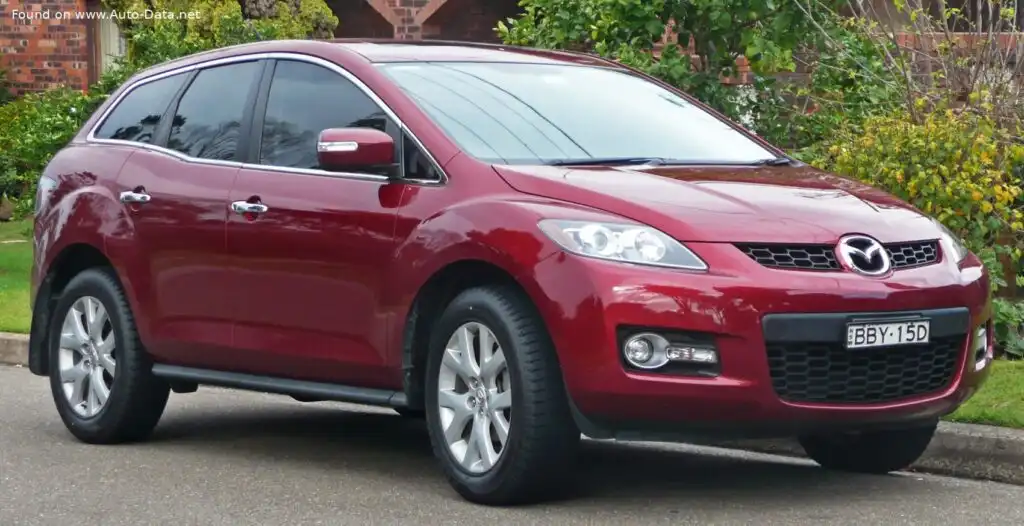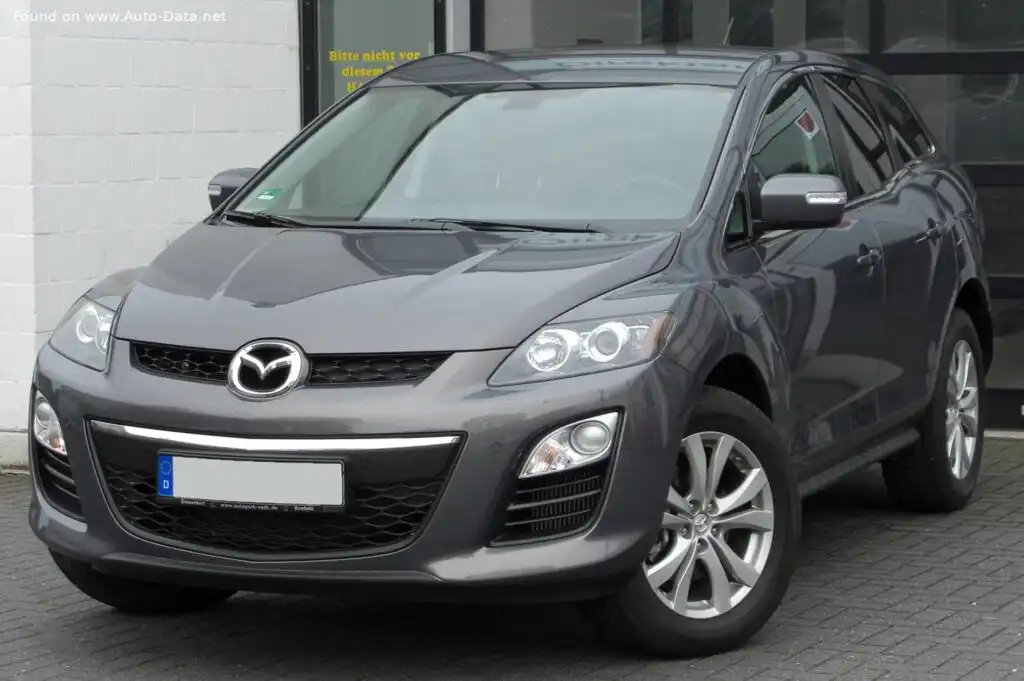
The Mazda CX-7, particularly the facelifted version produced from 2009 to 2012, represented Mazda’s entry into the burgeoning crossover SUV market. This iteration, equipped with the 2.3-liter DISI Turbo engine paired with an automatic transmission and all-wheel drive, aimed to deliver a more premium and performance-oriented experience compared to base models. Positioned as a mid-to-upper trim level, it offered a balance of sporty handling, respectable power, and a relatively luxurious interior for its time. The CX-7 competed directly with vehicles like the Honda CR-V, Toyota RAV4, and Nissan Murano, but distinguished itself with a more driver-focused approach.
Technical Specifications
| Brand | Mazda |
| Model | CX-7 |
| Generation | CX-7 (facelift 2009) |
| Type (Engine) | 2.3 DISI Turbo (244 Hp) AWD Automatic |
| Start of production | 2009 |
| End of production | 2012 |
| Powertrain Architecture | Internal Combustion engine |
| Body type | SUV, Crossover |
| Seats | 5 |
| Doors | 5 |
| Fuel consumption (economy) – urban (EPA) | 13.8 l/100 km (17 US mpg, 20.5 UK mpg) |
| Fuel consumption (economy) – extra urban (EPA) | 10.2 l/100 km (23.1 US mpg, 27.7 UK mpg) |
| Fuel Type | Petrol (Gasoline) |
| Weight-to-power ratio | 7.4 kg/Hp, 134.4 Hp/tonne |
| Weight-to-torque ratio | 5.2 kg/Nm, 192.8 Nm/tonne |
| Power | 244 Hp @ 5000 rpm |
| Power per litre | 107.9 Hp/l |
| Torque | 350 Nm @ 2500 rpm (258.15 lb.-ft. @ 2500 rpm) |
| Maximum engine speed | 6700 rpm |
| Engine layout | Front, Transverse |
| Engine Model/Code | L3-VDT |
| Engine displacement | 2261 cm3 (137.97 cu. in.) |
| Number of cylinders | 4 |
| Engine configuration | Inline |
| Cylinder Bore | 87.5 mm (3.44 in.) |
| Piston Stroke | 94 mm (3.7 in.) |
| Compression ratio | 9.5:1 |
| Number of valves per cylinder | 4 |
| Fuel injection system | Direct injection |
| Engine aspiration | Turbocharger, Intercooler |
| Valvetrain | DOHC |
| Engine oil capacity | 5.7 l (6.02 US qt | 5.02 UK qt) |
| Coolant | 9 l (9.51 US qt | 7.92 UK qt) |
| Kerb Weight | 1815 kg (4001.39 lbs.) |
| Max. weight | 2322 kg (5119.13 lbs.) |
| Max load | 507 kg (1117.74 lbs.) |
| Trunk (boot) space – minimum | 847 l (29.91 cu. ft.) |
| Trunk (boot) space – maximum | 1659 l (58.59 cu. ft.) |
| Fuel tank capacity | 69 l (18.23 US gal | 15.18 UK gal) |
| Permitted trailer load with brakes (12%) | 907 kg (1999.59 lbs.) |
| Length | 4694 mm (184.8 in.) |
| Width | 1872 mm (73.7 in.) |
| Height | 1645 mm (64.76 in.) |
| Wheelbase | 2750 mm (108.27 in.) |
| Front track | 1617 mm (63.66 in.) |
| Rear (Back) track | 1612 mm (63.46 in.) |
| Ride height (ground clearance) | 208 mm (8.19 in.) |
| Minimum turning circle (turning diameter) | 11.4 m (37.4 ft.) |
| Drivetrain Architecture | All wheel drive (4×4). ICE drives front wheels, rear driven by clutch. |
| Number of gears and type of gearbox | 6 gears, automatic transmission |
| Front suspension | Independent, McPherson with coil spring and anti-roll bar |
| Rear suspension | Independent multi-link spring suspension with stabilizer |
| Front brakes | Ventilated discs, 296 mm |
| Rear brakes | Ventilated discs, 302 mm |
| Assisting systems | ABS (Anti-lock braking system) |
| Steering type | Steering rack and pinion |
| Power steering | Electric Steering |
| Tires size | 235/60 R18; 235/55 R19 |
| Wheel rims size | 7.5J x 18; 7.5J x 19 |
Powertrain & Engine Architecture
The heart of the 2009-2012 Mazda CX-7 2.3 DISI Turbo was the L3-VDT engine, a 2.3-liter inline-four cylinder powerplant. “DISI” stands for Direct Injection Spark Ignition, highlighting the engine’s key technology. This direct injection system, combined with a turbocharger and intercooler, allowed for a high compression ratio (9.5:1) and efficient combustion, resulting in a substantial 244 horsepower and 350 Nm (258 lb-ft) of torque. The engine utilized a double overhead camshaft (DOHC) valvetrain with four valves per cylinder, optimizing airflow for increased performance. The automatic transmission was a six-speed unit, designed to handle the engine’s output and provide smooth shifts. It was calibrated to prioritize comfort and drivability over outright sportiness, reflecting the crossover’s intended market.
Driving Characteristics
The CX-7 2.3 DISI Turbo Automatic offered a noticeable step up in performance compared to the naturally aspirated versions. Acceleration was brisk, and the turbocharger provided a readily available boost of power for merging and overtaking. While not a sports car, the CX-7 felt responsive and capable. The six-speed automatic transmission generally shifted smoothly, but could sometimes feel hesitant during quick downshifts. The all-wheel-drive system provided enhanced traction in various weather conditions, contributing to a secure feeling behind the wheel. Compared to the manual transmission variants, the automatic traded some responsiveness for ease of use, appealing to a broader range of drivers.
Equipment & Trim Levels
The 2.3 DISI Turbo trim typically included features such as leather upholstery, heated front seats, a premium sound system (often Bose), automatic climate control, and power-adjustable driver’s seat. Exterior features often included alloy wheels (typically 18 or 19 inch), fog lights, and a rear spoiler. Optional extras could include a navigation system, sunroof, and advanced safety features like blind-spot monitoring. The interior design was generally considered modern and well-appointed for its class, though material quality wasn’t quite on par with some European competitors.
Chassis & Braking
The CX-7 utilized an independent suspension setup at all four corners. The front suspension employed a McPherson strut design with coil springs and an anti-roll bar, while the rear featured a multi-link setup, also with a stabilizer bar. This configuration aimed to balance ride comfort with handling precision. Braking duties were handled by ventilated discs on all four wheels, providing adequate stopping power. The inclusion of ABS (Anti-lock Braking System) was standard, enhancing safety during emergency braking situations. The suspension tuning was geared towards a comfortable ride, but the CX-7 still exhibited reasonably controlled body roll during cornering.
Market Reception & Comparison
Critics generally praised the CX-7 2.3 DISI Turbo for its powerful engine and engaging driving dynamics. However, some reviewers noted the relatively high fuel consumption compared to competitors. The interior, while well-equipped, was sometimes criticized for feeling a bit cramped, particularly in the rear seats. Compared to the base 2.5L engine, the turbo offered a significant performance boost, but came at a higher price point and with slightly increased maintenance requirements. Against rivals like the Honda CR-V and Toyota RAV4, the CX-7 offered a more sporty driving experience, but lacked the reputation for bulletproof reliability of the Japanese brands.
Legacy
The Mazda CX-7 2.3 DISI Turbo, while not a massive sales success, established Mazda as a player in the crossover SUV segment with a focus on driving enjoyment. The L3-VDT engine, while generally reliable, is known to require regular maintenance, particularly regarding the turbocharger and fuel injectors. Today, well-maintained examples are sought after by enthusiasts who appreciate the CX-7’s unique blend of performance and practicality. However, potential buyers should be aware of the potential for higher maintenance costs compared to naturally aspirated alternatives. The CX-7 paved the way for Mazda’s subsequent successful crossover models, like the CX-5 and CX-9, which built upon its strengths and addressed some of its weaknesses.