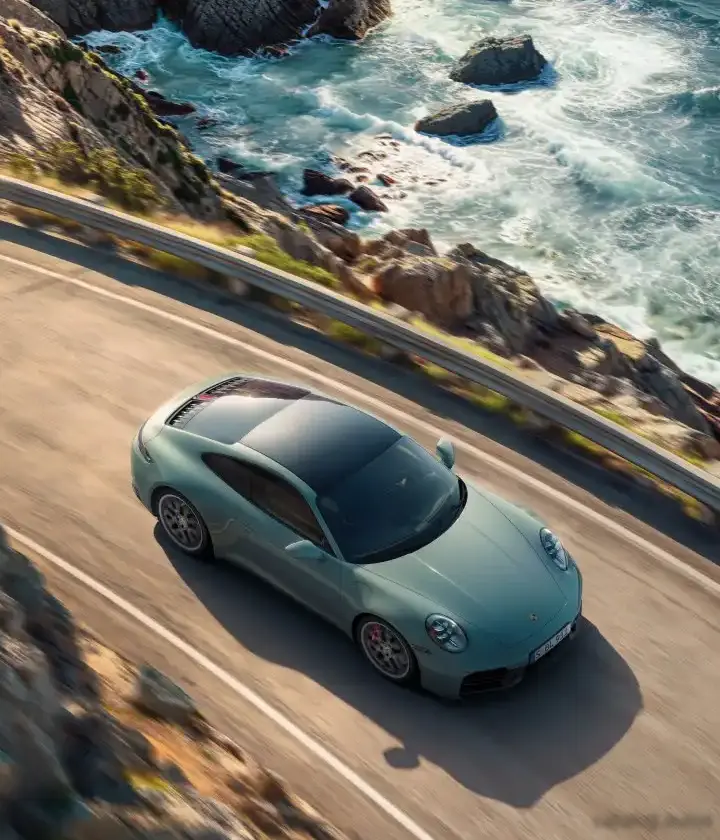
The Porsche 911 Carrera 4S (992, facelift 2024) represents the latest evolution of Porsche’s iconic sports car, building upon the already highly successful 992 generation. Introduced with the 2025 model year, this variant specifically features a 3.0-liter twin-turbocharged flat-six engine producing 480 horsepower, paired with Porsche’s 8-speed PDK (Porsche Doppelkupplung) dual-clutch automatic transmission and all-wheel drive. Positioned as a mid-range offering within the 911 lineup, the Carrera 4S balances performance with a degree of everyday usability, appealing to drivers seeking a thrilling experience without sacrificing comfort or refinement. It slots above the base Carrera models and below the more focused Carrera GTS and Turbo variants.
Technical Specifications
| Brand | Porsche |
| Model | 911 |
| Generation | 911 (992, facelift 2024) |
| Type (Engine) | Carrera 4S 3.0 (480 Hp) PDK |
| Start of production | July, 2025 |
| Powertrain Architecture | Internal Combustion engine |
| Body type | Coupe |
| Seats | 2-4 |
| Doors | 2 |
| Fuel consumption at Low speed (WLTP) | 18.7-19 l/100 km (12.6 – 12.4 US mpg, 15.1 – 14.9 UK mpg, 5.3 – 5.3 km/l) |
| Fuel consumption at Medium speed (WLTP) | 10-10.4 l/100 km (23.5 – 22.6 US mpg, 28.2 – 27.2 UK mpg, 10 – 9.6 km/l) |
| Fuel consumption at high speed (WLTP) | 8.7-9.2 l/100 km (27 – 25.6 US mpg, 32.5 – 30.7 UK mpg, 11.5 – 10.9 km/l) |
| Fuel consumption at very high speed (WLTP) | 9.2-9.9 l/100 km (25.6 – 23.8 US mpg, 30.7 – 28.5 UK mpg, 10.9 – 10.1 km/l) |
| Combined fuel consumption (WLTP) | 10.5-11 l/100 km (22.4 – 21.4 US mpg, 26.9 – 25.7 UK mpg, 9.5 – 9.1 km/l) |
| CO2 emissions (WLTP) | 237-249 g/km |
| Fuel Type | Petrol (Gasoline) |
| Acceleration 0 – 100 km/h | 3.3 sec |
| Acceleration 0 – 62 mph | 3.3 sec |
| Acceleration 0 – 60 mph | 3.1 sec |
| Acceleration 0 – 200 km/h | 11.8 sec |
| Maximum speed | 308 km/h (191.38 mph) |
| Weight-to-power ratio | 3.3 kg/Hp, 302.8 Hp/tonne |
| Weight-to-torque ratio | 3 kg/Nm, 334.4 Nm/tonne |
| Power | 480 Hp |
| Power per litre | 161 Hp/l |
| Torque | 530 Nm (390.91 lb.-ft.) |
| Maximum engine speed | 7500 rpm |
| Engine layout | Rear, Longitudinal |
| Engine displacement | 2981 cm3 (181.91 cu. in.) |
| Number of cylinders | 6 |
| Engine configuration | Boxer |
| Cylinder Bore | 91 mm (3.58 in.) |
| Piston Stroke | 76.4 mm (3.01 in.) |
| Number of valves per cylinder | 4 |
| Fuel injection system | Direct injection |
| Engine aspiration | BiTurbo, Intercooler |
| Valvetrain | DOHC |
| Engine systems | Start & Stop System, Particulate filter |
| Kerb Weight | 1585 kg (3494.33 lbs.) |
| Max. weight | 1910-2010 kg (4210.83 – 4431.29 lbs.) |
| Max load | 325-425 kg (716.5 – 936.96 lbs.) |
| Trunk (boot) space – minimum | 373 l (13.17 cu. ft.) |
| Max. roof load | 75 kg (165.35 lbs.) |
| Length | 4542 mm (178.82 in.) |
| Width | 1852 mm (72.91 in.) |
| Width including mirrors | 2033 mm (80.04 in.) |
| Height | 1293-1303 mm (50.91 – 51.3 in.) |
| Wheelbase | 2450 mm (96.46 in.) |
| Front overhang | 1016 mm (40 in.) |
| Rear overhang | 1077 mm (42.4 in.) |
| Ride height (ground clearance) | 114-124 mm (4.49 – 4.88 in.) |
| Minimum turning circle (turning diameter) | 11.2 m (36.75 ft.) |
| Approach angle | 9.5-10.1° |
| Departure angle | 13.5-14.1° |
| Ramp-over (brakeover) angle | 11.8-12.8° |
| Drivetrain Architecture | The Internal combustion engine (ICE) drives the rear wheels permanently, and the front wheels are driven through an electrically or mechanically operated clutch if necessary. |
| Drive wheel | All wheel drive (4×4) |
| Number of gears and type of gearbox | 8 gears, automatic transmission PDK |
| Front suspension | Coil spring, Double wishbone, Transverse stabilizer |
| Rear suspension | Independent multi-link spring suspension with stabilizer |
| Front brakes | Ventilated discs, 408 mm |
| Rear brakes | Ventilated discs, 380 mm |
| Assisting systems | ABS (Anti-lock braking system) |
| Steering type | Steering rack and pinion |
| Power steering | Electric Steering |
| Tires size | Front wheel tires: 245/35 ZR20, Rear wheel tires: 305/30 ZR21; 315/30 ZR21 |
| Wheel rims size | Front wheel rims: 8.5J x 20, Rear wheel rims: 11.5J x 21 |
Powertrain & Engine Architecture
At the heart of the Carrera 4S lies Porsche’s 3.0-liter twin-turbocharged flat-six engine, internally designated as the 9A2. This engine represents a significant advancement over previous generations, employing direct fuel injection, variable turbine geometry (VTG) turbochargers, and an intricate cooling system to maximize power and efficiency. The VTG turbochargers adjust the airflow based on engine speed and load, minimizing turbo lag and providing a broader, more accessible powerband. The engine’s “boxer” configuration – with cylinders arranged horizontally opposed – contributes to a low center of gravity, enhancing handling and stability. The PDK 8-speed dual-clutch transmission offers incredibly fast and smooth gear changes, whether in automatic or manual mode. Porsche’s active all-wheel-drive system intelligently distributes torque between the front and rear axles, optimizing traction in all conditions.
Driving Characteristics
The Carrera 4S with the PDK transmission delivers a remarkably refined yet exhilarating driving experience. The twin-turbocharged engine provides instant response and a relentless surge of power throughout the rev range. While not as raw or visceral as a manual transmission equipped 911, the PDK offers a level of convenience and performance that appeals to a wide range of drivers. The all-wheel-drive system inspires confidence, particularly on wet or slippery surfaces, and contributes to exceptional cornering grip. The PDK’s gear ratios are optimized for both acceleration and fuel efficiency, providing a balance between performance and economy. Compared to the base Carrera, the 4S offers noticeably stronger acceleration and improved stability, while the higher-output Carrera GTS provides an even more aggressive and track-focused experience.
Equipment & Trim Levels
The Carrera 4S comes standard with a comprehensive array of features, including Porsche Active Suspension Management (PASM), Porsche Communication Management (PCM) with a 10.9-inch touchscreen display, and a premium sound system. Interior appointments typically include leather upholstery, power-adjustable sports seats, and a leather-wrapped steering wheel. Optional extras are extensive, ranging from adaptive cruise control and lane keep assist to carbon fiber trim and a panoramic sunroof. Buyers could also specify upgraded interior packages, including different leather colors and stitching patterns, as well as various performance-enhancing options like Porsche Ceramic Composite Brakes (PCCB).
Chassis & Braking
The 992-generation 911 features a sophisticated chassis design, incorporating a multi-link rear suspension and a double-wishbone front suspension. The Carrera 4S benefits from a slightly wider track than the base Carrera, further enhancing stability. The braking system consists of ventilated discs at all four corners, providing ample stopping power. The front brakes measure 408mm in diameter, while the rear brakes are 380mm. Porsche’s ABS (Anti-lock Braking System) and stability control systems work in concert to maintain control during hard braking and cornering maneuvers.
Market Reception & Comparison
The 911 Carrera 4S (992) has been widely praised by automotive critics for its exceptional performance, handling, and refinement. It consistently ranks among the top sports cars in its class. Compared to other trims in the 911 lineup, the Carrera 4S offers a compelling balance of performance and practicality. While the base Carrera is more affordable, it lacks the all-wheel-drive system and the added performance of the 4S. The Carrera GTS offers even more power and a more aggressive character, but at a higher price point. Fuel economy is respectable for a high-performance sports car, but it’s not the primary focus for buyers in this segment. Reliability has generally been good, although maintenance costs can be significant due to the complexity of the engine and drivetrain.
Legacy
The 992-generation 911, and specifically the Carrera 4S variant, is expected to be a highly sought-after model in the used car market. The combination of its iconic design, exhilarating performance, and relatively high build quality ensures its long-term desirability. The 3.0-liter twin-turbocharged engine and PDK transmission are proven and reliable powertrains, provided they are properly maintained. As with all Porsches, regular servicing and adherence to the manufacturer’s recommended maintenance schedule are crucial for preserving its value and ensuring its continued performance.