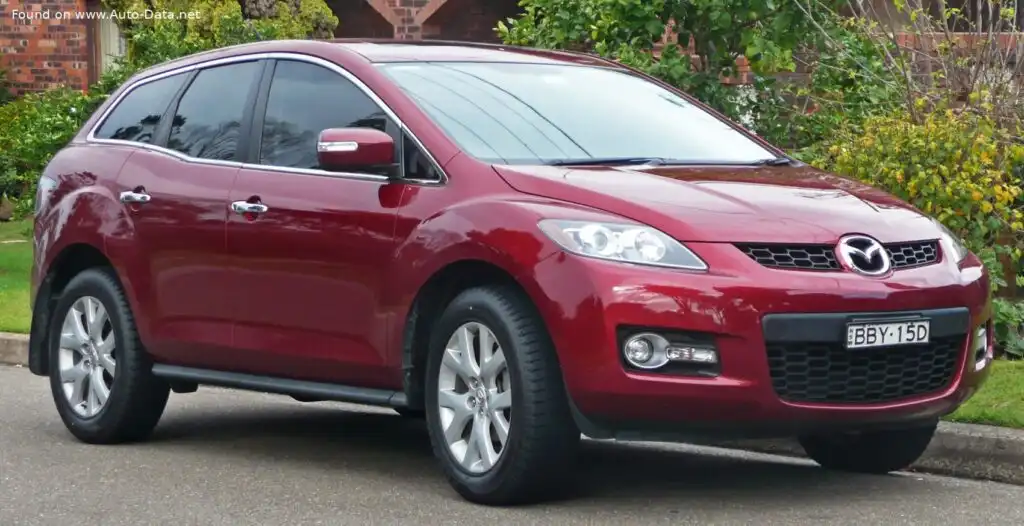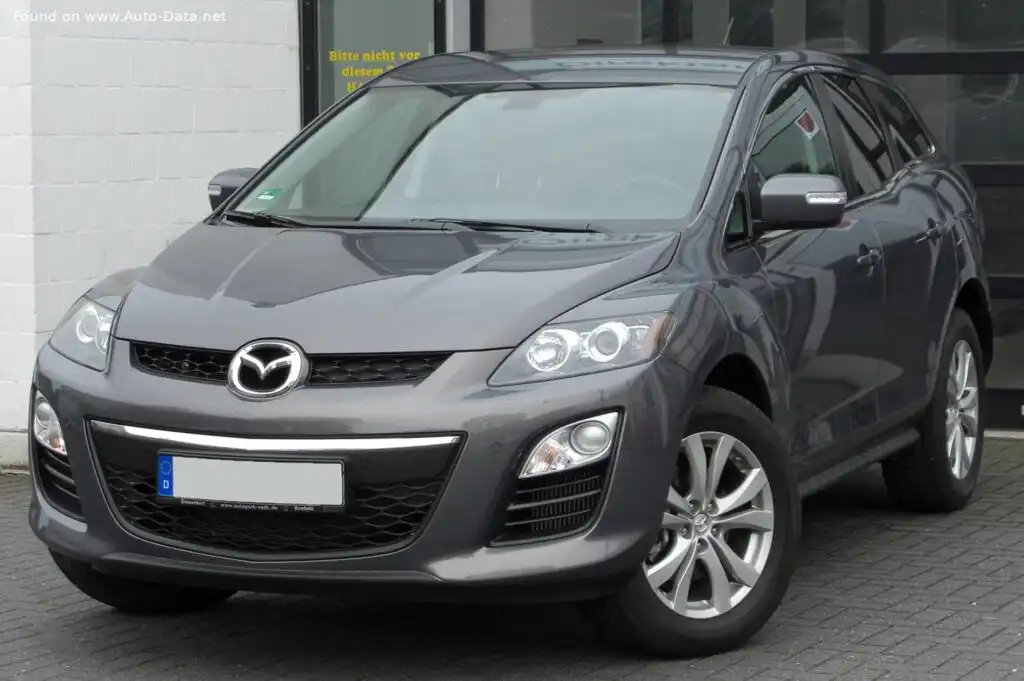
The Mazda CX-7, particularly the facelifted version produced from 2009 to 2012, represented Mazda’s entry into the burgeoning crossover SUV market. This iteration, equipped with the 2.5-liter four-cylinder engine producing 161 horsepower and paired with a five-speed automatic transmission, was positioned as a more accessible and fuel-efficient option within the CX-7 lineup, slotting below the more powerful turbocharged variants. The facelift brought revised styling cues, interior refinements, and subtle mechanical updates aimed at enhancing the vehicle’s overall appeal. It was primarily sold in North America, where the demand for compact and mid-size SUVs was rapidly increasing.
Technical Specifications
| Brand | Mazda |
| Model | CX-7 |
| Generation | CX-7 (facelift 2009) |
| Type (Engine) | 2.5 (161 Hp) Automatic |
| Start of production | 2009 |
| End of production | 2012 |
| Powertrain Architecture | Internal Combustion engine |
| Body type | SUV, Crossover |
| Seats | 5 |
| Doors | 5 |
| Fuel consumption (urban) | 11.8 l/100 km (19.9 US mpg) |
| Fuel consumption (extra urban) | 8.4 l/100 km (28 US mpg) |
| Fuel Type | Petrol (Gasoline) |
| Weight-to-power ratio | 9.9 kg/Hp |
| Weight-to-torque ratio | 7.3 kg/Nm |
| Power | 161 Hp @ 6000 rpm |
| Power per litre | 64.7 Hp/l |
| Torque | 218 Nm @ 3500 rpm (160.79 lb.-ft. @ 3500 rpm) |
| Maximum engine speed | 6500 rpm |
| Engine layout | Front, Transverse |
| Engine Model/Code | L5-VE |
| Engine displacement | 2488 cm3 (151.83 cu. in.) |
| Number of cylinders | 4 |
| Engine configuration | Inline |
| Cylinder Bore | 89 mm (3.5 in.) |
| Piston Stroke | 100 mm (3.94 in.) |
| Compression ratio | 9.7:1 |
| Number of valves per cylinder | 4 |
| Fuel injection system | Multi-port manifold injection |
| Engine aspiration | Naturally aspirated engine |
| Valvetrain | DOHC |
| Engine oil capacity | 5 l (5.28 US qt | 4.4 UK qt) |
| Coolant capacity | 9 l (9.51 US qt | 7.92 UK qt) |
| Kerb Weight | 1589 kg (3503.15 lbs.) |
| Max. weight | 2125 kg (4684.82 lbs.) |
| Max load | 536 kg (1181.68 lbs.) |
| Trunk (boot) space – minimum | 847 l (29.91 cu. ft.) |
| Trunk (boot) space – maximum | 1659 l (58.59 cu. ft.) |
| Fuel tank capacity | 62 l (16.38 US gal | 13.64 UK gal) |
| Permitted trailer load with brakes (12%) | 680 kg (1499.14 lbs.) |
| Length | 4694 mm (184.8 in.) |
| Width | 1872 mm (73.7 in.) |
| Height | 1645 mm (64.76 in.) |
| Wheelbase | 2750 mm (108.27 in.) |
| Front track | 1627 mm (64.06 in.) |
| Rear track | 1622 mm (63.86 in.) |
| Ride height (ground clearance) | 206 mm (8.11 in.) |
| Minimum turning circle | 11.4 m (37.4 ft.) |
| Drivetrain | Front wheel drive |
| Number of gears | 5 |
| Gearbox type | automatic transmission |
| Front suspension | Independent, type McPherson with coil spring and anti-roll bar |
| Rear suspension | Independent multi-link spring suspension with stabilizer |
| Front brakes | Ventilated discs, 296 mm |
| Rear brakes | Ventilated discs, 302 mm |
| Assisting systems | ABS (Anti-lock braking system) |
| Steering type | Steering rack and pinion |
| Power steering | Electric Steering |
| Tires size | 215/70 R17 |
| Wheel rims size | 7J x 17 |
INTRODUCTION
The 2009-2012 Mazda CX-7 facelift, powered by the 2.5-liter engine and automatic transmission, was a key component of Mazda’s strategy to broaden the appeal of the CX-7. Built on the 1HX0/A3 platform, shared with other Mazda models like the Mazda3, it aimed to provide a more affordable and economical option for buyers seeking a stylish and practical crossover. This variant was specifically targeted at customers prioritizing fuel efficiency and ease of driving over outright performance, making it a popular choice for families and commuters. The facelift brought a more aggressive front fascia, revised interior materials, and updated technology features.
Powertrain & Engine Architecture
The heart of this CX-7 variant is the L5-VE 2.5-liter inline-four cylinder engine. This engine utilizes a naturally aspirated configuration with multi-port fuel injection, delivering a balance between fuel economy and adequate power. The engine features a double overhead camshaft (DOHC) valvetrain, optimizing airflow for improved efficiency and responsiveness. The engine’s 9.7:1 compression ratio is a compromise between performance and the ability to run on regular unleaded gasoline. Paired with the engine is a five-speed automatic transmission, designed for smooth and convenient operation. This transmission features electronically controlled shifting and a torque converter for enhanced drivability. While not offering the sportiness of a manual transmission, the automatic provided a comfortable and user-friendly experience for everyday driving.
Driving Characteristics
The 161 horsepower and 160.79 lb-ft of torque produced by the 2.5-liter engine, when coupled with the five-speed automatic, resulted in a driving experience focused on practicality rather than exhilaration. Acceleration was adequate for merging onto highways and navigating city streets, but it wasn’t particularly brisk. The automatic transmission’s gear ratios were tuned for fuel efficiency, meaning that the engine often operated at lower RPMs during cruising. Compared to the turbocharged 2.3-liter engine offered in other CX-7 trims, this variant felt noticeably less powerful. However, the automatic transmission provided smooth shifts and predictable performance, making it a comfortable choice for daily commutes. The front-wheel-drive configuration contributed to decent fuel economy, but it didn’t offer the all-weather capability of the available all-wheel-drive system.
Equipment & Trim Levels
The 2.5-liter automatic CX-7 typically came standard with a respectable array of features. Base models generally included air conditioning, power windows and locks, a CD player with auxiliary input, and basic cloth upholstery. Higher trim levels, such as the Touring and Grand Touring, added features like alloy wheels, a sunroof, leather upholstery, a premium sound system, and Bluetooth connectivity. Optional extras included a navigation system, heated front seats, and a rear backup camera. Interior materials were generally of good quality for the price point, with a focus on durability and practicality. The dashboard layout was straightforward and user-friendly, with logically placed controls.
Chassis & Braking
The CX-7’s chassis featured an independent McPherson strut suspension in the front and an independent multi-link suspension in the rear. This setup provided a comfortable ride quality and decent handling characteristics. The suspension was tuned to prioritize comfort over sporty handling, resulting in a relatively soft and forgiving ride. Braking duties were handled by ventilated disc brakes on all four wheels, providing adequate stopping power for the vehicle’s weight class. An Anti-lock Braking System (ABS) was standard, enhancing safety and control during emergency braking situations. The stabilizer bars, both front and rear, helped to minimize body roll during cornering.
Market Reception & Comparison
Critics generally praised the 2009-2012 Mazda CX-7 2.5 for its stylish design, comfortable interior, and good fuel economy. However, the 2.5-liter engine was often criticized for being underpowered, especially when compared to the turbocharged engine options. Compared to competitors like the Honda CR-V and Toyota RAV4, the CX-7 offered a more sporty driving experience but lacked the same level of practicality and reliability. The 2.5-liter engine delivered better fuel economy than the turbocharged variants, but it also came with a noticeable performance penalty. Maintenance costs were generally reasonable, but some owners reported issues with the automatic transmission over the long term.
Legacy
The Mazda CX-7 2.5 (161 Hp) Automatic, while not the most powerful or sporty version of the CX-7, remains a popular choice in the used car market. Its affordability, fuel efficiency, and stylish design continue to appeal to buyers seeking a practical and reliable crossover SUV. The L5-VE engine, while not known for exceptional longevity, is generally considered to be reasonably durable with proper maintenance. Common issues include oil consumption and potential transmission problems, so prospective buyers should carefully inspect the vehicle’s maintenance history and have it thoroughly inspected by a qualified mechanic. The CX-7, in general, helped establish Mazda as a serious player in the crossover SUV segment, paving the way for future models like the CX-5 and CX-9.