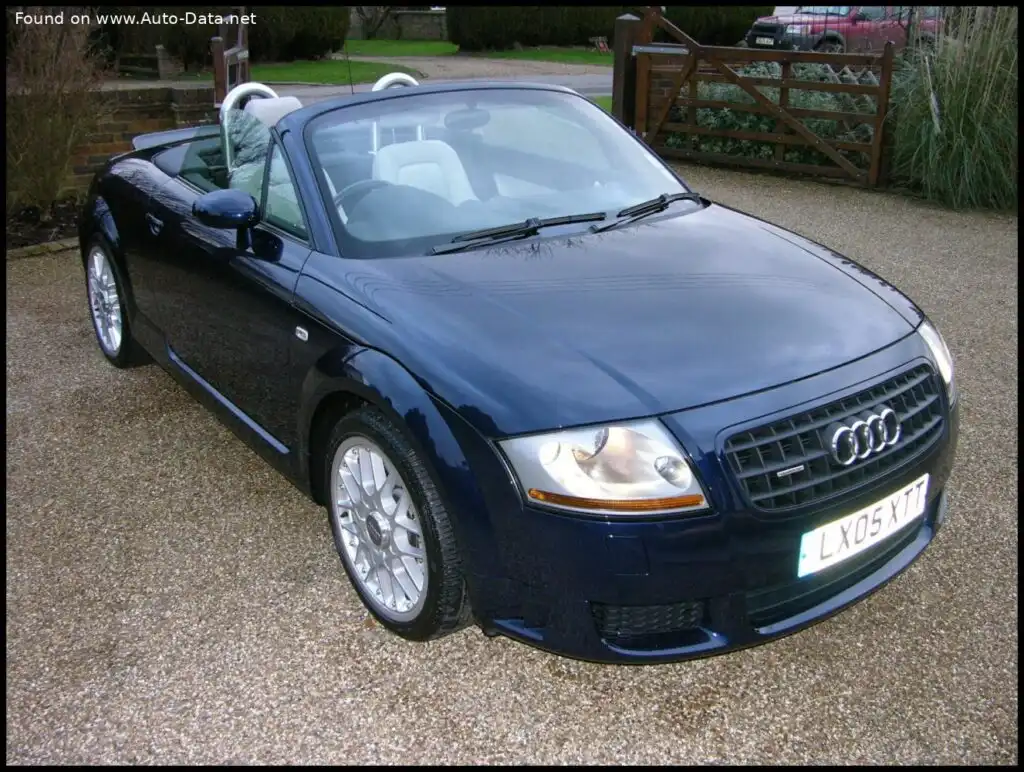
The Audi TT Roadster (8N, facelifted in 2000) 1.8T, producing 150 horsepower, represents a key iteration of Audi’s groundbreaking entry-level sports car. Introduced in January 2001 and continuing through June 2006, this variant occupied a significant middle ground within the 8N TT Roadster lineup, offering a balance between performance and affordability. It built upon the success of the original 1998 TT, addressing some early criticisms while retaining the model’s distinctive Bauhaus-inspired design. The facelift brought subtle but important changes to the exterior and interior, along with improvements to the engine and suspension. This model was primarily aimed at the European market, where compact roadsters were highly popular, but also saw moderate sales in North America.
Technical Specifications
| Brand | Audi |
| Model | TT |
| Generation | TT Roadster (8N, facelift 2000) |
| Type (Engine) | 1.8 T (150 Hp) |
| Start of production | January, 2001 |
| End of production | June, 2006 |
| Powertrain Architecture | Internal Combustion engine |
| Body type | Roadster |
| Seats | 2 |
| Doors | 2 |
| Fuel consumption (urban) | 11.2 l/100 km (21 US mpg, 25.2 UK mpg, 8.9 km/l) |
| Fuel consumption (extra urban) | 6.4 l/100 km (36.8 US mpg, 44.1 UK mpg, 15.6 km/l) |
| Fuel consumption (combined) | 8.2 l/100 km (28.7 US mpg, 34.4 UK mpg, 12.2 km/l) |
| CO2 emissions | 197 g/km |
| Fuel Type | Petrol (Gasoline) |
| Acceleration 0 – 100 km/h | 8.9 sec |
| Acceleration 0 – 62 mph | 8.9 sec |
| Acceleration 0 – 60 mph | 8.5 sec |
| Maximum speed | 214 km/h (132.97 mph) |
| Emission standard | Euro 4 |
| Weight-to-power ratio | 8.9 kg/Hp, 111.9 Hp/tonne |
| Weight-to-torque ratio | 6.4 kg/Nm, 156.7 Nm/tonne |
| Power | 150 Hp @ 5700 rpm |
| Power per litre | 84.2 Hp/l |
| Torque | 210 Nm @ 1750-4600 rpm (154.89 lb.-ft. @ 1750-4600 rpm) |
| Engine layout | Front, Transverse |
| Engine Model/Code | AUM |
| Engine displacement | 1781 cm3 (108.68 cu. in.) |
| Number of cylinders | 4 |
| Engine configuration | Inline |
| Cylinder Bore | 81 mm (3.19 in.) |
| Piston Stroke | 86.4 mm (3.4 in.) |
| Compression ratio | 9.5:1 |
| Number of valves per cylinder | 5 |
| Fuel injection system | Multi-port manifold injection |
| Engine aspiration | Turbocharger, Intercooler |
| Valvetrain | DOHC |
| Engine oil capacity | 4.5 l (4.76 US qt | 3.96 UK qt) |
| Coolant | 7 l (7.4 US qt | 6.16 UK qt) |
| Kerb Weight | 1340 kg (2954.19 lbs.) |
| Max. weight | 1640 kg (3615.58 lbs.) |
| Max load | 300 kg (661.39 lbs.) |
| Trunk (boot) space – minimum | 220 l (7.77 cu. ft.) |
| Fuel tank capacity | 55 l (14.53 US gal | 12.1 UK gal) |
| Length | 4041 mm (159.09 in.) |
| Width | 1764 mm (69.45 in.) |
| Height | 1349 mm (53.11 in.) |
| Wheelbase | 2422 mm (95.35 in.) |
| Front track | 1528 mm (60.16 in.) |
| Rear (Back) track | 1513 mm (59.57 in.) |
| Drag coefficient (Cd) | 0.34 |
| Minimum turning circle | 10.6 m (34.78 ft.) |
| Drivetrain Architecture | The Internal combustion engine (ICE) drives the front wheels of the vehicle. |
| Drive wheel | Front wheel drive |
| Number of gears and type of gearbox | 5 gears, manual transmission |
| Front suspension | Independent, type McPherson with coil spring and anti-roll bar |
| Rear suspension | independent torsion suspension |
| Front brakes | Ventilated discs |
| Rear brakes | Disc |
| Assisting systems | ABS (Anti-lock braking system) |
| Steering type | Steering rack and pinion |
| Power steering | Hydraulic Steering |
| Tires size | 205/55 R16 |
| Wheel rims size | 7J x 16 |
Powertrain & Engine Architecture
The heart of the 1.8T Roadster is the Audi-developed AUM engine code, a 1.8-liter inline-four cylinder gasoline engine. This engine utilizes a single overhead camshaft (SOHC) design with five valves per cylinder (three intake, two exhaust), a configuration that helped optimize both low-end torque and high-RPM power. The engine employs multi-port fuel injection and is turbocharged with an intercooler to enhance performance. The turbocharger, a Garrett GT15, provides approximately 8.3 psi of boost. The AUM engine is known for its relatively robust construction, but is susceptible to oil sludge buildup if maintenance is neglected. The 5-speed manual transmission was the standard offering, providing a direct and engaging driving experience. The transmission featured a relatively short throw and precise shift quality.
Driving Characteristics
The 150 hp 1.8T Roadster offered a respectable, though not overwhelming, driving experience. Acceleration from 0-60 mph took around 8.5 seconds, and top speed was approximately 133 mph. The turbocharger provided a noticeable surge of power in the mid-range, making overtaking maneuvers relatively easy. However, the engine lacked the outright punch of the more powerful 225 hp 1.8T quattro models. The front-wheel-drive configuration, while contributing to lower weight and cost, could exhibit torque steer under hard acceleration. The suspension provided a good balance between comfort and handling, making the Roadster suitable for both daily driving and spirited weekend excursions. The relatively light weight of the Roadster (around 2954 lbs) helped to mitigate the limitations of the 150 hp engine.
Equipment & Trim Levels
The 1.8T Roadster typically came standard with features such as power windows, power locks, air conditioning, and a leather-wrapped steering wheel. Upholstery was typically cloth, though leather options were available. Optional extras included a premium sound system, heated seats, and a wind deflector to reduce turbulence in the cabin. The interior design was minimalist and functional, reflecting the Bauhaus aesthetic that characterized the TT. Dashboard gauges were clear and easy to read, and the overall cabin layout was driver-focused.
Chassis & Braking
The 8N TT Roadster utilized a McPherson strut front suspension and a torsion beam rear suspension. This setup provided a good compromise between ride comfort and handling precision. The front suspension featured coil springs and an anti-roll bar to reduce body roll during cornering. Braking duties were handled by ventilated discs at the front and solid discs at the rear. Anti-lock braking system (ABS) was standard. The steering was a hydraulic power-assisted rack and pinion system, providing precise and responsive steering feel.
Market Reception & Comparison
The 1.8T Roadster was generally well-received by automotive critics. It was praised for its stylish design, engaging handling, and relatively affordable price. However, some critics noted that the engine lacked the power of its competitors, such as the BMW Z3 and Porsche Boxster. Compared to the higher-output 225 hp 1.8T models, the 150 hp version offered better fuel economy (around 29 mpg combined) and lower running costs, but at the expense of performance. The 1.8T was also considered more reliable than the more complex quattro models.
Legacy
The Audi TT Roadster (8N) 1.8T remains a popular choice among enthusiasts today. The AUM engine, while requiring regular maintenance, is generally considered reliable. Common issues include oil sludge buildup, turbocharger failure, and coil pack problems. The Roadster’s distinctive styling and engaging driving dynamics have ensured its continued appeal in the used car market. Parts availability is generally good, and the car’s relatively simple mechanical design makes it a relatively easy vehicle to maintain for DIY mechanics. The 8N TT Roadster helped establish Audi as a maker of desirable and sporty vehicles, and paved the way for future generations of the TT.