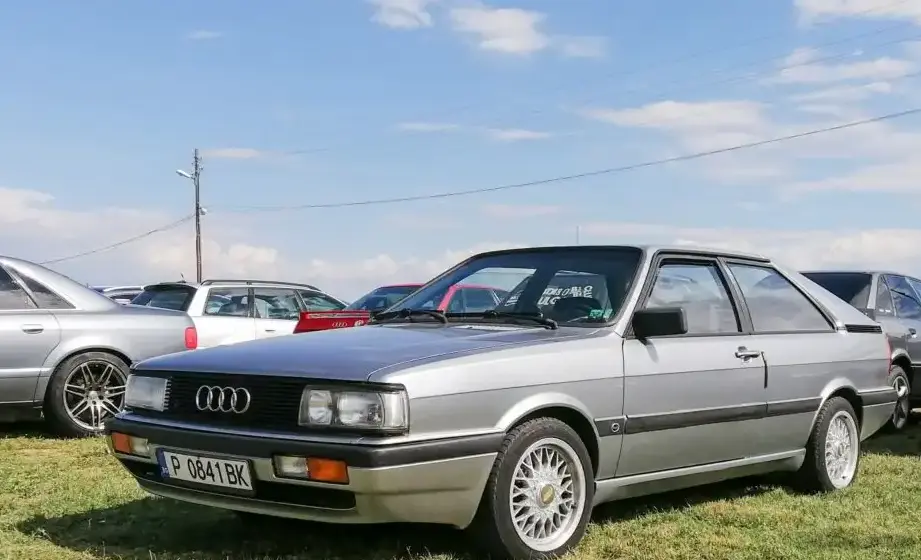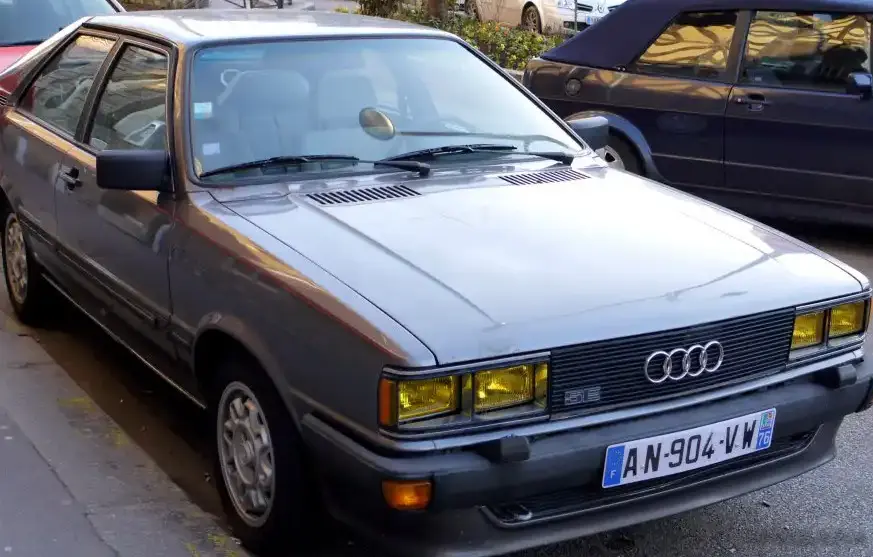
The Audi Coupe (B2), produced between 1980 and 1988, marked a significant evolution for Audi, successfully merging sporty aesthetics with the practicality expected of a compact coupe. The GT 5E 2.2 variant, manufactured from August 1982 to July 1984, occupied an important middle ground within the B2 Coupe lineup. Positioned above the base models featuring smaller engines, yet below the more performance-focused Quattro versions, the GT 5E offered a compelling balance of performance and affordability. It played a crucial role in Audi’s strategy to attract buyers desiring a stylish and reasonably economical grand tourer. The B2 Coupe was built upon the Audi B2 platform, a shared architecture with the Audi 80 (sedan) and Audi 90 (fastback) models.
Technical Specifications
| Brand | Audi |
| Model | Coupe |
| Generation | Coupe (B2 81, 85) |
| Type (Engine) | GT 5E 2.2 (130 Hp) |
| Start of production | August, 1982 |
| End of production | July, 1984 |
| Powertrain Architecture | Internal Combustion engine |
| Body type | Coupe |
| Seats | 5 |
| Doors | 2 |
| Fuel Type | Petrol (Gasoline) |
| Acceleration 0 – 100 km/h | 8.7 sec |
| Acceleration 0 – 62 mph | 8.7 sec |
| Acceleration 0 – 60 mph | 8.3 sec |
| Maximum speed | 196 km/h (121.79 mph) |
| Weight-to-power ratio | 7.8 kg/Hp, 127.5 Hp/tonne |
| Weight-to-torque ratio | 6 kg/Nm, 167.6 Nm/tonne |
| Power | 130 Hp @ 5900 rpm |
| Power per litre | 60.6 Hp/l |
| Torque | 171 Nm @ 4800 rpm (126.12 lb.-ft. @ 4800 rpm) |
| Engine layout | Front, Longitudinal |
| Engine Model/Code | KE, KL |
| Engine displacement | 2144 cm3 (130.83 cu. in.) |
| Number of cylinders | 5 |
| Engine configuration | Inline |
| Cylinder Bore | 79.5 mm (3.13 in.) |
| Piston Stroke | 86.4 mm (3.4 in.) |
| Compression ratio | 9.3:1 |
| Number of valves per cylinder | 2 |
| Fuel injection system | Multi-port manifold injection |
| Engine aspiration | Naturally aspirated engine |
| Engine oil capacity | 4.5 l (4.76 US qt | 3.96 UK qt) |
| Coolant | 8 l (8.45 US qt | 7.04 UK qt) |
| Kerb Weight | 1020 kg (2248.72 lbs) |
| Max. weight | 1480 kg (3262.84 lbs) |
| Max load | 460 kg (1014.13 lbs) |
| Trunk (boot) space – minimum | 494 l (17.45 cu. ft.) |
| Fuel tank capacity | 60 l (15.85 US gal | 13.2 UK gal) |
| Length | 4349 mm (171.22 in.) |
| Width | 1682 mm (66.22 in.) |
| Height | 1350 mm (53.15 in.) |
| Wheelbase | 2542 mm (100.08 in.) |
| Front track | 1400 mm (55.12 in.) |
| Rear (Back) track | 1420 mm (55.91 in.) |
| Drag coefficient (Cd) | 0.39 |
| Minimum turning circle | 10.4 m (34.12 ft.) |
| Drivetrain Architecture | The Internal combustion engine (ICE) drives the front wheels of the vehicle. |
| Drive wheel | Front wheel drive |
| Number of gears and type of gearbox | 5 gears, manual transmission |
| Front suspension | Independent, type McPherson with coil spring and anti-roll bar |
| Front brakes | Ventilated discs |
| Rear brakes | Drum |
| Tires size | 185/60 R14 |
| Wheel rims size | 14 |
The GT 5E 2.2 was powered by Audi’s renowned inline five-cylinder engine, identified by the KE or KL engine code depending on minor production variations. This engine was a defining feature of Audi’s engineering capabilities during the early 1980s, delivering a smooth and refined power delivery. The 2.2-liter displacement was achieved through a 79.5mm bore and an 86.4mm stroke, operating with a compression ratio of 9.3:1. The engine employed Bosch K-Jetronic multi-port fuel injection, a mechanical system celebrated for its reliability and precise fuel metering. The cylinder head incorporated two valves per cylinder (one intake, one exhaust), and the engine’s longitudinal front-engine layout contributed to balanced weight distribution. A five-speed manual transmission was standard, granting drivers complete control over the engine’s power band.
Driving Characteristics
The 130 horsepower and 126 lb-ft of torque generated by the GT 5E 2.2 provided brisk, though not overwhelming, performance. Acceleration from 0 to 60 mph was achieved in approximately 8.3 seconds, with a top speed around 122 mph. Compared to the more potent Quattro models, the GT 5E felt less aggressively quick in its acceleration. However, it offered a more relaxed and fuel-efficient driving experience. The five-speed manual transmission enabled precise gear selection, and the engine’s torque curve provided sufficient pulling power for everyday driving and highway cruising. The front-wheel-drive configuration, while offering good traction in most conditions, could exhibit some understeer when pushed aggressively through corners.
Equipment & Trim Levels
The GT 5E 2.2 was reasonably well-equipped for its era. Standard features generally included cloth upholstery, a basic stereo system, and power-assisted steering. Optional extras encompassed a sunroof, upgraded stereo systems, and metallic paint finishes. The interior design was functional and understated, reflecting the German emphasis on practicality. The dashboard layout was clean and easily readable, featuring clearly marked gauges for speed, engine temperature, fuel level, and other essential information. The GT 5E occupied a mid-range position within the B2 Coupe lineup, offering an upgrade in engine performance and features compared to the base models, but lacking the all-wheel-drive system and more luxurious appointments of the Quattro variants.
Chassis & Braking
The B2 Coupe featured an independent McPherson strut front suspension with coil springs and an anti-roll bar, delivering a comfortable ride and predictable handling. The rear suspension utilized a semi-trailing arm setup. Braking was managed by ventilated discs at the front and drum brakes at the rear. While adequate for typical driving, the rear drum brakes were a common point of criticism, as they lacked the stopping power and fade resistance of disc brakes. The car rode on 14-inch wheels fitted with 185/60 R14 tires. The chassis was relatively lightweight, contributing to the car’s nimble handling characteristics.
Market Reception & Comparison
The Audi Coupe B2 GT 5E 2.2 was generally well-received by automotive critics. It was praised for its stylish design, comfortable ride, and refined engine. However, some reviewers noted that the performance didn’t quite match the excitement of the Quattro models. Compared to other coupes of the time, such as the BMW 323i and the Porsche 924, the Audi offered a compelling combination of value, practicality, and performance. Fuel economy was respectable for the period, averaging around 25-30 mpg. Reliability was generally good, although the K-Jetronic fuel injection system occasionally required maintenance.
Legacy
The Audi Coupe B2 GT 5E 2.2 remains a popular choice among classic car enthusiasts. The inline five-cylinder engine is particularly admired for its smoothness and durability. While not as highly sought-after as the Quattro models, the GT 5E provides a more accessible entry point into the B2 Coupe world. Parts availability is generally good, although some specific components can be challenging to locate. Well-maintained examples of the GT 5E 2.2 are appreciating in value, reflecting the growing interest in classic German automobiles. The B2 Coupe, and the GT 5E variant specifically, helped solidify Audi’s reputation as a premium automotive brand and laid the groundwork for the company’s subsequent success.