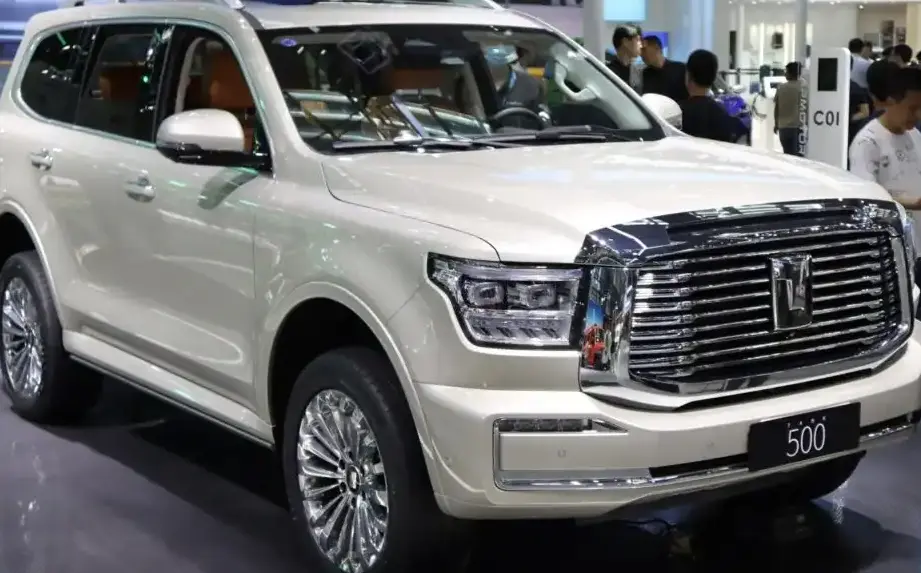
Technical Specifications
| Brand | Tank |
| Model | 500 |
| Generation | 500 |
| Type (Engine) | Hi4-Z 2.0T 59.05 kWh (863 Hp) Plug-in Hybrid 4WD DHT |
| Start of production | January, 2025 |
| End of production | August, 2025 |
| Powertrain Architecture | PHEV (Plug-in Hybrid Electric Vehicle) |
| Body type | SUV |
| Seats | 5 |
| Doors | 5 |
| Fuel consumption (economy) – combined (WLTC) | 0.76-8.6 l/100 km (309.5 – 27.4 US mpg, 371.7 – 32.8 UK mpg, 131.6 – 11.6 km/l) |
| Fuel Type | Petrol / electricity |
| Acceleration 0 – 100 km/h | 4.6 sec |
| Acceleration 0 – 62 mph | 4.6 sec |
| Acceleration 0 – 60 mph | 4.4 sec |
| Maximum speed | 180 km/h (111.85 mph) |
| Weight-to-power ratio | 3.5 kg/Hp, 289.6 Hp/tonne |
| Weight-to-torque ratio | 2.5 kg/Nm, 401 Nm/tonne |
| Gross battery capacity | 59.05 kWh |
| Battery voltage | 518 V |
| Battery technology | Lithium nickel manganese cobalt oxides (Li-NMC) |
| Battery location | Below the floor |
| All-electric range (WLTC) | 201 km (124.9 mi) |
| Average Energy consumption (WLTC) | 27.3 kWh/100 km (43.94 kWh/100 mi, 77 MPGe, 3.7 km/kWh, 2.3 mi/kWh) |
| Electric motor power (1) | 292 Hp |
| Electric motor Torque (1) | 400 Nm (295.02 lb.-ft.) |
| Electric motor model/code (1) | TZ290XH006 |
| Maximum revolutions of the electric motor (1) | 7000 rpm |
| Electric motor location (1) | Between the combustion engine and the transmission |
| Electric motor type (1) | Synchronous |
| Electric motor power (2) | 326 Hp |
| Electric motor Torque (2) | 415 Nm (306.09 lb.-ft.) |
| Electric motor model/code (2) | TZ220XH008 |
| Maximum revolutions of the electric motor (2) | 18000 rpm |
| Electric motor location (2) | Rear axle, Transverse |
| Electric motor type (2) | Synchronous |
| System power | 863 Hp |
| System torque | 1195 Nm (881.39 lb.-ft.) |
| Power | 252 Hp @ 6000 rpm |
| Torque | 385 Nm @ 1700-4000 rpm (283.96 lb.-ft. @ 1700-4000 rpm) |
| Engine layout | Front, Longitudinal |
| Engine Model/Code | E20NB |
| Engine displacement | 1998 cm3 (121.93 cu. in.) |
| Number of cylinders | 4 |
| Engine configuration | Inline |
| Cylinder Bore | 82 mm (3.23 in.) |
| Piston Stroke | 94.6 mm (3.72 in.) |
| Number of valves per cylinder | 4 |
| Fuel injection system | Direct injection |
| Engine aspiration | Turbocharger, Intercooler |
| Valvetrain | DOHC |
| Engine oil capacity | 5.9 l (6.23 US qt | 5.19 UK qt) |
| Coolant | 9.5 l (10.04 US qt | 8.36 UK qt) |
| Kerb Weight | 2980 kg (6569.78 lbs.) |
| Max. weight | 3430 kg (7561.86 lbs.) |
| Max load | 450 kg (992.08 lbs.) |
| Trunk (boot) space – maximum | 1489 l (52.58 cu. ft.) |
| Fuel tank capacity | 77 l (20.34 US gal | 16.94 UK gal) |
| Permitted trailer load with brakes (12%) | 2500 kg (5511.56 lbs.) |
| Length | 5078 mm (199.92 in.) |
| Width | 1934 mm (76.14 in.) |
| Height | 1905 mm (75 in.) |
| Wheelbase | 2850 mm (112.2 in.) |
| Front track | 1635 mm (64.37 in.) |
| Rear (Back) track | 1635 mm (64.37 in.) |
| Ride height (ground clearance) | 210 mm (8.27 in.) |
| Approach angle | 29° |
| Departure angle | 24° |
| Climb angle | 36.9° |
| Drivetrain Architecture | ICE drives front wheels, one electric motor drives front wheels, one electric motor drives rear wheels. Full electric or mixed mode. |
| Drive wheel | All wheel drive (4×4) |
| Number of gears and type of gearbox | 3 gears, automatic transmission DHT |
| Front suspension | Double wishbone, Independent coil spring, Transverse stabilizer |
| Rear suspension | Suspension De-Dion, Transverse stabilizer, Coil spring |
| Front brakes | Ventilated discs |
| Rear brakes | Ventilated discs |
| Assisting systems | ABS (Anti-lock braking system) |
| Steering type | Steering rack and pinion |
| Power steering | Electric Steering |
| Tires size | 265/55 R19; 265/50 R20 |
| Wheel rims size | 8.5J x 19; 8.5J x 20 |
The Tank 500 Hi4-Z 2.0T represents a significant step towards electrification for the Tank brand, known for its rugged, body-on-frame SUVs. Introduced in January 2025, this variant leverages a plug-in hybrid powertrain to deliver substantial power and torque while offering a degree of all-electric driving capability. Built on the Tank 500 platform, it shares the same robust chassis and off-road focused engineering as its gasoline-powered siblings, but distinguishes itself with its advanced hybrid system. The limited production run of eight months adds to its exclusivity.
Powertrain & Engine Architecture
At the heart of the Hi4-Z is a 2.0-liter turbocharged inline-four cylinder gasoline engine (code E20NB) producing 252 horsepower and 385 Nm (283.96 lb-ft) of torque. This engine utilizes direct fuel injection and a turbocharger with intercooling to maximize efficiency and power output. However, the defining feature of this variant is its dual-motor plug-in hybrid system. A 292 hp electric motor is integrated with the front drivetrain, while a separate 326 hp electric motor powers the rear axle. These motors are powered by a 59.05 kWh lithium nickel manganese cobalt oxide (Li-NMC) battery pack located under the vehicle floor. The combined system output reaches an impressive 863 horsepower and 1195 Nm (881.39 lb-ft) of torque. The transmission is a 3-speed Direct Drive Hybrid (DHT) automatic, designed to seamlessly blend power from the engine and electric motors. The DHT system allows for all-electric driving, series hybrid operation (engine charges the battery while driving the wheels), and parallel hybrid operation (engine and motors both drive the wheels).
Driving Characteristics
The Tank 500 Hi4-Z delivers exhilarating performance, with a 0-60 mph acceleration time of just 4.4 seconds. The instant torque from the electric motors provides strong off-the-line acceleration, while the gasoline engine contributes to sustained power at higher speeds. The DHT transmission is tuned for smooth and responsive shifts, although it prioritizes efficiency over outright sportiness. Compared to the standard gasoline-powered Tank 500, the Hi4-Z offers a quieter and more refined driving experience, particularly in all-electric mode. The added weight of the battery pack does slightly impact handling, but the robust suspension and all-wheel-drive system maintain a composed ride. The 201 km (124.9 mi) all-electric range allows for daily commutes to be completed without using any gasoline.
Equipment & Trim Levels
The Hi4-Z trim typically includes a high level of standard equipment. Interior features generally include premium leather upholstery, heated and ventilated front seats, a large touchscreen infotainment system with navigation, a panoramic sunroof, and a comprehensive suite of advanced driver-assistance systems (ADAS). Optional extras could include upgraded audio systems, rear-seat entertainment, and specialized off-road packages. The interior design emphasizes luxury and comfort, with high-quality materials and a modern aesthetic.
Chassis & Braking
The Tank 500 Hi4-Z utilizes a body-on-frame construction, providing exceptional strength and durability. The front suspension features a double wishbone design with independent coil springs and a transverse stabilizer bar. The rear suspension employs a De-Dion axle with coil springs and a transverse stabilizer bar. This setup is optimized for both on-road comfort and off-road capability. The braking system consists of ventilated discs on all four wheels, coupled with an anti-lock braking system (ABS) and electronic stability control. The robust braking system provides confident stopping power, even when towing or driving in challenging conditions.
Market Reception & Comparison
The Tank 500 Hi4-Z was generally well-received by automotive critics, who praised its impressive performance, luxurious interior, and advanced technology. The plug-in hybrid powertrain was seen as a significant step forward for the Tank brand, offering a compelling combination of power, efficiency, and environmental responsibility. Compared to the standard gasoline-powered Tank 500, the Hi4-Z offers superior fuel economy and a quieter driving experience. However, it also carries a higher price tag and slightly increased weight. Compared to other PHEV SUVs in its class, the Tank 500 Hi4-Z stands out with its exceptional power output and off-road capabilities.
Legacy
The Tank 500 Hi4-Z represents an important milestone in Tank’s transition towards electrification. While its limited production run makes it a relatively rare vehicle, it showcases the brand’s commitment to innovation and its ability to deliver high-performance, environmentally conscious SUVs. The powertrain’s long-term reliability remains to be fully assessed, but the use of proven technologies and high-quality components suggests a durable and dependable system. On the used car market, the Hi4-Z is expected to hold its value well due to its exclusivity and desirable features.