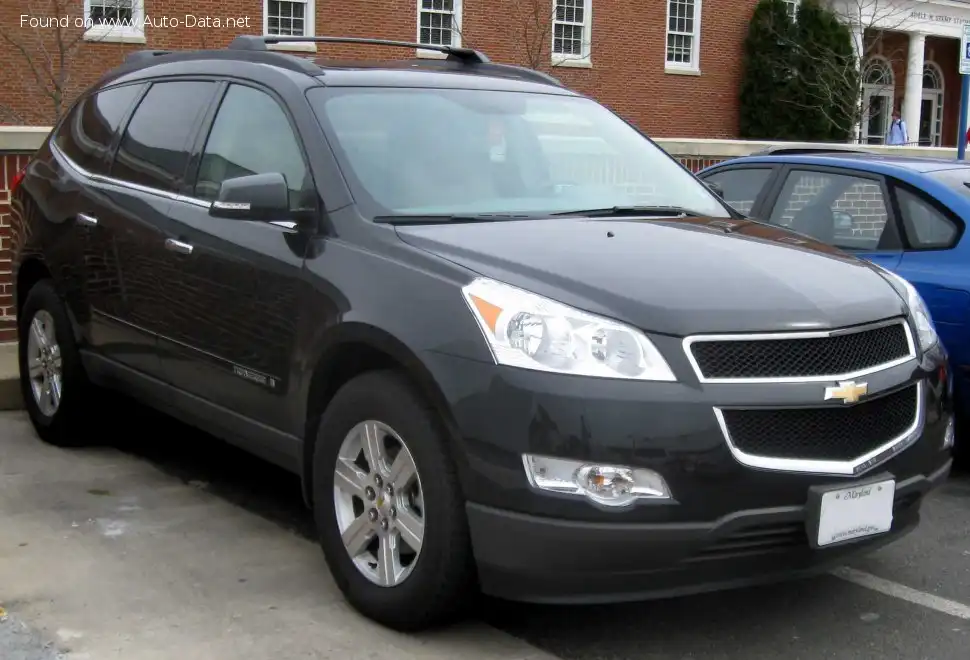
The Chevrolet Traverse I, specifically the 3.6-liter V6 281 horsepower all-wheel drive automatic variant, was a significant entry into the burgeoning crossover SUV market for General Motors. Produced from 2009 to 2012, this first-generation Traverse (model code: 84AY) was designed to address the growing demand for family-friendly vehicles with three-row seating and ample cargo space. Built on the GM Theta Premium platform – shared with the Buick Enclave, GMC Acadia, and Saturn Outlook – the Traverse aimed to provide a more affordable alternative to traditional large SUVs while maintaining a competitive level of features and capability. This particular configuration, with the 3.6L V6 and six-speed automatic transmission, represented a mid-range offering within the Traverse lineup, balancing performance with fuel efficiency and price.
Technical Specifications
| Brand | Chevrolet |
| Model | Traverse |
| Generation | Traverse I |
| Type (Engine) | 3.6 V6 (281 Hp) AWD Automatic |
| Start of production | 2009 |
| End of production | 2012 |
| Powertrain Architecture | Internal Combustion engine |
| Body type | SUV, Crossover |
| Seats | 7-8 |
| Doors | 5 |
| Fuel consumption (urban) | 14.7 l/100 km (16 US mpg, 19.2 UK mpg, 6.8 km/l) |
| Fuel consumption (combined) | 10.2 l/100 km (23.1 US mpg, 27.7 UK mpg, 9.8 km/l) |
| Fuel Type | Petrol (Gasoline) |
| Weight-to-power ratio | 8 kg/Hp, 125.8 Hp/tonne |
| Weight-to-torque ratio | 6.2 kg/Nm, 161.6 Nm/tonne |
| Power | 281 Hp @ 6300 rpm |
| Power per litre | 78.8 Hp/l |
| Torque | 361 Nm @ 3600 rpm (266.26 lb.-ft. @ 3600 rpm) |
| Maximum engine speed | 6950 rpm |
| Engine layout | Front, Transverse |
| Engine Model/Code | LLT |
| Engine displacement | 3564 cm3 (217.49 cu. in.) |
| Number of cylinders | 6 |
| Engine configuration | V-engine |
| Cylinder Bore | 94 mm (3.7 in.) |
| Piston Stroke | 85.6 mm (3.37 in.) |
| Compression ratio | 11.4:1 |
| Number of valves per cylinder | 4 |
| Fuel injection system | Direct injection |
| Engine aspiration | Naturally aspirated engine |
| Valvetrain | DOHC |
| Engine oil capacity | 5.2 l (5.49 US qt | 4.58 UK qt) |
| Coolant capacity | 10.8 l (11.41 US qt | 9.5 UK qt) |
| Kerb Weight | 2234 kg (4925.13 lbs.) |
| Max. weight | 2930 kg (6459.54 lbs.) |
| Max load | 696 kg (1534.42 lbs.) |
| Trunk (boot) space – minimum | 691 l (24.4 cu. ft.) |
| Trunk (boot) space – maximum | 3296 l (116.4 cu. ft.) |
| Fuel tank capacity | 83.3 l (22.01 US gal | 18.32 UK gal) |
| Permitted trailer load with brakes (12%) | 2358 kg (5198.5 lbs.) |
| Length | 5206 mm (204.96 in.) |
| Width including mirrors | 1991 mm (78.39 in.) |
| Height | 1846 mm (72.68 in.) |
| Wheelbase | 3019 mm (118.86 in.) |
| Front track | 1721 mm (67.76 in.) |
| Rear (Back) track | 1711 mm (67.36 in.) |
| Ride height (ground clearance) | 183 mm (7.2 in.) |
| Minimum turning circle (turning diameter) | 12.3 m (40.35 ft.) |
| Drive wheel | All wheel drive (4×4) |
| Number of gears and type of gearbox | 6 gears, automatic transmission Hydra-Matic 6T75 |
| Front suspension | Independent, type McPherson with coil spring and anti-roll bar |
| Rear suspension | Independent multi-link suspension |
| Front brakes | Ventilated discs, 325 mm |
| Rear brakes | Ventilated discs, 331 mm |
| Assisting systems | ABS (Anti-lock braking system) |
| Steering type | Steering rack and pinion |
| Power steering | Hydraulic Steering |
| Tires size | 245/70 R17; 255/65 R18; 255/55 R20 |
| Wheel rims size | 7J x 17; 7.5J x 18; 8J x 20 |
Powertrain & Engine Architecture
At the heart of this Traverse variant lies the GM LLT 3.6-liter V6 engine. This engine is a naturally aspirated, 60-degree V6 featuring an aluminum cylinder block and heads. It utilizes direct fuel injection, a technology that improves fuel efficiency and power output by injecting fuel directly into the combustion chamber. The LLT engine employs a dual overhead camshaft (DOHC) valvetrain with four valves per cylinder, optimizing airflow for enhanced performance. The engine’s output of 281 horsepower and 266 lb-ft of torque was considered adequate for moving the relatively heavy Traverse, but it wasn’t a performance leader in its class. The engine is paired with a six-speed Hydra-Matic 6T75 automatic transmission. This transmission was known for its smooth shifting characteristics and reliability, although some owners reported occasional issues with the torque converter. The all-wheel-drive system was an automatic, on-demand system that engaged the rear wheels when traction was lost, providing enhanced stability in inclement weather.
Driving Characteristics
The 3.6L V6 and automatic transmission combination in the Traverse offered a comfortable and predictable driving experience. Acceleration was adequate for everyday driving, but the Traverse wasn’t particularly quick. The automatic transmission was tuned for smooth shifts and fuel economy, rather than aggressive performance. The six-speed transmission helped keep engine speeds relatively low at highway speeds, contributing to a quieter cabin. Compared to the base 3.5L V6 engine offered in some Traverse trims, the 3.6L provided a noticeable increase in power and responsiveness. However, it didn’t offer the same level of performance as the optional upgraded engines found in other GM crossovers. The all-wheel-drive system provided confident handling in slippery conditions, but it added weight and slightly reduced fuel economy compared to front-wheel-drive models.
Equipment & Trim Levels
The 3.6L AWD automatic Traverse typically came standard with features such as tri-zone automatic climate control, a premium audio system, power-adjustable front seats, and a rearview camera. Higher trim levels, such as the LTZ, added features like leather upholstery, heated front seats, a power liftgate, and a navigation system. Optional extras included a DVD entertainment system, sunroof, and upgraded alloy wheels. The interior design was generally considered functional and spacious, with ample storage compartments throughout the cabin. The third-row seats were relatively comfortable for adults on shorter trips, but they could be cramped for taller passengers.
Chassis & Braking
The Traverse utilized an independent suspension system at all four wheels, featuring a McPherson strut setup in the front and a multi-link setup in the rear. This suspension design provided a comfortable ride quality, absorbing bumps and imperfections in the road effectively. The Traverse’s braking system consisted of ventilated discs at all four wheels, providing adequate stopping power for its weight class. Anti-lock brakes (ABS) were standard, enhancing safety and control during emergency braking situations. The steering was hydraulic power-assisted, offering a responsive and predictable feel.
Market Reception & Comparison
The Chevrolet Traverse was generally well-received by critics and consumers alike. It was praised for its spacious interior, comfortable ride, and competitive price. However, some reviewers noted that its handling wasn’t as sharp as some of its competitors, and its fuel economy was average for its class. Compared to other trims in the Traverse lineup, the 3.6L AWD automatic offered a good balance of performance, features, and price. It was a popular choice for families who needed a spacious and capable crossover SUV without breaking the bank. The 3.6L engine offered a noticeable improvement in performance over the base 3.5L engine, while the all-wheel-drive system provided added security and confidence in inclement weather.
Legacy
The Chevrolet Traverse I, particularly the 3.6L V6 AWD automatic variant, has proven to be a relatively reliable vehicle in the used car market. The LLT engine is known for its durability, and the 6T75 transmission has a generally good track record. Common issues reported by owners include occasional problems with the water pump and thermostat housing. However, these issues are typically not major and can be addressed with routine maintenance. Today, the first-generation Traverse remains a popular choice for budget-conscious buyers looking for a spacious and capable family vehicle. Its combination of practicality, reliability, and affordability has ensured its continued presence on roads across the United States.