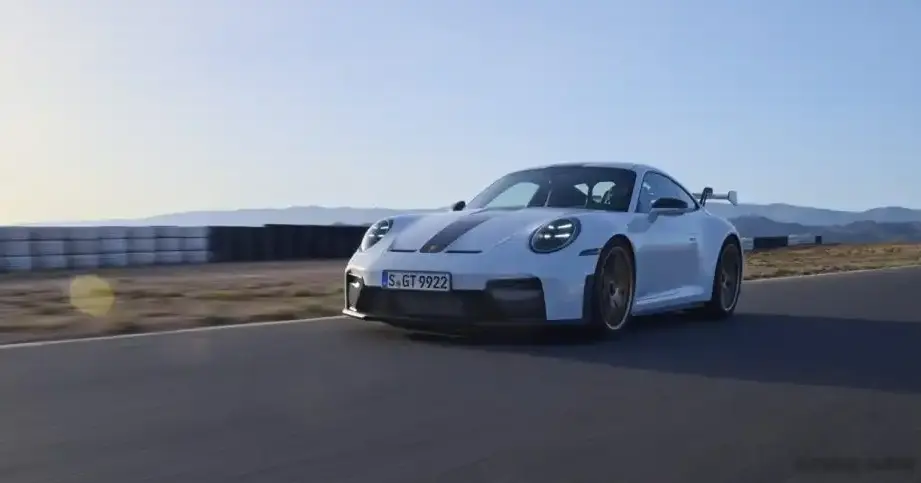
The Porsche 911 GT3 4.0 (510 Hp), introduced in October 2024 as part of the 992 generation’s facelift, represents a focused, high-performance iteration of Porsche’s iconic sports car. Building upon the already lauded 992 platform, the GT3 4.0 prioritizes track capability and driver engagement. It slots into the 911 lineup as a dedicated performance model, positioned above the Carrera and Carrera S variants, but below the even more extreme RS models. This variant is exclusively offered as a coupe with two doors and two seats, catering to enthusiasts seeking a visceral driving experience.
Technical Specifications
| Brand | Porsche |
| Model | 911 |
| Generation | 911 (992, facelift 2024) |
| Type (Engine) | GT3 4.0 (510 Hp) |
| Start of production | October, 2024 |
| Powertrain Architecture | Internal Combustion engine |
| Body type | Coupe |
| Seats | 2 |
| Doors | 2 |
| Combined fuel consumption (WLTP) | 13.7 l/100 km |
| Combined fuel consumption (US mpg) | 17.2 US mpg |
| Combined fuel consumption (UK mpg) | 20.6 UK mpg |
| Combined fuel consumption (km/l) | 7.3 km/l |
| CO2 emissions (WLTP) | 310 g/km |
| Fuel Type | Petrol (Gasoline) |
| Acceleration 0 – 100 km/h | 3.9 sec |
| Acceleration 0 – 62 mph | 3.9 sec |
| Acceleration 0 – 60 mph | 3.7 sec |
| Acceleration 0 – 200 km/h | 11.9 sec |
| Maximum speed | 313 km/h (194.49 mph) |
| Emission standard | Euro 6e |
| Weight-to-power ratio | 2.9 kg/Hp, 348.8 Hp/tonne |
| Weight-to-torque ratio | 3.2 kg/Nm, 307.8 Nm/tonne |
| Power | 510 Hp |
| Power per litre | 127.6 Hp/l |
| Torque | 450 Nm (331.9 lb.-ft.) |
| Maximum engine speed | 9000 rpm |
| Engine layout | Rear, Longitudinal |
| Engine displacement | 3996 cm3 (243.85 cu. in.) |
| Number of cylinders | 6 |
| Engine configuration | Boxer |
| Cylinder Bore | 102 mm (4.02 in.) |
| Piston Stroke | 81.5 mm (3.21 in.) |
| Number of valves per cylinder | 4 |
| Fuel injection system | Direct injection |
| Engine aspiration | Naturally aspirated engine |
| Valvetrain | DOHC |
| Kerb Weight | 1462 kg (3223.16 lbs.) |
| Max. weight | 1765 kg (3891.16 lbs.) |
| Max load | 303 kg (668 lbs.) |
| Trunk (boot) space – minimum | 373 l (13.17 cu. ft.) |
| Length | 4570 mm (179.92 in.) |
| Width | 1852 mm (72.91 in.) |
| Width including mirrors | 2033 mm (80.04 in.) |
| Height | 1279 mm (50.35 in.) |
| Wheelbase | 2457 mm (96.73 in.) |
| Ride height (ground clearance) | 76 mm (2.99 in.) |
| Minimum turning circle | 10.4 m (34.12 ft.) |
| Front tires | 255/35 ZR20 |
| Rear tires | 315/30 ZR21 |
| Front wheel rims | 20 |
| Rear wheel rims | 21 |
| Number of gears | 6 |
| Gearbox type | Manual transmission |
Powertrain & Engine Architecture
The heart of the 911 GT3 4.0 is its naturally aspirated 4.0-liter flat-six engine, derived from the 911 RSR race car. This engine, internally designated as the 9A2.2, produces 510 horsepower at 8,400 rpm and 450 Nm (331.9 lb.-ft.) of torque. It features direct fuel injection, a dry-sump lubrication system for reliable oil supply during high-G maneuvers, and a dual-mass flywheel. The engine’s valvetrain utilizes dual overhead camshafts (DOHC) and four valves per cylinder. A six-speed manual transmission is the sole gearbox option, emphasizing driver control and engagement. The rear-wheel drive configuration further contributes to the car’s focused driving dynamics.
Driving Characteristics
The 911 GT3 4.0 delivers a raw and engaging driving experience. The naturally aspirated engine provides a linear power delivery and a thrilling soundtrack, encouraging drivers to explore the engine’s high-revving nature. The manual transmission requires precise shifting, rewarding skilled drivers with optimal control. The car’s suspension, tuned for track performance, provides exceptional grip and stability, while the rear-wheel drive layout allows for controlled oversteer. Compared to lower-spec 911 models, the GT3 4.0 offers significantly sharper handling and a more direct connection to the road. While not as forgiving as some other sports cars, the GT3 4.0 rewards driver skill with exceptional performance.
Equipment & Trim Levels
The GT3 4.0 is relatively sparsely equipped compared to other 911 variants, prioritizing weight reduction and performance. Standard features include sport seats, a Porsche Communication Management (PCM) system with navigation, and a track-focused driving mode selector. Optional extras include carbon fiber interior trim, a Club Sport package (which adds a roll cage and six-point harnesses), and various customization options through Porsche’s “Personalization Plus” program. Interior upholstery is typically Alcantara and leather, with a focus on providing a secure and supportive driving environment. The dashboard layout is functional and driver-centric, with clear instrumentation and minimal distractions.
Chassis & Braking
The GT3 4.0 features a modified chassis compared to standard 911 models, with increased rigidity and optimized aerodynamics. The suspension utilizes coil springs, double wishbones at the front, and an independent multi-link setup at the rear, both incorporating transverse stabilizers. Braking is handled by ventilated discs on all four wheels, providing exceptional stopping power. The car is equipped with Porsche’s Active Brake Cooling (ABC) system, which directs airflow to the brakes to prevent fade during intense track use. The steering system is a rack-and-pinion setup with electric power assistance, offering precise and responsive control.
Market Reception & Comparison
The 911 GT3 4.0 has been widely praised by automotive critics for its exceptional performance, engaging driving dynamics, and track-focused capabilities. It is often considered one of the most rewarding sports cars available, offering a pure and unfiltered driving experience. Compared to other high-performance 911 variants, such as the Turbo S, the GT3 4.0 prioritizes driver involvement over outright speed. While the Turbo S offers quicker acceleration and more luxurious features, the GT3 4.0 provides a more visceral and engaging driving experience. Fuel economy is understandably poor, reflecting the car’s high-performance nature, and maintenance costs are significant due to the specialized components and frequent servicing required.
Legacy
The 911 GT3 4.0 is expected to become a highly sought-after collector’s item, particularly given its limited production run and focus on the traditional, naturally aspirated engine formula. The 9A2.2 engine is considered a masterpiece of engineering, and its reliability is generally good when properly maintained. On the used car market, prices for well-maintained examples are expected to remain high, reflecting the car’s desirability and performance credentials. The GT3 4.0 represents a high point in Porsche’s commitment to delivering a pure and engaging driving experience, and its legacy will likely endure for years to come.