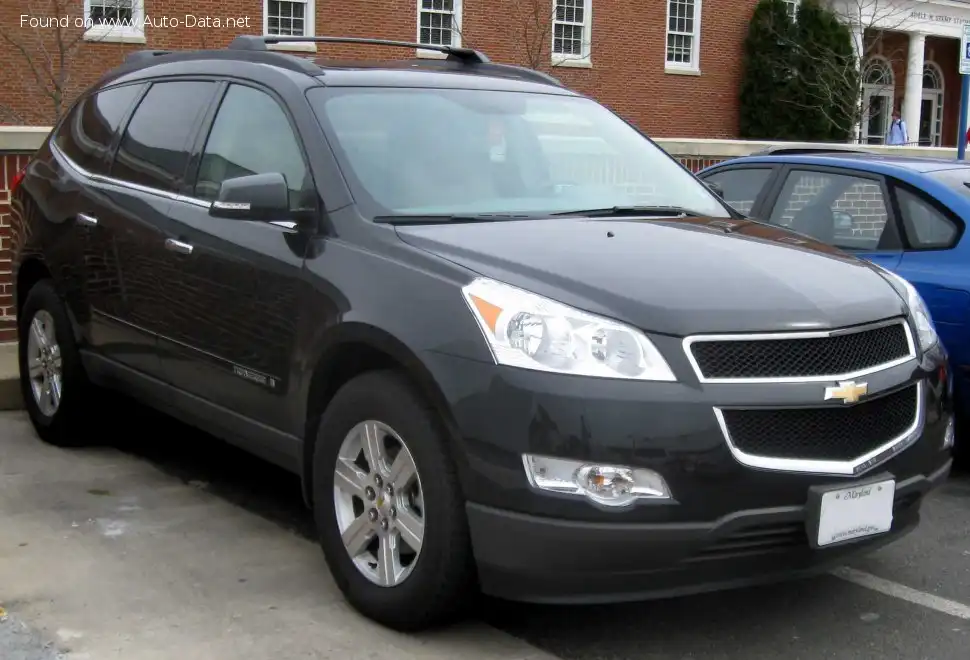
The Chevrolet Traverse I, equipped with the 3.6-liter V6 engine producing 288 horsepower and paired with a six-speed automatic transmission, represented Chevrolet’s entry into the burgeoning full-size crossover SUV segment. Produced from 2009 to 2012, this first-generation Traverse (model code: 84AY) was designed to compete with vehicles like the Ford Explorer and Honda Pilot, offering seating for up to eight passengers and a substantial cargo capacity. It was built on the GM Theta Premium platform, shared with the Buick Enclave, GMC Acadia, and Saturn Outlook, leveraging economies of scale for General Motors.
Technical Specifications
| Brand | Chevrolet |
| Model | Traverse |
| Generation | Traverse I |
| Type (Engine) | 3.6 V6 (288 Hp) Automatic |
| Start of production | 2009 |
| End of production | 2012 |
| Powertrain Architecture | Internal Combustion engine |
| Body type | SUV, Crossover |
| Seats | 7-8 |
| Doors | 5 |
| Fuel consumption (urban) | 13.8 l/100 km (17 US mpg, 20.5 UK mpg, 7.2 km/l) |
| Fuel consumption (combined) | 9.8 l/100 km (24 US mpg, 28.8 UK mpg, 10.2 km/l) |
| Fuel Type | Petrol (Gasoline) |
| Weight-to-power ratio | 7.4 kg/Hp, 134.5 Hp/tonne |
| Weight-to-torque ratio | 5.8 kg/Nm, 170.9 Nm/tonne |
| Power | 288 Hp @ 6300 rpm |
| Power per litre | 80.8 Hp/l |
| Torque | 366 Nm @ 3400 rpm (269.95 lb.-ft. @ 3400 rpm) |
| Maximum engine speed | 6950 rpm |
| Engine layout | Front, Transverse |
| Engine Model/Code | LLT |
| Engine displacement | 3564 cm3 (217.49 cu. in.) |
| Number of cylinders | 6 |
| Engine configuration | V-engine |
| Cylinder Bore | 94 mm (3.7 in.) |
| Piston Stroke | 85.6 mm (3.37 in.) |
| Compression ratio | 11.4:1 |
| Number of valves per cylinder | 4 |
| Fuel injection system | Direct injection |
| Engine aspiration | Naturally aspirated engine |
| Valvetrain | DOHC |
| Engine oil capacity | 5.2 l (5.49 US qt | 4.58 UK qt) |
| Coolant | 10.8 l (11.41 US qt | 9.5 UK qt) |
| Kerb Weight | 2141 kg (4720.1 lbs.) |
| Max. weight | 2930 kg (6459.54 lbs.) |
| Max load | 789 kg (1739.45 lbs.) |
| Trunk (boot) space – minimum | 691 l (24.4 cu. ft.) |
| Trunk (boot) space – maximum | 3296 l (116.4 cu. ft.) |
| Fuel tank capacity | 83.3 l (22.01 US gal | 18.32 UK gal) |
| Permitted trailer load with brakes (12%) | 2358 kg (5198.5 lbs.) |
| Length | 5206 mm (204.96 in.) |
| Width including mirrors | 1991 mm (78.39 in.) |
| Height | 1846 mm (72.68 in.) |
| Wheelbase | 3019 mm (118.86 in.) |
| Front track | 1721 mm (67.76 in.) |
| Rear (Back) track | 1711 mm (67.36 in.) |
| Ride height (ground clearance) | 183 mm (7.2 in.) |
| Minimum turning circle (turning diameter) | 12.3 m (40.35 ft.) |
| Drivetrain Architecture | The Internal combustion engine (ICE) drives the front wheels of the vehicle. |
| Drive wheel | Front wheel drive |
| Number of gears and type of gearbox | 6 gears, automatic transmission Hydra-Matic T75 |
| Front suspension | Independent, type McPherson with coil spring and anti-roll bar |
| Rear suspension | Independent multi-link suspension |
| Front brakes | Ventilated discs, 325 mm |
| Rear brakes | Ventilated discs, 331 mm |
| Assisting systems | ABS (Anti-lock braking system) |
| Steering type | Steering rack and pinion |
| Power steering | Hydraulic Steering |
| Tires size | 245/70 R17; 255/65 R18; 255/55 R20 |
| Wheel rims size | 7J x 17; 7.5J x 18; 8J x 20 |
Powertrain & Engine Architecture
The heart of the Traverse I 3.6L was the LLT engine, a 3.6-liter naturally aspirated V6. This engine featured a 60-degree V-angle and utilized aluminum cylinder heads and a cast iron block. Direct fuel injection was a key feature, improving fuel efficiency and power output. The engine employed a dual overhead camshaft (DOHC) valvetrain with four valves per cylinder, contributing to its relatively high specific output. The Hydra-Matic 6T75 six-speed automatic transmission was the sole transmission offering for this variant. This transmission was known for its smooth shifts and relatively quick response, though it wasn’t particularly sporty in its tuning. The transmission was electronically controlled, adapting shift points based on driving conditions and throttle input.
Driving Characteristics
The 288-horsepower V6 and six-speed automatic provided adequate, but not exhilarating, performance. Acceleration from 0 to 60 mph typically took around 8-9 seconds. The automatic transmission was geared for comfortable cruising rather than aggressive acceleration. The gear ratios were optimized for highway efficiency and relaxed driving. Compared to the available 220-horsepower 2.8L four-cylinder engine (not widely offered), the 3.6L offered a significant improvement in power and towing capacity. However, it lacked the more spirited performance of potential upgrades like a V8 found in some competing models. The front-wheel-drive configuration contributed to decent fuel economy for a vehicle of its size, but also limited traction in inclement weather.
Equipment & Trim Levels
The 3.6L Traverse typically came in LS, LT, and LTZ trim levels. The LS model served as the base trim, offering standard features like cloth upholstery, a basic audio system, and manual climate control. The LT trim added features such as alloy wheels, upgraded audio, and power-adjustable seats. The LTZ was the premium trim, boasting leather upholstery, a premium audio system, rear-seat entertainment options, and advanced safety features. Optional extras included a navigation system, sunroof, and all-wheel drive (though AWD was more common with the V6 engine). Standard safety features across all trims included ABS, stability control, and multiple airbags.
Chassis & Braking
The Traverse I utilized an independent suspension system at all four wheels. The front suspension employed a McPherson strut design with coil springs and an anti-roll bar, while the rear featured an independent multi-link setup. This suspension configuration provided a comfortable ride quality, though handling was not particularly sharp. Braking duties were handled by ventilated discs at all four corners. The braking system was adequate for everyday driving, but larger wheels and tires on higher trims offered improved stopping power. The steering system was a hydraulic rack-and-pinion setup, providing reasonable steering feel and responsiveness.
Market Reception & Comparison
The Chevrolet Traverse I was generally well-received by critics for its spacious interior, comfortable ride, and competitive pricing. However, some reviewers noted its somewhat bland styling and lack of a truly sporty driving experience. Compared to the four-cylinder version, the 3.6L V6 was the preferred choice for most buyers due to its superior performance and towing capacity. Fuel economy was comparable to other V6-powered crossovers in its class. Reliability was generally good, though some owners reported minor issues with the automatic transmission and electrical components.
Legacy
The Chevrolet Traverse I, particularly the 3.6L V6 Automatic variant, established the Traverse as a viable contender in the full-size crossover segment. While the first generation had its shortcomings, it laid the foundation for the more refined and popular second-generation model. On the used car market, these Traverses represent a relatively affordable option for families needing a spacious and practical vehicle. The LLT engine is generally considered reliable, but regular maintenance, including oil changes and transmission fluid services, is crucial for long-term durability. Parts availability remains good, making repairs relatively straightforward and cost-effective.