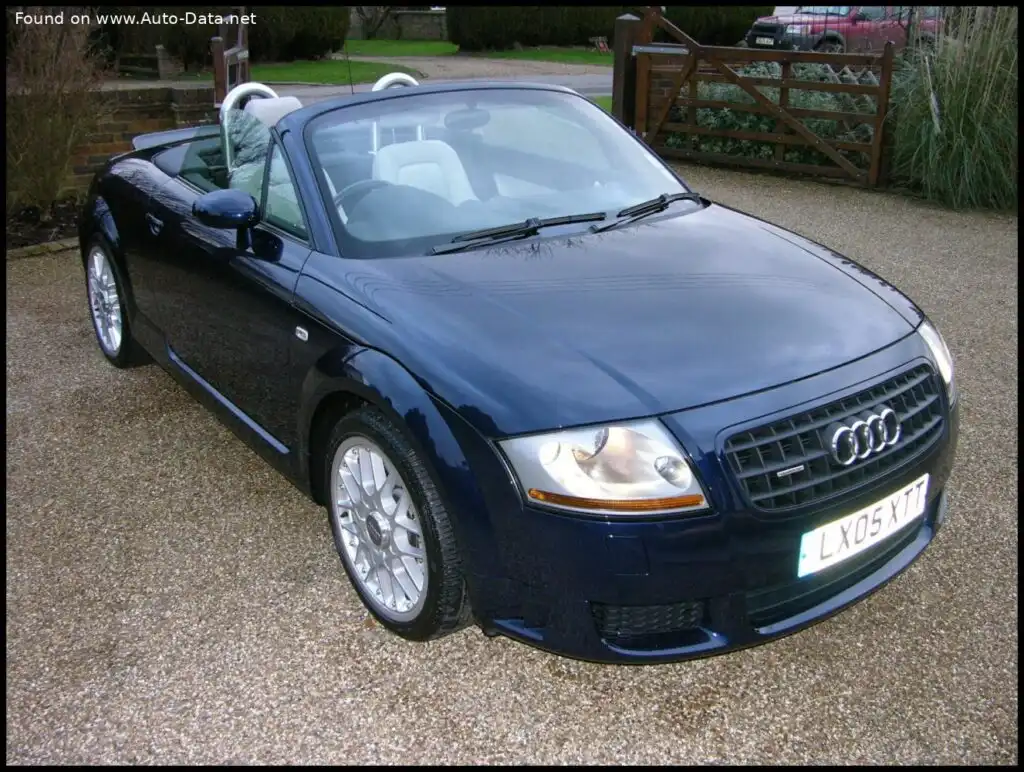
The Audi TT Roadster (8N, facelifted in 2000) 1.8T quattro represents a compelling blend of sporty handling and open-air driving enjoyment within the first generation TT lineup. Introduced in 2000 as part of a mid-cycle refresh of the 8N platform, this variant occupied a sweet spot in the range, offering a significant performance upgrade over the base 1.8T models while remaining more accessible than the flagship 3.2L V6. Production continued through June 2006, solidifying its place as a popular choice for enthusiasts seeking a stylish and engaging roadster. The 8N TT, in general, was Audi’s attempt to inject a youthful, design-focused offering into their traditionally conservative lineup, and the Roadster variant further amplified this appeal.
Technical Specifications
| Brand | Audi |
| Model | TT |
| Generation | TT Roadster (8N, facelift 2000) |
| Type (Engine) | 1.8 T (180 Hp) quattro |
| Start of production | 2000 |
| End of production | June, 2006 |
| Powertrain Architecture | Internal Combustion engine |
| Body type | Roadster |
| Seats | 2 |
| Doors | 2 |
| Fuel consumption (urban) | 13.1 l/100 km (18 US mpg, 21.6 UK mpg, 7.6 km/l) |
| Fuel consumption (extra urban) | 7.6 l/100 km (30.9 US mpg, 37.2 UK mpg, 13.2 km/l) |
| Fuel consumption (combined) | 9.5 l/100 km (24.8 US mpg, 29.7 UK mpg, 10.5 km/l) |
| CO2 emissions | 228 g/km |
| Fuel Type | Petrol (Gasoline) |
| Acceleration 0 – 100 km/h | 8.2 sec |
| Acceleration 0 – 62 mph | 8.2 sec |
| Acceleration 0 – 60 mph | 7.8 sec |
| Maximum speed | 220 km/h (136.7 mph) |
| Emission standard | Euro 4 |
| Weight-to-power ratio | 8.1 kg/Hp, 122.9 Hp/tonne |
| Weight-to-torque ratio | 6.2 kg/Nm, 160.4 Nm/tonne |
| Power | 180 Hp @ 5500 rpm |
| Power per litre | 101.1 Hp/l |
| Torque | 235 Nm @ 1950-5000 rpm (173.33 lb.-ft. @ 1950-5000 rpm) |
| Engine layout | Front, Transverse |
| Engine Model/Code | AJQ, APP, ATC, AUQ |
| Engine displacement | 1781 cm3 (108.68 cu. in.) |
| Number of cylinders | 4 |
| Engine configuration | Inline |
| Cylinder Bore | 81 mm (3.19 in.) |
| Piston Stroke | 86.4 mm (3.4 in.) |
| Compression ratio | 9.5:1 |
| Number of valves per cylinder | 5 |
| Fuel injection system | Multi-port manifold injection |
| Engine aspiration | Turbocharger |
| Valvetrain | DOHC |
| Engine oil capacity | 4.5 l (4.76 US qt | 3.96 UK qt) |
| Coolant | 5 l (5.28 US qt | 4.4 UK qt) |
| Kerb Weight | 1465 kg (3229.77 lbs.) |
| Max. weight | 1765 kg (3891.16 lbs.) |
| Max load | 300 kg (661.39 lbs.) |
| Trunk (boot) space – minimum | 180 l (6.36 cu. ft.) |
| Fuel tank capacity | 62 l (16.38 US gal | 13.64 UK gal) |
| Length | 4041 mm (159.09 in.) |
| Width | 1764 mm (69.45 in.) |
| Height | 1348 mm (53.07 in.) |
| Wheelbase | 2429 mm (95.63 in.) |
| Front track | 1528 mm (60.16 in.) |
| Rear (Back) track | 1505 mm (59.25 in.) |
| Drag coefficient (Cd) | 0.34 |
| Minimum turning circle | 10.6 m (34.78 ft.) |
| Drive wheel | All wheel drive (4×4) |
| Number of gears | 6 |
| Gearbox type | Manual transmission |
| Front suspension | Independent, type McPherson with coil spring and anti-roll bar |
| Rear suspension | Independent torsion suspension |
| Front brakes | Ventilated discs |
| Rear brakes | Disc |
| Assisting systems | ABS (Anti-lock braking system) |
| Steering type | Steering rack and pinion |
| Power steering | Hydraulic Steering |
| Tires size | 205/55 R16 |
| Wheel rims size | 7J x 16 |
Powertrain & Engine Architecture
At the heart of the 1.8T quattro Roadster lies the Audi-developed 1.8-liter inline-four cylinder engine. Engine codes such as AJQ, APP, ATC, and AUQ were commonly found in this variant, each with minor variations. This engine utilizes a cast iron block with an aluminum cylinder head, a configuration that balanced durability with weight savings. The engine is turbocharged, employing a K03 turbocharger to boost power output. Fuel delivery is managed by a multi-port fuel injection system, providing precise fuel metering for optimal combustion. The engine features a double overhead camshaft (DOHC) valvetrain with five valves per cylinder (three intake, two exhaust), enhancing volumetric efficiency and contributing to the engine’s responsive nature. The six-speed manual transmission, standard on this model, provides precise gear changes and allows the driver to fully exploit the engine’s powerband. The quattro all-wheel drive system, a hallmark of Audi, distributes power between the front and rear axles, providing enhanced traction and stability, particularly in adverse weather conditions.
Driving Characteristics
The 180 horsepower and 235 Nm (173 lb-ft) of torque delivered by the 1.8T engine, coupled with the quattro all-wheel drive system, resulted in a spirited driving experience. Acceleration from 0-60 mph took approximately 7.8 seconds, making it a competitive performer in its class. While not as brutally fast as the 3.2L V6 TT Roadster, the 1.8T offered a more accessible and engaging driving experience. The turbocharger provides a noticeable surge of power in the mid-range, making overtaking maneuvers effortless. The six-speed manual transmission allows for precise control over the engine’s power delivery, while the quattro system ensures confident handling in a variety of conditions. Compared to the base 1.8T models without quattro, the 1.8T quattro offered significantly improved grip and stability, particularly during cornering.
Equipment & Trim Levels
The 1.8T quattro Roadster typically came well-equipped, reflecting Audi’s reputation for quality and refinement. Standard features included leather upholstery, power windows and locks, air conditioning, and a premium audio system. Sport seats provided excellent support during spirited driving. Optional extras included heated seats, a wind deflector (to reduce wind buffeting in the cabin), and upgraded audio systems. The interior design was minimalist and driver-focused, with a clear and intuitive layout. The dashboard featured aluminum trim accents, adding a touch of sportiness to the cabin.
Chassis & Braking
The 8N TT Roadster utilized a McPherson strut front suspension and an independent torsion beam rear suspension. This setup provided a good balance between ride comfort and handling precision. Stabilizer bars were fitted to both the front and rear axles to reduce body roll during cornering. The braking system consisted of ventilated discs at the front and solid discs at the rear, providing ample stopping power. Anti-lock braking system (ABS) was standard, enhancing safety and control. The steering was a rack-and-pinion system with hydraulic power assistance, offering precise and responsive steering feel.
Market Reception & Comparison
The Audi TT Roadster (8N) was widely praised by automotive critics for its striking design, engaging driving dynamics, and high-quality interior. The 1.8T quattro variant was particularly well-regarded for its blend of performance and practicality. It offered a compelling alternative to rivals such as the BMW Z3 and Porsche Boxster. Fuel economy was reasonable for a sports car, averaging around 24.8 US mpg in combined driving. Reliability was generally good, although some owners reported issues with the turbocharger and the cooling system. Compared to the 3.2L V6 TT Roadster, the 1.8T quattro was more affordable and fuel-efficient, making it a more accessible option for a wider range of buyers.
Legacy
The Audi TT Roadster (8N) 1.8T quattro has become a sought-after classic among enthusiasts. Its distinctive styling and engaging driving dynamics continue to appeal to drivers today. The 1.8T engine, while not the most powerful in the TT lineup, is known for its reliability and tunability. Well-maintained examples command respectable prices in the used car market. The 8N TT, in general, is credited with revitalizing Audi’s brand image and establishing the company as a leader in automotive design and innovation. The 1.8T quattro variant remains a testament to Audi’s commitment to creating sporty, stylish, and engaging vehicles.