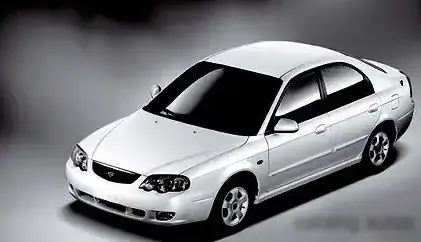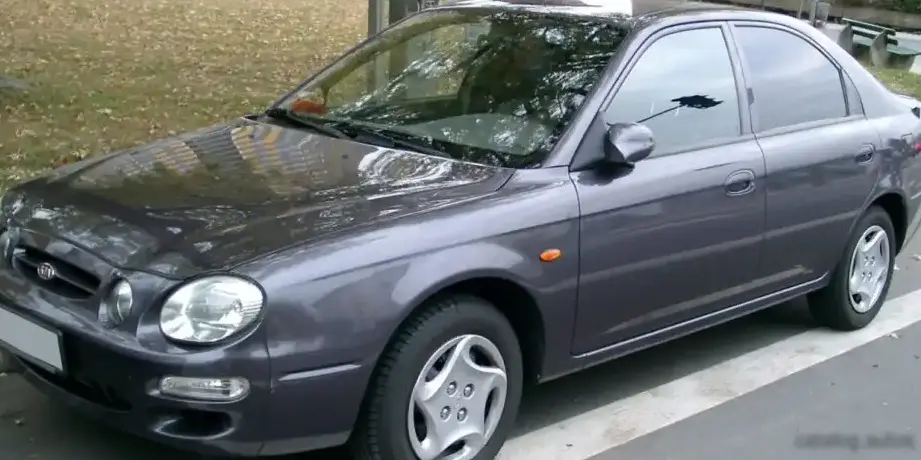
The Kia Shuma (FB) 1.8 i 16V Automatic, produced between 1997 and 2001, represented a significant step forward for Kia in the compact hatchback segment. Positioned as a mid-range offering within the Shuma lineup, this variant aimed to provide a balance of performance and convenience, appealing to buyers seeking a comfortable and practical family vehicle. The Shuma itself was Kia’s replacement for the Sephia, and was a key model in establishing the brand’s presence in European and other international markets. It was built on the shared platform with the Hyundai Accent (X3), known internally as the 1HX0/A3 platform.
Technical Specifications
| Brand | Kia |
| Model | Shuma |
| Generation | Shuma (FB) |
| Type (Engine) | 1.8 i 16V (110 Hp) Automatic |
| Start of production | 1997 |
| End of production | 2001 |
| Powertrain Architecture | Internal Combustion engine |
| Body type | Hatchback |
| Seats | 5 |
| Doors | 5 |
| Fuel consumption (urban) | 13.5 l/100 km (17.4 US mpg, 20.9 UK mpg) |
| Fuel consumption (extra urban) | 7.2 l/100 km (32.7 US mpg, 39.2 UK mpg) |
| Fuel Type | Petrol (Gasoline) |
| Acceleration 0 – 100 km/h | 12.3 sec |
| Acceleration 0 – 62 mph | 12.3 sec |
| Acceleration 0 – 60 mph | 11.7 sec |
| Maximum speed | 188 km/h (116.82 mph) |
| Weight-to-power ratio | 10.4 kg/Hp |
| Weight-to-torque ratio | 7.5 kg/Nm |
| Power | 110 Hp @ 5750 rpm |
| Torque | 152 Nm @ 4400 rpm (112.11 lb.-ft. @ 4400 rpm) |
| Engine layout | Front, Transverse |
| Engine Model/Code | T8D |
| Engine displacement | 1793 cm3 (109.42 cu. in.) |
| Number of cylinders | 4 |
| Engine configuration | Inline |
| Cylinder Bore | 81 mm (3.19 in.) |
| Piston Stroke | 87 mm (3.43 in.) |
| Compression ratio | 9.5:1 |
| Number of valves per cylinder | 4 |
| Fuel injection system | Multi-port manifold injection |
| Engine aspiration | Naturally aspirated |
| Engine oil capacity | 4 l (4.23 US qt | 3.52 UK qt) |
| Coolant capacity | 6 l (6.34 US qt | 5.28 UK qt) |
| Kerb Weight | 1140 kg (2513.27 lbs.) |
| Max. weight | 1640 kg (3615.58 lbs.) |
| Max load | 500 kg (1102.31 lbs.) |
| Trunk (boot) space – minimum | 328 l (11.58 cu. ft.) |
| Trunk (boot) space – maximum | 780 l (27.55 cu. ft.) |
| Fuel tank capacity | 50 l (13.21 US gal | 11 UK gal) |
| Length | 4475 mm (176.18 in.) |
| Width | 1711 mm (67.36 in.) |
| Height | 1427 mm (56.18 in.) |
| Wheelbase | 2560 mm (100.79 in.) |
| Front track | 1465 mm (57.68 in.) |
| Rear track | 1455 mm (57.28 in.) |
| Drivetrain Architecture | Front wheel drive |
| Number of gears | 4 |
| Gearbox type | Automatic transmission |
| Front suspension | Coil spring |
| Rear suspension | Coil spring |
| Front brakes | Disc |
| Rear brakes | Disc |
| Assisting systems | ABS (Anti-lock braking system) |
| Steering type | Steering rack and pinion |
| Power steering | Hydraulic |
| Tires size | 185/60 R14 |
| Wheel rims size | 14 |
Powertrain & Engine Architecture
The heart of the Shuma 1.8 i Automatic is the Kia T8D engine, a 1.8-liter inline-four cylinder gasoline engine. This engine utilizes a multi-port fuel injection system, delivering fuel directly into the intake ports for improved combustion efficiency. The engine features a single overhead camshaft (SOHC) design with four valves per cylinder (16V), contributing to its respectable power output for its displacement. The T8D engine is closely related to Mitsubishi’s 4G6 series engines, a result of Kia’s technical partnership with Mitsubishi during the 1990s. The automatic transmission paired with this engine is a conventional four-speed unit. While not known for its cutting-edge technology, it provided smooth and reliable shifting for everyday driving. The transmission was tuned for comfort rather than outright performance, prioritizing fuel economy and ease of use.
Driving Characteristics
The 110 horsepower and 152 Nm (112 lb-ft) of torque produced by the 1.8L engine and automatic transmission combination resulted in a 0-60 mph time of around 11.7 seconds and a top speed of 116.82 mph. Compared to the manual transmission version of the same engine, the automatic suffered a slight performance penalty due to the inherent losses within the torque converter. However, the automatic offered a more relaxed driving experience, particularly in urban environments. The gear ratios were optimized for fuel efficiency and smooth acceleration, but aggressive driving revealed the transmission’s limitations. The Shuma 1.8 Automatic wasn’t a sporty car, but it provided adequate power for merging onto highways and overtaking slower traffic. The automatic transmission’s shift points were generally well-chosen, but lacked the responsiveness of a manual gearbox.
Equipment & Trim Levels
The Shuma 1.8 i Automatic typically came equipped with features considered standard for a mid-range compact car of the late 1990s. These included power steering, central locking, electric front windows, and an AM/FM radio. Higher trim levels offered options such as air conditioning, alloy wheels, a sunroof, and upgraded interior upholstery. Interior materials were generally durable but not luxurious, reflecting the car’s price point. The dashboard layout was functional and straightforward, with easy-to-read gauges and well-placed controls. Safety features were relatively basic, consisting primarily of ABS brakes and seatbelts.
Chassis & Braking
The Shuma utilized a relatively simple chassis design, featuring coil spring suspension at all four corners. The front suspension employed MacPherson struts, while the rear utilized a twist beam setup. This configuration provided a comfortable ride, but didn’t offer particularly sharp handling. Braking duties were handled by disc brakes on all four wheels, a notable feature for a car in this class. The ABS system helped to maintain steering control during hard braking. The Shuma’s suspension was tuned for comfort, prioritizing ride quality over sporty handling. Stabilizer bars were fitted to both the front and rear axles to reduce body roll, but the car still exhibited noticeable lean in corners.
Market Reception & Comparison
The Kia Shuma 1.8 i Automatic was generally well-received by automotive critics as a practical and affordable family car. It offered a good level of equipment for its price and provided a comfortable ride. However, it wasn’t considered a particularly exciting or dynamic vehicle. Compared to other trims in the Shuma lineup, the 1.8 Automatic offered a more refined driving experience than the base 1.5L models, but lacked the performance of the higher-output engines. Fuel economy was reasonable, but not class-leading. Reliability was generally good, although some owners reported minor issues with the automatic transmission over time.
Legacy
The Kia Shuma 1.8 i Automatic, while not a groundbreaking vehicle, played an important role in establishing Kia as a credible automotive manufacturer. The T8D engine proved to be a relatively durable and reliable unit, and many examples are still on the road today. The automatic transmission, while not the most technologically advanced, generally held up well over time with proper maintenance. In the used car market, the Shuma 1.8 Automatic represents a budget-friendly option for buyers seeking a practical and reliable hatchback. Its simplicity and affordability make it an attractive choice for those looking for a no-frills transportation solution.