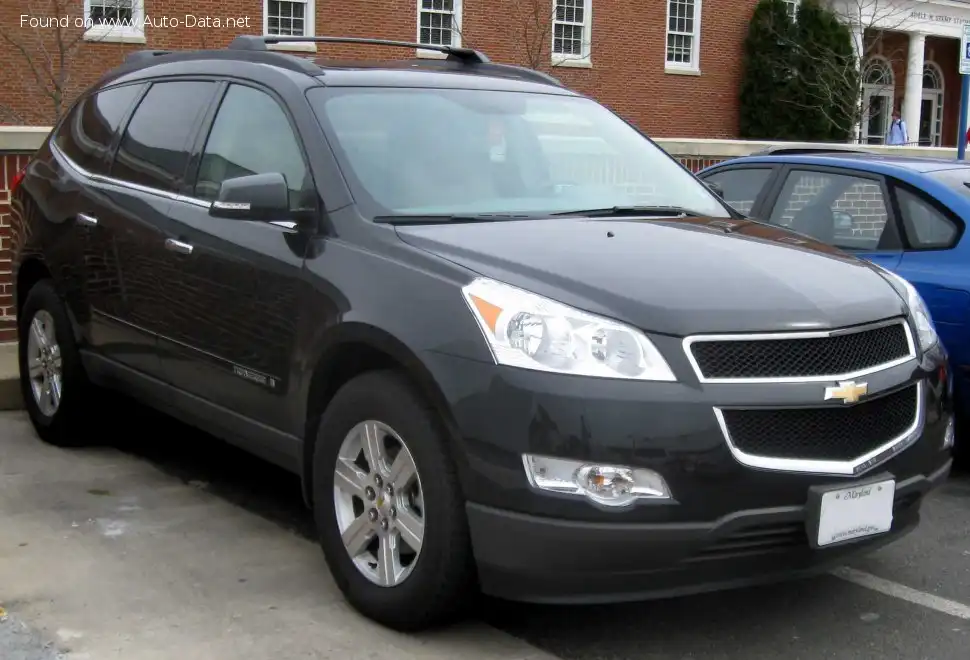
Technical Specifications
| Brand | Chevrolet |
| Model | Traverse |
| Generation | Traverse I (facelift 2012) |
| Type (Engine) | 3.6 V6 (281 Hp) AWD Automatic |
| Start of production | 2012 |
| End of production | 2017 |
| Powertrain Architecture | Internal Combustion engine |
| Body type | SUV, Crossover |
| Seats | 7-8 |
| Doors | 5 |
| Fuel consumption (urban) | 14.7 l/100 km (16 US mpg, 19.2 UK mpg, 6.8 km/l) |
| Fuel consumption (combined) | 10.2 l/100 km (23.1 US mpg, 27.7 UK mpg, 9.8 km/l) |
| Fuel Type | Petrol (Gasoline) |
| Weight-to-power ratio | 8 kg/Hp, 125 Hp/tonne |
| Weight-to-torque ratio | 6.2 kg/Nm, 160.6 Nm/tonne |
| Power | 281 Hp @ 6300 rpm |
| Power per litre | 78.8 Hp/l |
| Torque | 361 Nm @ 3400 rpm (266.26 lb.-ft. @ 3400 rpm) |
| Maximum engine speed | 6700 rpm |
| Engine layout | Front, Transverse |
| Engine Model/Code | LLT |
| Engine displacement | 3564 cm3 (217.49 cu. in.) |
| Number of cylinders | 6 |
| Engine configuration | V-engine |
| Cylinder Bore | 94 mm (3.7 in.) |
| Piston Stroke | 85.6 mm (3.37 in.) |
| Compression ratio | 11.3:1 |
| Number of valves per cylinder | 4 |
| Fuel injection system | Direct injection |
| Engine aspiration | Naturally aspirated engine |
| Valvetrain | DOHC |
| Engine oil capacity | 5.7 l (6.02 US qt | 5.02 UK qt) |
| Coolant capacity | 11.3 l (11.94 US qt | 9.94 UK qt) |
| Kerb Weight | 2248 kg (4955.99 lbs.) |
| Max. weight | 2930 kg (6459.54 lbs.) |
| Max load | 682 kg (1503.55 lbs.) |
| Trunk (boot) space – minimum | 691 l (24.4 cu. ft.) |
| Trunk (boot) space – maximum | 3293 l (116.29 cu. ft.) |
| Fuel tank capacity | 83.3 l (22.01 US gal | 18.32 UK gal) |
| Permitted trailer load with brakes (12%) | 2358 kg (5198.5 lbs.) |
| Length | 5173 mm (203.66 in.) |
| Width including mirrors | 1993 mm (78.46 in.) |
| Height | 1792 mm (70.55 in.) |
| Wheelbase | 3021 mm (118.94 in.) |
| Front track | 1709 mm (67.28 in.) |
| Rear (Back) track | 1704 mm (67.09 in.) |
| Ride height (ground clearance) | 183 mm (7.2 in.) |
| Minimum turning circle (turning diameter) | 12.3 m (40.35 ft.) |
| Drive wheel | All wheel drive (4×4) |
| Number of gears and type of gearbox | 6 gears, automatic transmission Hydra-Matic T75 |
| Front suspension | Independent, type McPherson with coil spring and anti-roll bar |
| Rear suspension | Independent multi-link suspension |
| Front brakes | Ventilated discs, 325 mm |
| Rear brakes | Ventilated discs, 331 mm |
| Assisting systems | ABS (Anti-lock braking system) |
| Steering type | Steering rack and pinion |
| Power steering | Hydraulic Steering |
| Tires size | 245/70 R17; 255/65 R18; 255/55 R20 |
| Wheel rims size | 7J x 17; 7.5J x 18; 8J x 20 |
The Chevrolet Traverse, introduced for the 2009 model year, marked Chevrolet’s entry into the growing crossover SUV segment. The first generation Traverse (2009-2017) quickly gained popularity for its generous interior space, capable of seating up to eight passengers, and its focus on family practicality. The 2012 facelift brought with it refreshed styling, upgraded interior materials, and refinements to the 3.6-liter V6 engine. This specific variant – the 3.6L V6 producing 281 horsepower, paired with a six-speed automatic transmission and all-wheel drive (AWD) – proved to be a popular choice, positioned as a mid-range offering within the Traverse lineup, striking a balance between performance, affordability, and all-weather capability.
Powertrain & Engine Architecture
The core of this Traverse variant is the 3.6-liter LLT V6 engine. This engine belongs to GM’s High Feature V6 engine family, recognized for its durable construction and generally smooth operation. The LLT incorporates direct fuel injection, a crucial technology for enhancing both power output and fuel efficiency. Direct injection allows for more precise fuel delivery, leading to a more complete combustion process. The engine also features a double overhead camshaft (DOHC) valvetrain with four valves per cylinder, further optimizing its breathing and power delivery. The Hydra-Matic 6T75 six-speed automatic transmission was the standard transmission choice. This transmission is known for its smooth shifting characteristics and relatively quick response, although it doesn’t possess the sophistication of newer eight or nine-speed automatics found in more recent vehicles. The AWD system operates primarily in front-wheel drive, engaging the rear wheels as needed to improve traction.
Driving Characteristics
The combination of the 3.6L V6’s 281 horsepower and 266 lb-ft of torque, coupled with the 6T75 automatic transmission, delivered adequate, but not particularly sporty, performance. Acceleration from 0 to 60 mph typically took around 7.5 to 8.5 seconds, depending on vehicle load and road conditions. Compared to the base 2.5L four-cylinder engine, the V6 offered a substantial power increase, making highway merging and passing maneuvers considerably easier. However, it didn’t offer the same level of performance as some competitors equipped with more powerful V6 engines. The automatic transmission’s gear ratios were calibrated for comfort and fuel economy, rather than maximizing performance. The AWD system provided confident handling in adverse weather conditions, but didn’t transform the Traverse into a dedicated off-road vehicle.
Equipment & Trim Levels
The 2012-2017 Chevrolet Traverse equipped with the 3.6L V6 and AWD typically came standard with features such as tri-zone automatic climate control, a rearview camera, Bluetooth connectivity, and a six-speaker audio system. Higher trim levels, including the LT and Premier, added features like leather upholstery, heated front seats, a power liftgate, and a navigation system. Optional extras included a dual-screen rear entertainment system, a Bose premium audio system, and advanced safety technologies like blind-spot monitoring and rear cross-traffic alert.
Chassis & Braking
The Traverse utilized an independent front suspension with McPherson struts and a multi-link independent rear suspension. This suspension setup provided a comfortable ride, effectively absorbing bumps and road imperfections. Front brakes consisted of ventilated discs measuring 325mm, while the rear brakes were also ventilated discs at 331mm. An Anti-lock Braking System (ABS) was standard equipment. The steering system was a hydraulic power-assisted rack and pinion, offering a reasonably responsive feel, although it lacked the precision found in some more modern electric power steering systems.
Market Reception & Comparison
The 281 hp V6/AWD Traverse was generally well-received by both automotive critics and consumers. It was praised for its spacious interior, comfortable ride quality, and strong value proposition. Fuel economy, however, was a frequent point of criticism, with the combined 23.1 mpg being somewhat lower than some competing models. Compared to the base four-cylinder model, the V6 offered a significant performance upgrade, justifying the higher price point. When compared to other V6-powered crossovers, the Traverse offered a competitive level of features and interior space for the money. Some competitors, offering 1.8L and 2.0L turbocharged engines, provided better fuel economy, but often at the expense of overall power and towing capacity.
Legacy
The LLT 3.6L V6 engine and 6T75 transmission pairing proved to be relatively reliable in the Chevrolet Traverse. While not entirely without minor issues – such as occasional timing chain wear and potential transmission fluid leaks – the powertrain generally demonstrated good durability over time. Today, used 2012-2017 Chevrolet Traverses with this configuration represent a compelling value for families seeking a spacious and capable crossover SUV. Maintenance costs are generally reasonable, and parts availability remains good. The Traverse continues to be a popular choice in the used car market, particularly for buyers prioritizing interior space and all-weather capability.