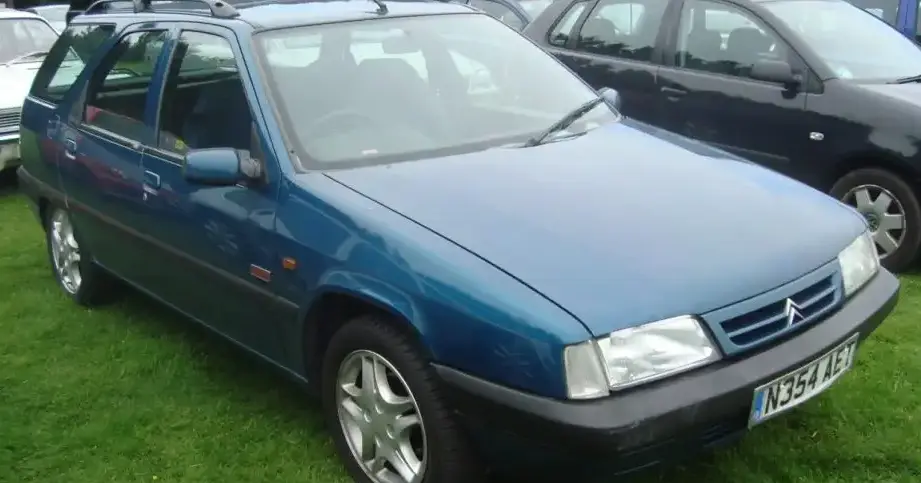
The Citroen ZX Break 1.6 MPI, produced between November 1993 and 1994, represents a practical and affordable variant within the broader ZX Break (N2, Phase I) range. Positioned as an entry-level to mid-range offering, this station wagon aimed to provide family-friendly versatility with reasonable running costs. It was a key model in Citroen’s lineup during a period focused on offering innovative design and comfort at a competitive price point, primarily targeting the European market. The ZX Break, in general, was Citroen’s replacement for the aging BX, offering a more modern and aerodynamic design.
Technical Specifications
| Brand | Citroen |
| Model | ZX |
| Generation | ZX Break (N2, Phase I) |
| Type (Engine) | 1.6 MPI (88 Hp) |
| Start of production | November, 1993 |
| End of production | 1994 |
| Powertrain Architecture | Internal Combustion engine |
| Body type | Station wagon (estate) |
| Seats | 5 |
| Doors | 5 |
| Fuel consumption (urban) | 9.7 l/100 km (24.2 US mpg, 29.1 UK mpg, 10.3 km/l) |
| Fuel consumption (extra urban) | 5.6 l/100 km (42 US mpg, 50.4 UK mpg, 17.9 km/l) |
| Fuel consumption (combined) | 7.6 l/100 km (30.9 US mpg, 37.2 UK mpg, 13.2 km/l) |
| Fuel Type | Petrol (Gasoline) |
| Acceleration 0 – 100 km/h | 12 sec |
| Acceleration 0 – 62 mph | 12 sec |
| Acceleration 0 – 60 mph | 11.4 sec |
| Maximum speed | 172 km/h (106.88 mph) |
| Weight-to-power ratio | 12.2 kg/Hp, 82.2 Hp/tonne |
| Weight-to-torque ratio | 8.1 kg/Nm, 123.4 Nm/tonne |
| Power | 88 Hp @ 6000 rpm |
| Power per litre | 55.7 Hp/l |
| Torque | 132 Nm @ 2600 rpm (97.36 lb.-ft. @ 2600 rpm) |
| Engine layout | Front, Transverse |
| Engine Model/Code | BFZ XU5JP/LZ |
| Engine displacement | 1580 cm3 (96.42 cu. in.) |
| Number of cylinders | 4 |
| Engine configuration | Inline |
| Cylinder Bore | 83 mm (3.27 in.) |
| Piston Stroke | 73 mm (2.87 in.) |
| Compression ratio | 8.95:1 |
| Number of valves per cylinder | 2 |
| Fuel injection system | Multi-port manifold injection |
| Engine aspiration | Naturally aspirated engine |
| Valvetrain | OHC |
| Engine oil capacity | 4.75 l (5.02 US qt | 4.18 UK qt) |
| Coolant | 7.5 l (7.93 US qt | 6.6 UK qt) |
| Kerb Weight | 1070 kg (2358.95 lbs.) |
| Max. weight | 1590 kg (3505.35 lbs.) |
| Max load | 520 kg (1146.4 lbs.) |
| Trunk (boot) space – minimum | 488 l (17.23 cu. ft.) |
| Trunk (boot) space – maximum | 1580 l (55.8 cu. ft.) |
| Fuel tank capacity | 65 l (17.17 US gal | 14.3 UK gal) |
| Max. roof load | 100 kg (220.46 lbs.) |
| Permitted trailer load with brakes (12%) | 1000 kg (2204.62 lbs.) |
| Permitted trailer load without brakes | 535 kg (1179.47 lbs.) |
| Permitted towbar download | 40 kg (88.18 lbs.) |
| Length | 4260 mm (167.72 in.) |
| Width | 1702 mm (67.01 in.) |
| Height | 1451 mm (57.13 in.) |
| Wheelbase | 2540 mm (100 in.) |
| Front track | 1422 mm (55.98 in.) |
| Rear (Back) track | 1415 mm (55.71 in.) |
| Front overhang | 849 mm (33.43 in.) |
| Rear overhang | 871 mm (34.29 in.) |
| Minimum turning circle (turning diameter) | 11.5 m (37.73 ft.) |
| Drivetrain Architecture | The Internal combustion engine (ICE) drives the front wheels of the vehicle. |
| Drive wheel | Front wheel drive |
| Number of gears and type of gearbox | 5 gears, manual transmission |
| Front suspension | Independent type McPherson, Wishbone |
| Rear suspension | Hydro-pneumatic element, Trailing arm |
| Front brakes | Ventilated discs |
| Rear brakes | Drum |
| Assisting systems | ABS (Anti-lock braking system) |
| Steering type | Steering rack and pinion |
| Power steering | Hydraulic Steering |
| Tires size | 175/65 R14 |
| Wheel rims size | 5.5J x 14 |
Powertrain & Engine Architecture
The Citroen ZX Break 1.6 MPI utilized the BFZ (and sometimes XU5JP/LZ) engine code, a 1.6-liter inline-four cylinder gasoline engine. This engine was a common powerplant in various Peugeot and Citroen models of the era. It featured a single overhead camshaft (OHC) valvetrain with two valves per cylinder. Fuel delivery was managed by a multi-port fuel injection system, contributing to improved efficiency and smoother operation compared to earlier carbureted designs. The engine produced 88 horsepower at 6000 rpm and 132 Nm (97.36 lb-ft) of torque at 2600 rpm. The engine’s design prioritized reliability and ease of maintenance. The 5-speed manual transmission was the standard offering, providing a balance between fuel economy and drivability.
Driving Characteristics
The 1.6 MPI engine in the ZX Break provided adequate, but not exhilarating, performance. Acceleration from 0 to 60 mph took approximately 11.4 seconds, and the top speed was around 106.88 mph. The engine felt relatively responsive at lower RPMs, making it suitable for everyday driving. However, when fully loaded or tackling steep inclines, the engine could feel strained. The 5-speed manual transmission allowed drivers to keep the engine in its optimal power band. Compared to the more powerful 2.0-liter 16V versions of the ZX, the 1.6 MPI offered a more economical driving experience, but at the expense of outright performance. The hydro-pneumatic suspension, a Citroen hallmark, provided a remarkably comfortable ride, absorbing bumps and imperfections in the road effectively.
Equipment & Trim Levels
The 1.6 MPI ZX Break typically came with a reasonable level of standard equipment. This included power steering, central locking, and an adjustable steering column. Interior upholstery was typically cloth, and the dashboard featured a functional, if somewhat utilitarian, design. Optional extras included air conditioning, electric windows, and a sunroof. The trim level was generally considered to be a step above the very basic models, offering a good balance of features for the price. The focus was on practicality and affordability rather than luxury.
Chassis & Braking
The ZX Break featured an independent McPherson strut front suspension and a hydro-pneumatic rear suspension. The hydro-pneumatic system, unique to Citroen, provided self-leveling capabilities and a very smooth ride. Front brakes were ventilated discs, offering good stopping power, while rear brakes were drums. ABS (Anti-lock Braking System) was often included as standard equipment, enhancing safety. The chassis was designed to provide a stable and predictable handling experience, prioritizing comfort over sporty dynamics.
Market Reception & Comparison
The Citroen ZX Break 1.6 MPI was generally well-received by critics as a practical and affordable family car. It was praised for its comfortable ride, spacious interior, and reasonable fuel economy. However, some reviewers noted that the engine lacked outright power, particularly when the car was fully loaded. Compared to other station wagons in its class, such as the Ford Escort Estate or the Vauxhall Astra Estate, the ZX Break offered a unique combination of comfort and practicality, thanks to its hydro-pneumatic suspension. Fuel economy was competitive, averaging around 30.9 US mpg in combined driving.
Legacy
The BFZ engine, while not known for being particularly high-performance, proved to be relatively reliable. Common issues included oil leaks and occasional problems with the fuel injection system. However, with regular maintenance, these engines could provide many years of service. Today, the Citroen ZX Break 1.6 MPI is a relatively affordable classic car, appealing to those seeking a comfortable and practical vintage station wagon. Parts availability can be a challenge, but many components are still available through specialist suppliers. The car’s unique hydro-pneumatic suspension remains a key selling point for enthusiasts.