
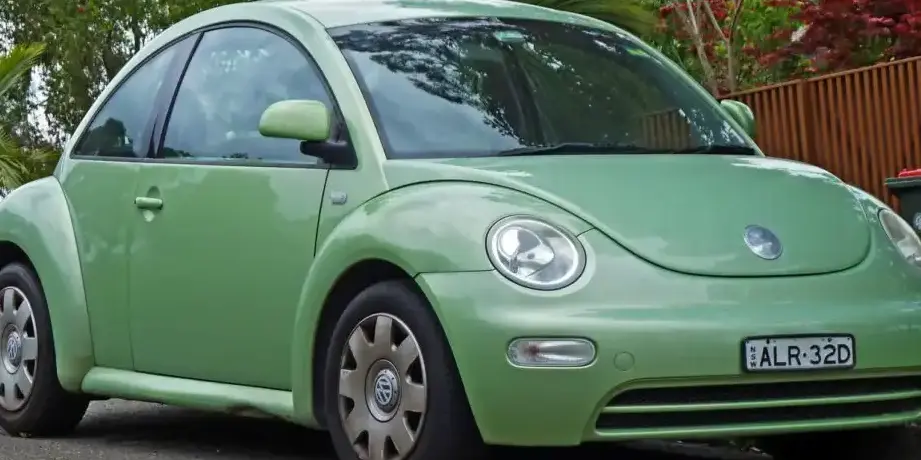
The Volkswagen New Beetle 1.6, producing 100 horsepower, was a key entry point into the New Beetle (9C) range when it launched in late 1999 and continued through the 2000 model year. Representing a nostalgic reimagining of the original Type 1 “Bug,” the New Beetle aimed to capture a youthful, style-conscious market. This 1.6-liter variant served as the base model, offering a more affordable option compared to the higher-specification engines available. It was positioned within the A3 platform family, sharing components with the Volkswagen Golf, Bora (Jetta), and Audi A3.
Technical Specifications
| Brand | Volkswagen |
| Model | Beetle |
| Generation | NEW Beetle (9C) |
| Type (Engine) | 1.6 (100 Hp) |
| Start of production | November, 1999 |
| End of production | October, 2000 |
| Powertrain Architecture | Internal Combustion engine |
| Body type | Hatchback |
| Seats | 4 |
| Doors | 3 |
| Fuel consumption (urban) | 11.1 l/100 km (21.2 US mpg, 25.4 UK mpg, 9 km/l) |
| Fuel consumption (extra urban) | 6.3 l/100 km (37.3 US mpg, 44.8 UK mpg, 15.9 km/l) |
| Fuel consumption (combined) | 7.5 l/100 km (31.4 US mpg, 37.7 UK mpg, 13.3 km/l) |
| Fuel Type | Petrol (Gasoline) |
| Acceleration 0 – 100 km/h | 11 sec |
| Acceleration 0 – 62 mph | 11 sec |
| Acceleration 0 – 60 mph | 10.5 sec |
| Maximum speed | 178 km/h (110.6 mph) |
| Weight-to-power ratio | 12.1 kg/Hp, 83 Hp/tonne |
| Weight-to-torque ratio | 8.3 kg/Nm, 120.3 Nm/tonne |
| Power | 100 Hp @ 5600 rpm |
| Power per litre | 62.7 Hp/l |
| Torque | 145 Nm @ 3800 rpm (106.95 lb.-ft. @ 3800 rpm) |
| Engine layout | Front, Transverse |
| Engine Model/Code | AWH |
| Engine displacement | 1595 cm3 (97.33 cu. in.) |
| Number of cylinders | 4 |
| Engine configuration | Inline |
| Cylinder Bore | 81 mm (3.19 in.) |
| Piston Stroke | 77.4 mm (3.05 in.) |
| Compression ratio | 10:1 |
| Number of valves per cylinder | 2 |
| Fuel injection system | Multi-port manifold injection |
| Engine aspiration | Naturally aspirated engine |
| Valvetrain | OHC |
| Engine oil capacity | 4.5 l (4.76 US qt | 3.96 UK qt) |
| Coolant | 5 l (5.28 US qt | 4.4 UK qt) |
| Kerb Weight | 1205 kg (2656.57 lbs.) |
| Max. weight | 1630 kg (3593.53 lbs.) |
| Max load | 425 kg (936.96 lbs.) |
| Trunk (boot) space – minimum | 209 l (7.38 cu. ft.) |
| Trunk (boot) space – maximum | 770 l (27.19 cu. ft.) |
| Fuel tank capacity | 55 l (14.53 US gal | 12.1 UK gal) |
| Length | 4081 mm (160.67 in.) |
| Width | 1720 mm (67.72 in.) |
| Height | 1500 mm (59.06 in.) |
| Wheelbase | 2508 mm (98.74 in.) |
| Front track | 1508 mm (59.37 in.) |
| Rear (Back) track | 1494 mm (58.82 in.) |
| Minimum turning circle | 10.9 m (35.76 ft.) |
| Drivetrain Architecture | Front wheel drive |
| Drive wheel | Front wheel drive |
| Number of gears | 5 gears, manual transmission |
| Front suspension | Coil spring |
| Rear suspension | Coil spring |
| Front brakes | Disc |
| Rear brakes | Disc |
| Assisting systems | ABS (Anti-lock braking system) |
| Steering type | Steering rack and pinion |
| Power steering | Hydraulic Steering |
| Tires size | 195/65 R15; 205/55 R16 |
| Wheel rims size | 6J x 15; 6.5J x 16 |
Powertrain & Engine Architecture
The New Beetle 1.6 was powered by the Volkswagen AWH engine, a 1.6-liter inline-four cylinder gasoline engine. This engine was a relatively simple design, utilizing a single overhead camshaft (OHC) and two valves per cylinder. Fuel delivery was handled by a multi-port fuel injection system, providing adequate, though not exceptional, performance. The AWH engine produced 100 horsepower at 5600 rpm and 145 Nm (107 lb-ft) of torque at 3800 rpm. This engine was a common sight in various Volkswagen Group vehicles of the era, known for its reliability and relatively low maintenance costs. The engine was transversely mounted at the front of the vehicle, driving the front wheels. The standard transmission for this variant was a five-speed manual gearbox, although a four-speed automatic transmission was also offered as an option, albeit less common.
Driving Characteristics
The 1.6-liter New Beetle, particularly with the manual transmission, offered a reasonably engaging driving experience for its class. However, with only 100 horsepower, acceleration was not its strong suit. The 0-60 mph time was around 10.5 seconds, and top speed was approximately 110 mph. The automatic transmission version further diminished performance, with slightly slower acceleration times. The engine felt somewhat strained when pushed hard, requiring frequent downshifts to maintain momentum. The gear ratios were tuned for fuel economy rather than outright performance. Compared to the more powerful 1.8-liter and 2.0-liter versions, the 1.6 felt noticeably slower, especially when fully loaded or tackling uphill climbs. However, its lighter weight and predictable handling made it a pleasant daily driver.
Equipment & Trim Levels
The base 1.6-liter New Beetle typically came with a modest level of standard equipment. This included power steering, central locking, electric front windows, and an AM/FM radio. Interior upholstery was typically cloth, with a simple, functional dashboard layout. Optional extras included air conditioning, alloy wheels, a sunroof, and upgraded audio systems. Higher trim levels, such as the “Comfort” or “Sport” packages, added features like heated mirrors, cruise control, and sport seats. The interior design echoed the retro theme of the exterior, with a large speedometer and a small fuel gauge, reminiscent of the original Beetle.
Chassis & Braking
The New Beetle 1.6 utilized a MacPherson strut front suspension and a twist-beam rear suspension. This setup provided a comfortable ride, although it wasn’t particularly sporty. The front brakes were ventilated discs, while the rear brakes were solid discs. Anti-lock Braking System (ABS) was standard, enhancing safety. The steering was a hydraulic power-assisted rack and pinion system, offering reasonable precision. The suspension was tuned for comfort, prioritizing ride quality over sharp handling. Stabilizer bars were fitted to both the front and rear axles to reduce body roll.
Market Reception & Comparison
The New Beetle 1.6 was generally well-received as an affordable and stylish entry point into the New Beetle range. Critics praised its retro design and comfortable ride, but noted its lack of performance. Compared to the 1.8-liter and 2.0-liter versions, the 1.6 offered significantly less power and acceleration. However, it also offered better fuel economy and lower running costs. The 1.8-liter engine, while more expensive, provided a noticeable improvement in performance and was often considered the sweet spot in the New Beetle lineup. The 1.6 was primarily targeted at buyers who prioritized style and affordability over outright performance.
Legacy
The Volkswagen New Beetle 1.6, while not the most powerful or dynamic version of the New Beetle, remains a popular choice in the used car market. The AWH engine is known for its reliability, and maintenance costs are generally reasonable. However, like all older vehicles, it’s important to check for signs of rust and ensure that regular maintenance has been performed. The New Beetle 1.6 represents a unique blend of retro styling and modern engineering, and it continues to appeal to buyers who appreciate its distinctive character. Its simplicity and affordability make it a viable option for those seeking a stylish and reliable classic car.
