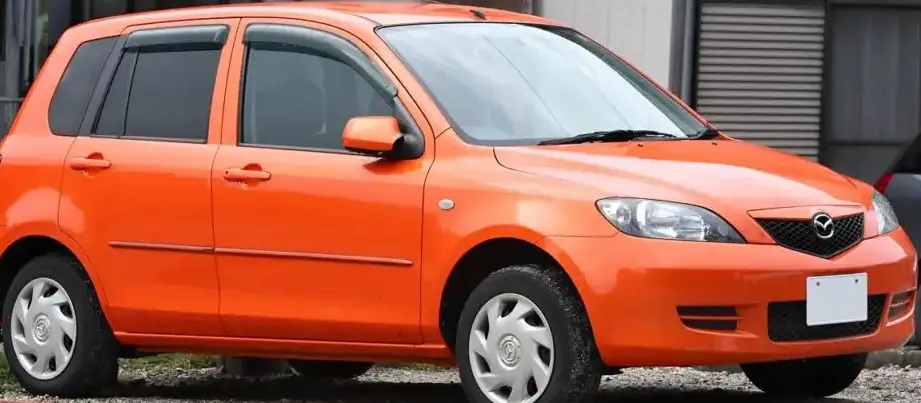
The Mazda Demio (DW) 1.5 16V, produced from 2000 to 2002, represented an entry-level offering within the second generation (DW) Demio lineup. Positioned as a practical and economical subcompact hatchback, it served as a key model for Mazda in various international markets, particularly in regions where smaller, fuel-efficient vehicles were highly sought after. The DW generation Demio, also known as the Mazda2 in some markets, aimed to provide a blend of affordability, reliability, and surprisingly spacious interior packaging for its size. This 1.5-liter variant, delivering 75 horsepower, was designed to appeal to budget-conscious buyers and those prioritizing fuel economy over outright performance.
Technical Specifications
| Brand | Mazda |
| Model | Demio |
| Generation | Demio (DW) |
| Type (Engine) | 1.5 16V (75 Hp) |
| Start of production | 2000 |
| End of production | 2002 |
| Powertrain Architecture | Internal Combustion engine |
| Body type | Hatchback |
| Seats | 5 |
| Doors | 5 |
| Fuel consumption (urban) | 9.2 l/100 km (25.6 US mpg) |
| Fuel consumption (extra urban) | 6.2 l/100 km (37.9 US mpg) |
| Fuel consumption (combined) | 7.3 l/100 km (32.2 US mpg) |
| Fuel Type | Petrol (Gasoline) |
| Acceleration 0 – 100 km/h | 13 sec |
| Acceleration 0 – 62 mph | 13 sec |
| Acceleration 0 – 60 mph | 12.4 sec |
| Maximum speed | 160 km/h (99.42 mph) |
| Weight-to-power ratio | 12.9 kg/Hp |
| Weight-to-torque ratio | 8.4 kg/Nm |
| Power | 75 Hp @ 5000 rpm |
| Torque | 116 Nm @ 2500 rpm (85.56 lb.-ft. @ 2500 rpm) |
| Engine layout | Front, Transverse |
| Engine Model/Code | B5 E |
| Engine displacement | 1498 cm3 (91.41 cu. in.) |
| Number of cylinders | 4 |
| Engine configuration | Inline |
| Cylinder Bore | 78 mm (3.07 in.) |
| Piston Stroke | 78.4 mm (3.09 in.) |
| Compression ratio | 9.4:1 |
| Number of valves per cylinder | 4 |
| Fuel injection system | Multi-port manifold injection |
| Engine aspiration | Naturally aspirated engine |
| Valvetrain | OHC |
| Engine oil capacity | 3.5 l (3.7 US qt | 3.08 UK qt) |
| Coolant capacity | 6 l (6.34 US qt | 5.28 UK qt) |
| Kerb Weight | 970 kg (2138.48 lbs.) |
| Trunk (boot) space – minimum | 330 l (11.65 cu. ft.) |
| Trunk (boot) space – maximum | 1298 l (45.84 cu. ft.) |
| Fuel tank capacity | 40 l (10.57 US gal | 8.8 UK gal) |
| Length | 3815 mm (150.2 in.) |
| Width | 1670 mm (65.75 in.) |
| Height | 1535 mm (60.43 in.) |
| Wheelbase | 2390 mm (94.09 in.) |
| Front track | 1420 mm (55.91 in.) |
| Rear track | 1418 mm (55.83 in.) |
| Drivetrain Architecture | Front wheel drive |
| Number of gears | 5 |
| Gearbox type | Manual transmission |
| Front suspension | Spring Strut |
| Rear suspension | Coil spring |
| Front brakes | Disc |
| Rear brakes | Drum |
| Assisting systems | ABS (Anti-lock braking system) |
| Steering type | Steering rack and pinion |
| Power steering | Hydraulic Steering |
| Tires size | 175/60R14 |
Powertrain & Engine Architecture
The heart of the Demio 1.5 16V is the B5-E engine, a 1.5-liter inline-four cylinder gasoline engine. This engine utilizes a single overhead camshaft (SOHC) valvetrain operating 16 valves (four per cylinder). Fuel delivery is managed by a multi-point fuel injection system, providing a balance between efficiency and responsiveness. The engine’s 9.4:1 compression ratio was a typical specification for naturally aspirated engines of the era, aiming for a compromise between power output and fuel economy. The engine’s design prioritized reliability and ease of maintenance, reflecting Mazda’s engineering philosophy at the time. The five-speed manual transmission was the standard offering for this variant, providing a relatively direct connection between the engine and the front wheels. The transmission was chosen for its simplicity and cost-effectiveness, contributing to the overall affordability of the vehicle.
Driving Characteristics
The 75 horsepower and 116 Nm (85.56 lb-ft) of torque produced by the 1.5-liter engine resulted in modest, but adequate, performance. Acceleration from 0 to 60 mph took approximately 12.4 seconds, and top speed was limited to around 99 mph. Compared to higher-spec Demio models equipped with larger engines (like the 1.8L), the 1.5L felt noticeably less powerful, particularly when fully loaded or tackling inclines. The five-speed manual transmission offered a reasonable spread of gear ratios, allowing drivers to keep the engine within its optimal power band. However, frequent downshifting was often required for overtaking maneuvers or maintaining speed on hills. The steering was light and precise, making the Demio easy to maneuver in urban environments. The suspension provided a comfortable ride, although it wasn’t particularly sporty.
Equipment & Trim Levels
The 1.5 16V Demio typically came with a fairly basic level of equipment, reflecting its position as an entry-level model. Standard features generally included power steering, central locking, and an AM/FM radio. Air conditioning was often an optional extra. Interior upholstery was typically cloth, and the dashboard featured a simple, functional design. Higher trim levels, available at an additional cost, could add features such as alloy wheels, electric windows, and a more sophisticated audio system. The focus was on providing essential features at an affordable price point.
Chassis & Braking
The Demio 1.5 16V utilized a front-wheel-drive layout with a MacPherson strut suspension in the front and a coil spring suspension in the rear. The front brakes were disc brakes, providing adequate stopping power, while the rear brakes were drum brakes, a cost-saving measure common in this class of vehicle. Anti-lock Braking System (ABS) was often included as standard equipment, enhancing safety. The chassis was designed to be lightweight, contributing to the vehicle’s fuel efficiency and nimble handling. Stabilizer bars were present, but relatively thin, prioritizing ride comfort over aggressive cornering.
Market Reception & Comparison
The Demio 1.5 16V was generally well-received by critics as a practical and economical city car. Its fuel economy of around 32.2 US mpg combined was a major selling point. However, its performance was often criticized as being somewhat underwhelming, particularly when compared to competitors with more powerful engines. Compared to other trims in the Demio lineup, such as the 1.8L models, the 1.5L offered a more affordable entry point but sacrificed performance. Reliability was generally considered to be good, with the B5-E engine proving to be durable and relatively trouble-free.
Legacy
The Mazda Demio (DW) 1.5 16V has proven to be a relatively reliable and long-lasting vehicle. In the used car market, these models are often sought after for their affordability and fuel efficiency. While not known for blistering performance, the B5-E engine has a reputation for durability, and parts availability remains reasonably good. The Demio 1.5 16V represents a solid example of a well-engineered, practical subcompact car that provided a valuable transportation solution for many buyers in the early 2000s. Its simplicity and reliability continue to make it a viable option for those seeking an economical and dependable used vehicle.