
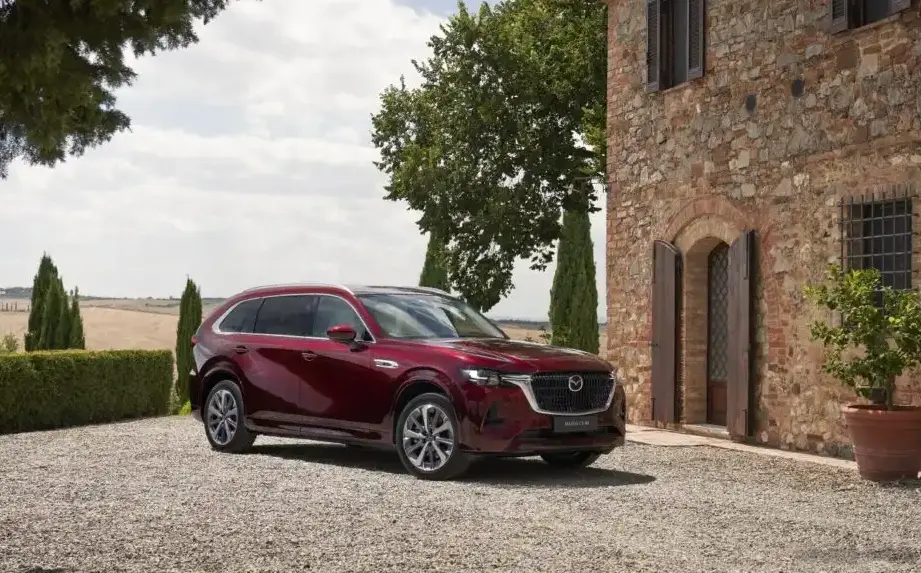
The Mazda CX-80 2.5 e-Skyactiv (327 Hp) Plug-in Hybrid i-ACTIV AWD Automatic represents Mazda’s entry into the larger, three-row SUV segment, launched in 2024. Positioned as a premium offering, it combines a naturally aspirated 2.5-liter inline-four engine with an electric motor and a substantial battery pack, delivering both all-electric range and powerful combined performance. The CX-80 is primarily aimed at the European and Asian markets, offering a blend of Mazda’s signature driving dynamics with the practicality of a seven-seat SUV. This particular powertrain configuration is a top-tier offering within the CX-80 lineup, emphasizing performance and efficiency.
Technical Specifications
| Brand | Mazda |
| Model | CX-80 |
| Generation | CX-80 |
| Type (Engine) | 2.5 e-Skyactiv (327 Hp) Plug-in Hybrid i-ACTIV AWD Automatic |
| Start of production | 2024 |
| Powertrain Architecture | PHEV (Plug-in Hybrid Electric Vehicle) |
| Body type | SUV |
| Seats | 6-7 |
| Doors | 5 |
| Combined fuel consumption (WLTP) | 1.6 l/100 km (147 US mpg, 176.6 UK mpg, 62.5 km/l) |
| CO2 emissions (WLTP) | 36 g/km |
| Fuel Type | Petrol / electricity |
| Acceleration 0 – 100 km/h | 6.8 sec |
| Acceleration 0 – 62 mph | 6.8 sec |
| Acceleration 0 – 60 mph | 6.5 sec |
| Maximum speed | 195 km/h (121.17 mph) – Electronically limited |
| Emission standard | Euro 6e |
| Weight-to-power ratio | 6.6 kg/Hp, 151 Hp/tonne |
| Weight-to-torque ratio | 4.3 kg/Nm, 230.9 Nm/tonne |
| Gross battery capacity | 17.8 kWh |
| Battery voltage | 355 V |
| Battery technology | Lithium-ion (Li-Ion) |
| Battery weight | 178 kg (392.42 lbs) |
| Battery location | Below the floor |
| All-electric range (WLTP) | 60 km (37.28 mi) |
| Average Energy consumption (WLTP) | 23.9 kWh/100 km (38.46 kWh/100 mi, 88 MPGe, 4.2 km/kWh, 2.6 mi/kWh) |
| Electric motor power | 175 Hp @ 5500 rpm |
| Electric motor Torque | 270 Nm @ 400 rpm (199.14 lb.-ft. @ 400 rpm) |
| Electric motor location | Between the combustion engine and the transmission |
| Electric motor type | Synchronous |
| System power | 327 Hp @ 6000 rpm |
| System torque | 500 Nm @ 4000 rpm (368.78 lb.-ft. @ 4000 rpm) |
| Power | 191 Hp @ 6000 rpm |
| Torque | 261 Nm @ 4000 rpm (192.5 lb.-ft. @ 4000 rpm) |
| Engine layout | Front, Longitudinal |
| Engine displacement | 2488 cm3 (151.83 cu. in.) |
| Number of cylinders | 4 |
| Engine configuration | Inline |
| Cylinder Bore | 89 mm (3.5 in.) |
| Piston Stroke | 100 mm (3.94 in.) |
| Compression ratio | 13:1 |
| Number of valves per cylinder | 4 |
| Fuel injection system | Direct injection |
| Engine aspiration | Naturally aspirated engine |
| Valvetrain | DOHC |
| Kerb Weight | 2165-2248 kg (4773.01 – 4955.99 lbs) |
| Max. weight | 2889 kg (6369.15 lbs) |
| Max load | 641-724 kg (1413.16 – 1596.15 lbs) |
| Trunk (boot) space – minimum | 258 l (9.11 cu. ft.) |
| Trunk (boot) space – maximum | 1971 l (69.61 cu. ft.) |
| Fuel tank capacity | 70 l (18.49 US gal | 15.4 UK gal) |
| Max. roof load | 100 kg (220.46 lbs) |
| Permitted trailer load with brakes (8%) | 2500 kg (5511.56 lbs) |
| Permitted trailer load with brakes (12%) | 2500 kg (5511.56 lbs) |
| Permitted trailer load without brakes | 750 kg (1653.47 lbs) |
| Length | 4995 mm (196.65 in.) |
| Width | 1890 mm (74.41 in.) |
| Height | 1710 mm (67.32 in.) |
| Wheelbase | 3120 mm (122.83 in.) |
| Front track | 1640 mm (64.57 in.) |
| Rear (Back) track | 1645 mm (64.76 in.) |
| Front overhang | 850 mm (33.46 in.) |
| Rear overhang | 1020 mm (40.16 in.) |
| Ride height (ground clearance) | 165 mm (6.5 in.) |
| Minimum turning circle (turning diameter) | 11.6 m (38.06 ft.) |
| Front brakes | Ventilated discs, 347 mm |
| Rear brakes | Ventilated discs, 350 mm |
| Front suspension | Double wishbone |
| Rear suspension | Independent multi-link spring suspension with stabilizer |
| Drive wheel | All wheel drive (4×4) |
| Number of gears and type of gearbox | 8 gears, automatic transmission |
| Steering type | Steering rack and pinion |
| Power steering | Electric Steering |
| Tires size | 235/50 R20 |
| Wheel rims size | 7.5J x 20 |
INTRODUCTION
The Mazda CX-80 2.5 e-Skyactiv Plug-in Hybrid is a significant addition to Mazda’s lineup, representing a move towards larger, more versatile SUVs. Introduced in 2024, it’s built on Mazda’s scalable architecture, allowing for a spacious interior accommodating up to seven passengers. This variant, equipped with the 2.5-liter engine and plug-in hybrid system, is positioned as a premium offering, balancing performance, fuel efficiency, and Mazda’s renowned driving experience. It’s primarily targeted towards markets where larger SUVs are in high demand, such as Europe and Asia, offering a compelling alternative to established competitors.
Powertrain & Engine Architecture
At the heart of the CX-80 2.5 e-Skyactiv is Mazda’s naturally aspirated 2.5-liter inline-four engine, designated as the P-VMOT. This engine utilizes direct injection and a high compression ratio of 13:1 to maximize efficiency and power output. It produces 191 horsepower and 192.5 lb-ft of torque. Coupled with this is a 175 hp electric motor, integrated between the engine and the eight-speed automatic transmission. The electric motor draws power from a 17.8 kWh lithium-ion battery pack located under the floor of the vehicle. The combined system output is a substantial 327 horsepower and 368.78 lb-ft of torque. The transmission itself is a sophisticated eight-speed automatic, tuned to seamlessly blend the power delivery from both the engine and the electric motor. Mazda’s i-ACTIV AWD system provides intelligent all-wheel drive, distributing torque between the front and rear axles as needed for optimal traction and stability.
Driving Characteristics
The CX-80 2.5 e-Skyactiv Plug-in Hybrid delivers a refined and surprisingly engaging driving experience. In all-electric mode, the vehicle offers quiet and smooth acceleration, with a range of approximately 37 miles. Switching to hybrid mode allows the engine and electric motor to work in tandem, providing strong acceleration and responsive performance. The 0-60 mph sprint is achieved in around 6.5 seconds. The eight-speed automatic transmission shifts smoothly and efficiently, contributing to a comfortable ride. Compared to lower-powered CX-80 variants, this plug-in hybrid offers significantly more power and torque, resulting in a more confident and capable driving experience, especially when fully loaded with passengers and cargo. While the added weight of the battery pack is noticeable, Mazda’s chassis tuning minimizes body roll and maintains a composed feel in corners.
Equipment & Trim Levels
The CX-80 2.5 e-Skyactiv Plug-in Hybrid typically comes well-equipped, reflecting its premium positioning. Standard features often include leather upholstery, a panoramic sunroof, a premium sound system, and a comprehensive suite of advanced driver-assistance systems (ADAS). These systems include adaptive cruise control, lane-keeping assist, blind-spot monitoring, and automatic emergency braking. The infotainment system features a large touchscreen display with Apple CarPlay and Android Auto integration. Optional extras may include upgraded interior trim materials, a head-up display, and ventilated front seats. Trim levels vary by market, but generally offer increasing levels of luxury and technology.
Chassis & Braking
The CX-80 utilizes a double wishbone front suspension and an independent multi-link rear suspension, both incorporating stabilizer bars to minimize body roll. This suspension setup is tuned to provide a comfortable ride while maintaining responsive handling. Braking duties are handled by ventilated discs on all four wheels, measuring 347mm at the front and 350mm at the rear. The braking system is augmented by ABS, electronic brakeforce distribution, and brake assist. The vehicle’s weight, due to the hybrid powertrain, necessitates a robust braking system to ensure confident stopping power.
Market Reception & Comparison
The Mazda CX-80 2.5 e-Skyactiv Plug-in Hybrid has been generally well-received by automotive critics, who praise its stylish design, spacious interior, and engaging driving dynamics. The plug-in hybrid powertrain is lauded for its efficiency and performance. Compared to other CX-80 trims, such as those with solely gasoline engines, the plug-in hybrid offers superior fuel economy and lower emissions, albeit at a higher price point. Competitors in the premium three-row SUV segment include the Volvo XC90 Recharge, the BMW X5 xDrive45e, and the Mercedes-Benz GLE 350e. The CX-80 aims to differentiate itself through its distinctive styling, Mazda’s focus on driving pleasure, and a competitive price-to-feature ratio.
Legacy
As a relatively new model, the long-term reliability of the CX-80 2.5 e-Skyactiv Plug-in Hybrid powertrain remains to be fully established. However, Mazda has a strong reputation for building reliable vehicles, and the naturally aspirated engine is generally considered to be less complex and potentially more durable than turbocharged alternatives. The hybrid system components, including the battery pack and electric motor, are covered by Mazda’s standard warranty. In the used car market, this variant is expected to hold its value well due to its desirable combination of performance, efficiency, and premium features. Its appeal will likely grow as demand for plug-in hybrid SUVs continues to increase.
