Technical Specifications
| Brand | Ford |
| Model | S-MAX |
| Generation | S-MAX II |
| Type (Engine) | 2.0 EcoBlue (150 Hp) S&S |
| Start of production | 2018 |
| End of production | 2019 |
| Powertrain Architecture | Internal Combustion engine |
| Body type | MPV |
| Seats | 5 |
| Doors | 5 |
| Fuel consumption (urban) | 6.0-6.2 l/100 km (39.2 – 37.9 US mpg) |
| Fuel consumption (extra urban) | 4.5-4.7 l/100 km (52.3 – 50 US mpg) |
| Fuel consumption (combined) | 5.0-5.6 l/100 km (47 – 42 US mpg) |
| CO2 emissions | 132-145 g/km |
| Fuel Type | Diesel |
| Acceleration 0 – 100 km/h | 10.6 sec |
| Acceleration 0 – 62 mph | 10.6 sec |
| Acceleration 0 – 60 mph | 10.1 sec |
| Maximum speed | 198 km/h (123.03 mph) |
| Emission standard | Euro 6 d-TEMP |
| Weight-to-power ratio | 11.5 kg/Hp |
| Weight-to-torque ratio | 4.7 kg/Nm |
| Power | 150 Hp @ 3500 rpm |
| Torque | 370 Nm @ 2000-2500 rpm (272.9 lb.-ft. @ 2000-2500 rpm) |
| Engine layout | Front, Transverse |
| Engine Model/Code | YMCB |
| Engine displacement | 1997 cm3 (121.86 cu. in.) |
| Number of cylinders | 4 |
| Engine configuration | Inline |
| Cylinder Bore | 85 mm (3.35 in.) |
| Piston Stroke | 88 mm (3.46 in.) |
| Compression ratio | 17:1 |
| Number of valves per cylinder | 4 |
| Fuel injection system | Diesel Commonrail |
| Engine aspiration | Turbocharger, Intercooler |
| Valvetrain | DOHC |
| Engine oil capacity | 6.4 l (6.76 US qt | 5.63 UK qt) |
| Coolant capacity | 10.7 l (11.31 US qt | 9.41 UK qt) |
| Kerb Weight | 1725 kg (3802.97 lbs.) |
| Max. weight | 2530 kg (5577.7 lbs.) |
| Max load | 805 kg (1774.72 lbs.) |
| Trunk (boot) space – minimum | 700 l (24.72 cu. ft.) |
| Trunk (boot) space – maximum | 2200 l (77.69 cu. ft.) |
| Fuel tank capacity | 70 l (18.49 US gal | 15.4 UK gal) |
| Length | 4796 mm (188.82 in.) |
| Width | 1916 mm (75.43 in.) |
| Width including mirrors | 2137 mm (84.13 in.) |
| Height | 1655 mm (65.16 in.) |
| Wheelbase | 2849 mm (112.17 in.) |
| Front track | 1606 mm (63.23 in.) |
| Rear track | 1606 mm (63.23 in.) |
| Ride height (ground clearance) | 128-150 mm (5.04 – 5.91 in.) |
| Minimum turning circle | 12 m (39.37 ft.) |
| Drivetrain Architecture | Front wheel drive |
| Number of gears | 6 |
| Gearbox type | Manual transmission |
| Front suspension | Independent, McPherson with coil spring and anti-roll bar |
| Rear suspension | Independent coil spring |
| Front brakes | Ventilated discs |
| Rear brakes | Disc |
| Assisting systems | ABS (Anti-lock braking system) |
| Steering type | Steering rack and pinion |
| Tires size | 235/55 R17; 235/50 R18; 245/45 R19 |
| Wheel rims size | 7.5J x 17; 7.5J x 18; 8J x 19 |
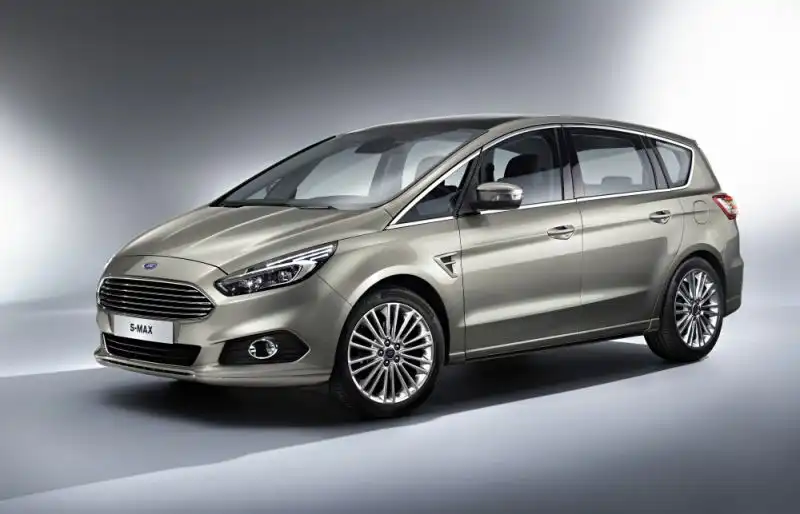
The Ford S-MAX II 2.0 EcoBlue (150 hp) S&S was a mid-range variant of Ford’s second-generation S-MAX multi-purpose vehicle (MPV), produced from 2018 to 2019. Positioned within the broader S-MAX II lineup – which included more powerful gasoline and diesel options – this model aimed to balance fuel efficiency, practicality, and affordability for family buyers. It represented Ford’s continued commitment to the MPV segment in Europe, offering a spacious and versatile vehicle designed to compete with offerings from Volkswagen, Opel, and Renault. The “S&S” designation indicates the inclusion of Ford’s Auto Start-Stop technology, further enhancing fuel economy.
Powertrain & Engine Architecture
The S-MAX II 2.0 EcoBlue (150 hp) S&S utilized Ford’s YMCB engine code, a 1997cc inline four-cylinder diesel engine. This engine belonged to the EcoBlue family, representing Ford’s advancements in diesel technology focused on improved efficiency and reduced emissions. It featured a common-rail direct fuel injection system, delivering fuel at extremely high pressure for optimized combustion. The engine employed a single turbocharger with an intercooler to enhance power output and reduce turbo lag. The double overhead camshaft (DOHC) valvetrain, with four valves per cylinder, further contributed to the engine’s breathing efficiency. The Auto Start-Stop system, denoted by the “S&S” badge, automatically shut off the engine when the vehicle came to a standstill (e.g., at traffic lights) and restarted it instantly when the driver depressed the clutch pedal (in manual transmission models) or released the brake pedal (in automatic models). This feature significantly reduced fuel consumption in urban driving conditions. The 6-speed manual transmission was standard, providing a balance between fuel economy and driver engagement.
Driving Characteristics
The 150 hp EcoBlue engine, paired with the 6-speed manual transmission, offered a respectable, though not particularly sporty, driving experience. Acceleration from 0-60 mph took approximately 10.1 seconds, and top speed was limited to 123 mph. The engine delivered its peak torque of 370 Nm (272.9 lb-ft) between 2000 and 2500 rpm, providing adequate pulling power for everyday driving and highway cruising. Compared to the higher-output 2.0-liter EcoBlue variants (available with up to 240 hp), this version felt less eager to accelerate, particularly when fully loaded with passengers and luggage. However, the lower power output translated to improved fuel economy. The gear ratios in the 6-speed manual were well-spaced, allowing the driver to keep the engine within its optimal torque band for efficient and comfortable driving. The S-MAX’s suspension provided a comfortable ride, absorbing bumps and imperfections in the road surface effectively.
Equipment & Trim Levels
The 2.0 EcoBlue (150 hp) S&S typically represented a mid-range trim level within the S-MAX II lineup. Standard equipment generally included air conditioning, a basic infotainment system with Bluetooth connectivity, alloy wheels, and a suite of safety features such as ABS, ESP (Electronic Stability Program), and multiple airbags. Interior upholstery was typically cloth, with options for leather upgrades available at an extra cost. Higher trim levels offered features like a larger touchscreen infotainment system with navigation, a panoramic sunroof, heated seats, and advanced driver-assistance systems such as adaptive cruise control and lane-keeping assist. Optional extras for this variant often included parking sensors, a rear-view camera, and upgraded sound systems.
Chassis & Braking
The S-MAX II featured a front-wheel-drive chassis with independent suspension all around. The front suspension utilized a McPherson strut design with coil springs and an anti-roll bar, while the rear suspension employed an independent multi-link setup, also with coil springs. This configuration provided a good balance between ride comfort and handling. Braking duties were handled by ventilated discs at the front and solid discs at the rear, providing adequate stopping power for the vehicle’s weight and performance. ABS (Anti-lock Braking System) was standard, enhancing braking performance and stability in emergency situations.
Market Reception & Comparison
The Ford S-MAX II 2.0 EcoBlue (150 hp) S&S was generally well-received by automotive critics as a practical and fuel-efficient MPV. It was praised for its spacious interior, comfortable ride, and versatile seating configuration. However, some reviewers noted that the 150 hp engine could feel underpowered when the vehicle was fully loaded. Compared to the more powerful gasoline and diesel variants, this model offered better fuel economy but less exhilarating performance. Against competitors like the Volkswagen Touran and Opel Zafira, the S-MAX II offered a compelling combination of features, practicality, and value.
Legacy
The 2.0 EcoBlue engine proved to be a relatively reliable powertrain, with few widespread issues reported. The EcoBlue family of engines, in general, has gained a reputation for durability and fuel efficiency. On the used car market, the S-MAX II 2.0 EcoBlue (150 hp) S&S represents a good value proposition for buyers seeking a spacious and practical MPV. Maintenance costs are generally reasonable, and parts availability is good. However, as with any used vehicle, it’s important to have a thorough inspection performed by a qualified mechanic before making a purchase to identify any potential issues.