
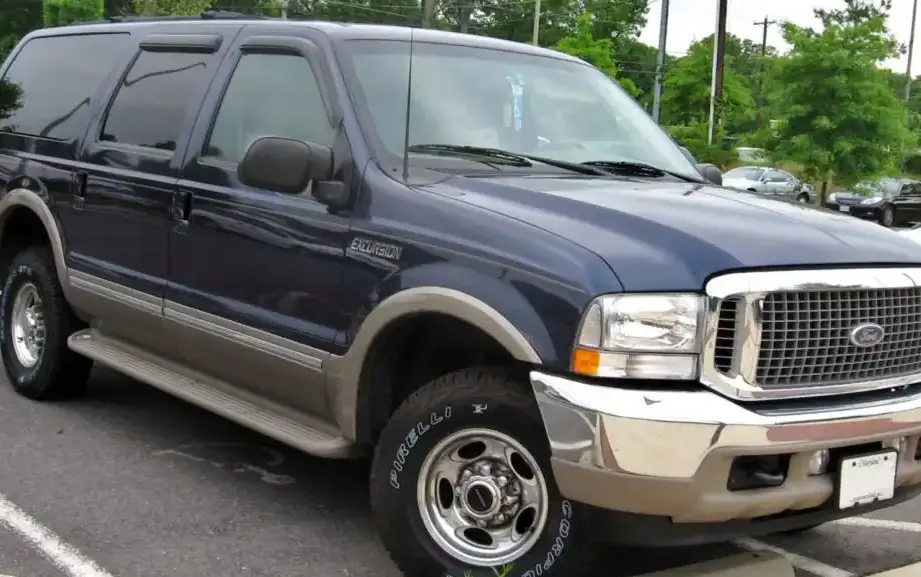
The Ford Excursion 5.4, produced from 2001 to 2005, represented Ford’s entry into the full-size SUV segment, aiming to provide maximum space and towing capacity. Powered by a 5.4-liter V8 engine paired with a four-speed automatic transmission, this variant occupied a middle ground within the Excursion lineup, positioned below the more powerful 6.8-liter V10 but offering a more accessible price point than its larger sibling. The Excursion was built on a heavily modified Ford Super Duty truck chassis, and was the largest SUV ever produced by Ford, and remains a significant vehicle in the history of American automotive engineering.
Technical Specifications
| Brand | Ford |
| Model | Excursion |
| Generation | Excursion |
| Type (Engine) | 5.4 (263 Hp) Automatic |
| Start of production | 2001 |
| End of production | 2005 |
| Powertrain Architecture | Internal Combustion engine |
| Body type | SUV |
| Seats | 8-9 |
| Doors | 5 |
| Fuel Type | Petrol (Gasoline) |
| Maximum speed | 153 km/h (95.07 mph) |
| Weight-to-power ratio | 11.9 kg/Hp, 84.2 Hp/tonne |
| Weight-to-torque ratio | 6.6 kg/Nm, 151.7 Nm/tonne |
| Power | 263 Hp @ 4500 rpm |
| Power per litre | 48.7 Hp/l |
| Torque | 474 Nm @ 2500 rpm (349.6 lb.-ft. @ 2500 rpm) |
| Engine layout | Front, Longitudinal |
| Engine displacement | 5398 cm3 (329.41 cu. in.) |
| Number of cylinders | 8 |
| Engine configuration | V-engine |
| Cylinder Bore | 90.2 mm (3.55 in.) |
| Piston Stroke | 105.7 mm (4.16 in.) |
| Compression ratio | 9:1 |
| Number of valves per cylinder | 2 |
| Fuel injection system | Multi-port manifold injection |
| Engine aspiration | Naturally aspirated engine |
| Valvetrain | OHC |
| Engine oil capacity | 5.7 l (6.02 US qt | 5.02 UK qt) |
| Coolant | 25 l (26.42 US qt | 22 UK qt) |
| Kerb Weight | 3125 kg (6889.45 lbs.) |
| Max. weight | 3900 kg (8598.03 lbs.) |
| Max load | 775 kg (1708.58 lbs.) |
| Trunk (boot) space – minimum | 1359 l (47.99 cu. ft.) |
| Trunk (boot) space – maximum | 4146 l (146.41 cu. ft.) |
| Fuel tank capacity | 167 l (44.12 US gal | 36.73 UK gal) |
| Length | 5758 mm (226.69 in.) |
| Width | 2032 mm (80 in.) |
| Height | 1965 mm (77.36 in.) |
| Wheelbase | 3482 mm (137.09 in.) |
| Front track | 1737 mm (68.39 in.) |
| Rear (Back) track | 1730 mm (68.11 in.) |
| Drive wheel | All wheel drive (4×4) |
| Number of gears and type of gearbox | 4 gears, automatic transmission |
| Front suspension | Coil spring |
| Rear suspension | Leaf spring |
| Front brakes | Ventilated discs |
| Rear brakes | Ventilated discs |
| Assisting systems | ABS (Anti-lock braking system) |
| Steering type | Worm-reduction unit |
| Power steering | Hydraulic Steering |
| Tires size | 265/75 R16 |
Powertrain & Engine Architecture
The heart of the Excursion 5.4 was Ford’s 5.4-liter Modular V8 engine, specifically the Triton family. This engine, designated internally as the 3V, featured a cast iron block with aluminum cylinder heads. The engine utilized a sequential multi-port fuel injection system, delivering fuel directly into each intake port. The overhead camshaft (OHC) design, with two valves per cylinder, contributed to a relatively broad torque curve. The four-speed 4R75E automatic transmission was chosen for its durability and ability to handle the Excursion’s substantial weight. This transmission featured electronic control and overdrive, aiming to balance performance with fuel efficiency, though the latter remained a challenge given the vehicle’s size and mass.
Driving Characteristics
The 5.4-liter engine in the Excursion provided adequate, but not exhilarating, performance. Acceleration was leisurely, particularly when fully loaded or towing. The four-speed automatic transmission, while robust, lacked the closer gear ratios of more modern transmissions, resulting in noticeable gaps between gears. The torque converter provided smooth shifts, but also contributed to some power loss. Compared to the 6.8L V10 Excursion, the 5.4L felt noticeably less powerful, especially when climbing hills or merging onto highways. However, the 5.4L offered a more manageable driving experience for those who didn’t require the V10’s brute force.
Equipment & Trim Levels
The Excursion 5.4 was typically offered in XLT and Limited trim levels. The XLT provided a good balance of features and affordability, including cloth upholstery, air conditioning, power windows and locks, and an AM/FM stereo. The Limited trim added leather upholstery, heated front seats, a premium sound system, and alloy wheels. Optional extras included a DVD entertainment system, a sunroof, and various towing packages. The interior design was functional and spacious, prioritizing comfort and utility over luxury.
Chassis & Braking
The Excursion’s chassis was based on the Ford Super Duty truck platform, featuring a robust frame and heavy-duty suspension components. The front suspension utilized coil springs, while the rear suspension employed leaf springs, designed to handle heavy loads. The braking system consisted of ventilated discs on all four wheels, coupled with an Anti-lock Braking System (ABS). However, despite the heavy-duty components, the Excursion’s substantial weight required significant braking distances. The steering system utilized a worm-reduction unit with hydraulic power assist, providing a stable but somewhat indirect steering feel.
Market Reception & Comparison
The Excursion 5.4 received mixed reviews. Critics praised its spacious interior, impressive towing capacity, and comfortable ride. However, it was also criticized for its poor fuel economy, cumbersome handling, and high price. Compared to the V10-powered Excursion, the 5.4L offered better fuel economy (though still relatively poor), but at the expense of performance. Against competitors like the Chevrolet Suburban and GMC Yukon XL, the Excursion offered more interior space and towing capacity, but was often perceived as less refined and more difficult to maneuver.
Legacy
The Ford Excursion, despite its relatively short production run, left a lasting impression on the full-size SUV market. While its fuel economy and size were often criticized, its immense capability and spaciousness appealed to a specific segment of buyers. Today, the Excursion 5.4 remains a popular choice among those seeking a large, capable SUV for towing and hauling. The 5.4-liter Triton engine, while known for potential spark plug issues in some applications, is generally considered reliable when properly maintained. Used examples are often sought after by enthusiasts and those needing a robust work vehicle, and continue to command reasonable prices in the used car market.
