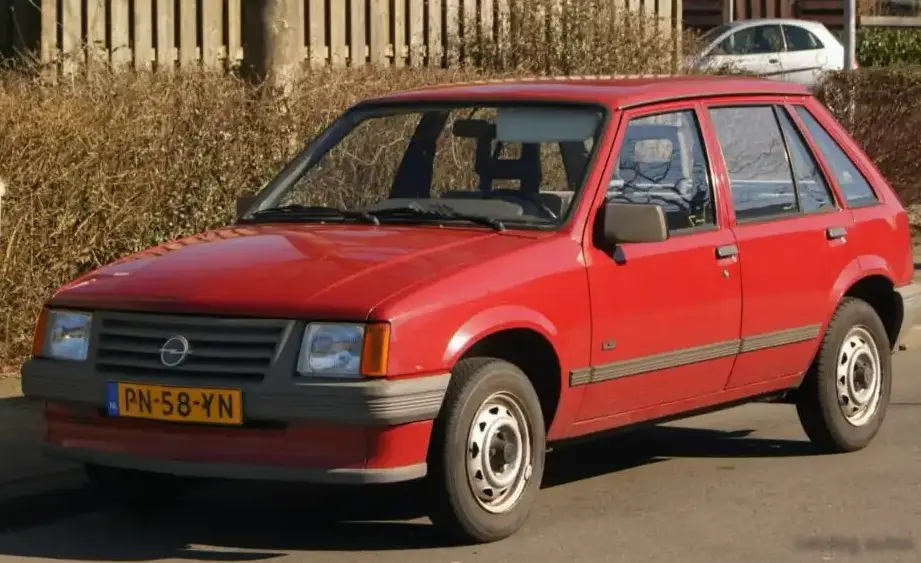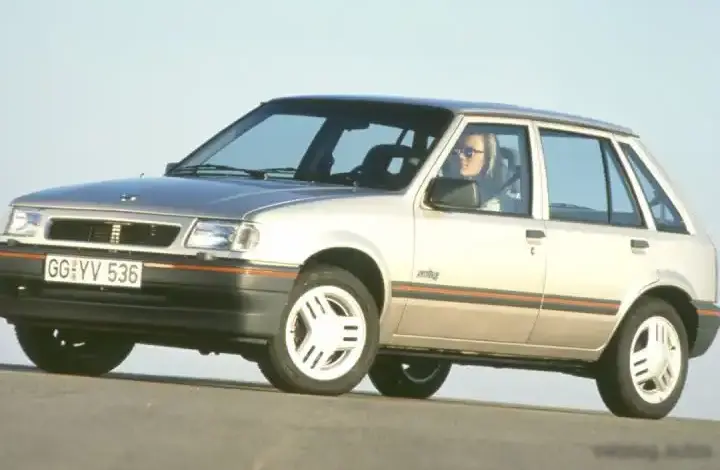
The Opel Corsa A 1.4i, produced from 1989 to 1990, represented an entry-level offering within the facelifted first generation of the Corsa (1987-1990). Positioned as a practical and economical hatchback, it served as a key model for Opel in the European small car segment. This variant, equipped with a 1.4-liter engine producing 60 horsepower and paired with a 5-speed manual transmission, aimed to provide affordable transportation for a broad customer base. The Corsa A was Opel’s attempt to directly compete with popular rivals like the Volkswagen Polo, Ford Fiesta, and Peugeot 205.
Technical Specifications
| Brand | Opel |
| Model | Corsa |
| Generation | Corsa A (facelift 1987) |
| Type (Engine) | 1.4i (60 Hp) |
| Start of production | 1989 |
| End of production | 1990 |
| Powertrain Architecture | Internal Combustion engine |
| Body type | Hatchback |
| Seats | 5 |
| Doors | 3-5 |
| Fuel consumption (urban) | 8.6 l/100 km (27.4 US mpg, 32.8 UK mpg, 11.6 km/l) |
| Fuel consumption (extra urban) | 5.2 l/100 km (45.2 US mpg, 54.3 UK mpg, 19.2 km/l) |
| Fuel consumption (combined) | 6.9 l/100 km (34.1 US mpg, 40.9 UK mpg, 14.5 km/l) |
| Fuel Type | Petrol (Gasoline) |
| Acceleration 0 – 100 km/h | 14.5 sec |
| Acceleration 0 – 62 mph | 14.5 sec |
| Acceleration 0 – 60 mph | 13.8 sec |
| Maximum speed | 155 km/h (96.31 mph) |
| Weight-to-power ratio | 12.8 kg/Hp, 77.9 Hp/tonne |
| Weight-to-torque ratio | 7.5 kg/Nm, 133.8 Nm/tonne |
| Power | 60 Hp @ 5200 rpm |
| Power per litre | 43.2 Hp/l |
| Torque | 103 Nm @ 2600 rpm (75.97 lb.-ft. @ 2600 rpm) |
| Engine layout | Front, Transverse |
| Engine Model/Code | C14NZ |
| Engine displacement | 1389 cm3 (84.76 cu. in.) |
| Number of cylinders | 4 |
| Engine configuration | Inline |
| Cylinder Bore | 77.6 mm (3.06 in.) |
| Piston Stroke | 73.4 mm (2.89 in.) |
| Compression ratio | 9.4:1 |
| Number of valves per cylinder | 2 |
| Fuel injection system | Multi-port manifold injection |
| Engine aspiration | Naturally aspirated engine |
| Valvetrain | SOHC |
| Engine oil capacity | 3 l (3.17 US qt | 2.64 UK qt) |
| Coolant capacity | 5.7 l (6.02 US qt | 5.02 UK qt) |
| Kerb Weight | 770 kg (1697.56 lbs.) |
| Max. weight | 1245 kg (2744.76 lbs.) |
| Max load | 475 kg (1047.2 lbs.) |
| Trunk (boot) space – minimum | 270 l (9.53 cu. ft.) |
| Trunk (boot) space – maximum | 1060 l (37.43 cu. ft.) |
| Fuel tank capacity | 42 l (11.1 US gal | 9.24 UK gal) |
| Length | 3622 mm (142.6 in.) |
| Width | 1532 mm (60.31 in.) |
| Height | 1365 mm (53.74 in.) |
| Wheelbase | 2343 mm (92.24 in.) |
| Front track | 1320 mm (51.97 in.) |
| Rear track | 1307 mm (51.46 in.) |
| Ride height (ground clearance) | 140 mm (5.51 in.) |
| Drag coefficient (Cd) | 0.36 |
| Minimum turning circle | 10 m (32.81 ft.) |
| Drivetrain Architecture | Front wheel drive |
| Number of gears | 5 |
| Gearbox type | Manual transmission |
| Front suspension | Coil spring |
| Rear suspension | Coil spring |
| Front brakes | Disc |
| Rear brakes | Drum |
| Assisting systems | ABS (Anti-lock braking system) |
| Steering type | Steering rack and pinion |
| Tires size | 165/65 R14 |
| Wheel rims size | 14 |
Powertrain & Engine Architecture
The Corsa A 1.4i utilized the C14NZ engine, a naturally aspirated, inline-four cylinder petrol engine. This engine featured a single overhead camshaft (SOHC) valvetrain operating two valves per cylinder. Fuel delivery was managed by a multi-port fuel injection system, a relatively modern feature for its time, contributing to improved fuel efficiency and smoother operation compared to carbureted engines. The 1389cc engine produced 60 horsepower at 5200 rpm and 103 Nm (76 lb-ft) of torque at 2600 rpm. The engine’s relatively modest output was typical for entry-level small cars of the late 1980s and early 1990s. The 5-speed manual transmission was chosen for its efficiency and affordability, providing a balance between fuel economy and drivability. The transmission’s gear ratios were geared towards maximizing fuel economy rather than outright performance.
Driving Characteristics
The Corsa A 1.4i offered a predictable, if uninspiring, driving experience. Acceleration was modest, taking approximately 14.5 seconds to reach 100 km/h (62 mph). The engine felt somewhat strained when pushed hard, particularly when fully loaded with passengers or cargo. The 5-speed manual transmission allowed drivers to keep the engine in its optimal power band, but the overall performance was geared towards economical commuting rather than spirited driving. Compared to higher-spec Corsa A models equipped with larger engines (like the 1.6-liter), the 1.4i felt noticeably slower. However, it offered a lighter steering feel and a more manageable driving experience, making it well-suited for urban environments. The suspension provided a comfortable ride, absorbing bumps and imperfections in the road reasonably well.
Equipment & Trim Levels
The 1.4i Corsa A typically came with a basic level of equipment. Standard features generally included cloth upholstery, a basic instrument cluster, and manual windows and door locks. Power steering was often an optional extra. Interior trim was functional and durable, prioritizing practicality over luxury. Optional extras could include a radio/cassette player, upgraded seat fabrics, and central locking. The trim level was generally considered the base model, appealing to buyers seeking the most affordable option in the Corsa range.
Chassis & Braking
The Corsa A featured a relatively simple chassis design. Front suspension utilized coil springs, while the rear suspension also employed coil springs. The front brakes were disc brakes, providing adequate stopping power, while the rear brakes were drum brakes, a cost-saving measure common in this class of vehicle. ABS (Anti-lock Braking System) was available as an option, enhancing safety by preventing wheel lockup during hard braking. The steering system was a rack and pinion setup, offering precise and responsive steering feel. The relatively lightweight construction of the Corsa A contributed to its nimble handling characteristics.
Market Reception & Comparison
The Corsa A 1.4i was generally well-received as an affordable and reliable small car. Critics praised its fuel efficiency and practicality, but noted its lack of outright performance. Compared to other trims in the Corsa lineup, such as the 1.6-liter models, the 1.4i offered lower running costs but sacrificed performance. It competed directly with rivals like the Ford Fiesta, Volkswagen Polo, and Peugeot 205, offering a similar level of equipment and performance at a comparable price point. Fuel economy was a strong point, with combined fuel consumption figures around 6.9 l/100 km (34.1 US mpg).
Legacy
The Corsa A 1.4i, while not a performance icon, proved to be a durable and reliable vehicle. The C14NZ engine is known for its robustness and relatively simple maintenance requirements. Today, surviving examples are relatively common in the used car market, often sought after by enthusiasts looking for a classic and affordable small car. While parts availability may be diminishing, the Corsa A remains a popular choice for those seeking a nostalgic and economical driving experience. The Corsa A laid the foundation for subsequent generations of the Corsa, establishing it as a key model in Opel’s lineup and a significant player in the European small car market.