
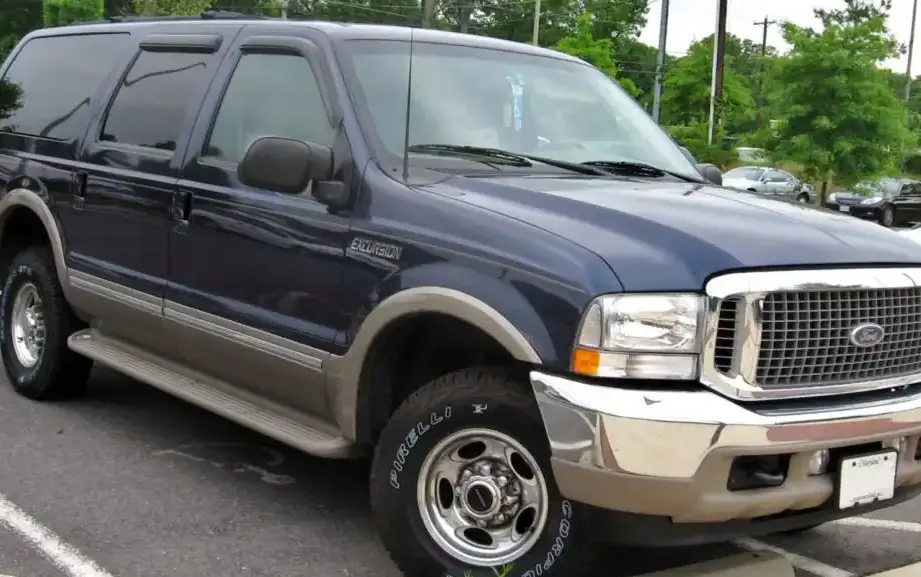
The Ford Excursion, produced from 2000 to 2005, represented Ford’s entry into the full-size, heavy-duty SUV segment, directly competing with the Chevrolet Suburban and GMC Yukon XL. Built on a heavily modified Ford Super Duty truck chassis, the Excursion was notable for its immense size and capability. The 5.4L V8 engine paired with a four-speed automatic transmission was a popular configuration, positioned as the base engine option for buyers seeking a large SUV without the higher cost and complexity of the available diesel and larger gasoline engines. This variant aimed to provide a balance of power, towing capacity, and affordability within the Excursion lineup.
Technical Specifications
| Brand | Ford |
| Model | Excursion |
| Generation | Excursion |
| Type (Engine) | 5.4 L (258 Hp) Automatic |
| Start of production | 2000 year |
| End of production | 2005 year |
| Powertrain Architecture | Internal Combustion engine |
| Body type | SUV |
| Seats | 8-9 |
| Doors | 5 |
| Fuel Type | Petrol (Gasoline) |
| Weight-to-power ratio | 12.1 kg/Hp, 82.6 Hp/tonne |
| Weight-to-torque ratio | 6.6 kg/Nm, 151.7 Nm/tonne |
| Power | 258 Hp @ 4500 rpm |
| Power per litre | 47.8 Hp/l |
| Torque | 474 Nm @ 2500 rpm, 349.6 lb.-ft. @ 2500 rpm |
| Engine layout | Front, Longitudinal |
| Engine displacement | 5398 cm3, 329.41 cu. in. |
| Number of cylinders | 8 |
| Engine configuration | V-engine |
| Cylinder Bore | 90.2 mm, 3.55 in. |
| Piston Stroke | 105.7 mm, 4.16 in. |
| Compression ratio | 9:1 |
| Number of valves per cylinder | 2 |
| Fuel injection system | Multi-port manifold injection |
| Engine aspiration | Naturally aspirated engine |
| Valvetrain | OHC |
| Engine oil capacity | 5.7 l, 6.02 US qt | 5.02 UK qt |
| Coolant | 25 l, 26.42 US qt | 22 UK qt |
| Kerb Weight | 3125 kg, 6889.45 lbs |
| Max. weight | 3266 kg, 7200.3 lbs |
| Max load | 141 kg, 310.85 lbs |
| Trunk (boot) space – minimum | 1359 l, 47.99 cu. ft |
| Trunk (boot) space – maximum | 4145 l, 146.38 cu. ft |
| Fuel tank capacity | 167 l, 44.12 US gal | 36.73 UK gal |
| Length | 5758 mm, 226.69 in |
| Width | 2032 mm, 80 in |
| Height | 1948 mm, 76.69 in |
| Wheelbase | 3480 mm, 137.01 in |
| Front track | 1737 mm, 68.39 in |
| Rear (Back) track | 1730 mm, 68.11 in |
| Drive wheel | All wheel drive (4×4) |
| Number of gears and type of gearbox | 4 gears, automatic transmission |
| Front suspension | Coil spring |
| Rear suspension | Leaf spring |
| Front brakes | Ventilated discs |
| Rear brakes | Ventilated discs |
| Assisting systems | ABS (Anti-lock braking system) |
| Steering type | Worm-reduction unit |
| Power steering | Hydraulic Steering |
| Tires size | 265/75 R16 |
Powertrain & Engine Architecture
The 5.4-liter V8 engine, designated as the Triton family, was a staple in Ford’s truck and SUV lineup during this period. This particular iteration of the Triton engine featured a cast-iron block with aluminum cylinder heads. It utilized a multi-port fuel injection system, delivering fuel directly into each intake port. The engine employed an overhead camshaft (OHC) valvetrain with two valves per cylinder. The 9:1 compression ratio was a compromise between performance and the ability to run on readily available gasoline. The four-speed 4R70W automatic transmission was chosen for its durability and ability to handle the engine’s torque output. This transmission featured electronic control for smoother shifting and improved fuel efficiency compared to earlier designs.
Driving Characteristics
The 5.4L Excursion, while capable, wasn’t known for its blistering acceleration. With a curb weight exceeding 6,800 pounds, the 258 horsepower engine provided adequate, but not overwhelming, power. Acceleration from 0 to 60 mph typically took around 9-10 seconds. The automatic transmission’s gear ratios were optimized for towing and hauling, prioritizing low-end torque over outright speed. Compared to the 6.8L V10 engine option, the 5.4L felt noticeably less powerful, especially when fully loaded or towing a trailer. However, the 5.4L offered better fuel economy than the V10, making it a more practical choice for everyday driving. The ride quality, while generally comfortable, could be firm due to the heavy-duty suspension.
Equipment & Trim Levels
The 5.4L engine was typically offered in the base XLT and mid-range Eddie Bauer trim levels. The XLT trim included standard features such as air conditioning, power windows and locks, a CD player, and cloth upholstery. The Eddie Bauer trim added leather upholstery, woodgrain interior trim, and upgraded audio systems. Optional extras included a power sunroof, rear-seat entertainment system, and a navigation system. Both trims offered a variety of interior color choices and seating configurations, accommodating up to nine passengers.
Chassis & Braking
The Excursion’s chassis was based on the Ford Super Duty truck platform, featuring a robust fully boxed frame. The front suspension utilized coil springs, while the rear suspension employed leaf springs, designed to handle heavy loads. The braking system consisted of ventilated discs on all four wheels, providing adequate stopping power for the vehicle’s weight. An Anti-lock Braking System (ABS) was standard equipment. Steering was accomplished through a hydraulic power-assisted worm-reduction unit. The standard tire size was 265/75R16, providing a good balance of on-road comfort and off-road capability.
Market Reception & Comparison
The Ford Excursion, particularly with the 5.4L engine, received mixed reviews. Critics praised its spacious interior, impressive towing capacity, and comfortable ride. However, it was also criticized for its poor fuel economy, large size (making it difficult to maneuver in urban environments), and relatively slow acceleration with the 5.4L engine. Compared to the V10 and diesel options, the 5.4L offered a lower price point but sacrificed performance. The 5.4L was often seen as a good choice for buyers who primarily used their SUV for commuting and light towing, while those needing maximum towing capacity opted for the more powerful engines.
Legacy
The Ford Excursion, despite its relatively short production run, has developed a loyal following among enthusiasts. The 5.4L engine, while not the most powerful option, has proven to be reasonably reliable with proper maintenance. Common issues include spark plug breakage and oil leaks. Today, well-maintained Excursions with the 5.4L engine can be found on the used car market, often appealing to buyers seeking a large, capable SUV at a relatively affordable price. The Excursion remains a symbol of the early 2000s SUV boom, representing a time when size and capability were highly valued.
