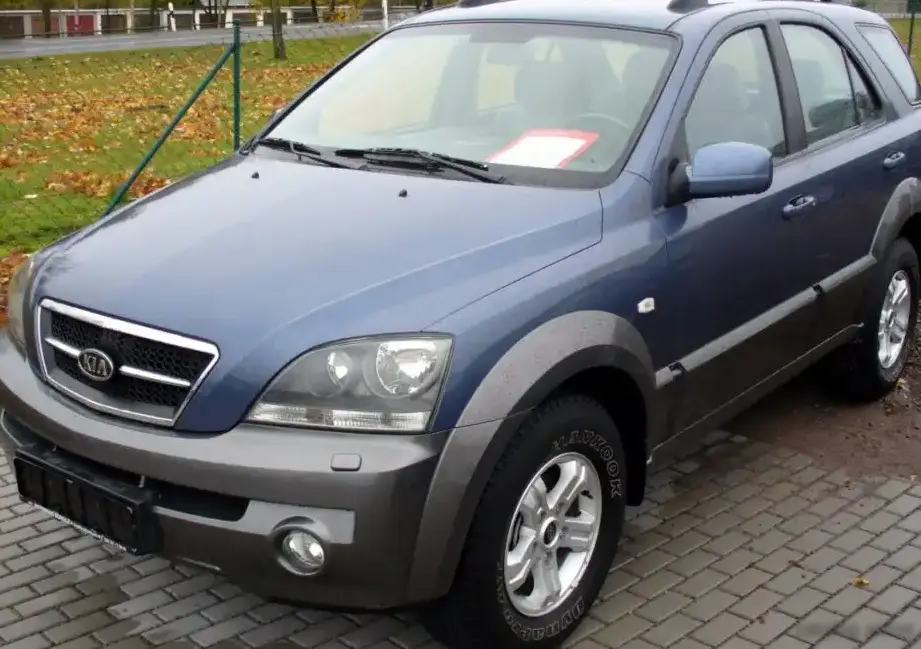
The Kia Sorento I 2.5 DCR (140 hp) Automatic, produced between 2002 and 2006, represents Kia’s initial foray into the mid-size SUV segment. This variant, powered by the D4CB diesel engine and paired with a four-speed automatic transmission, was positioned as a practical and capable all-wheel-drive option within the first generation Sorento (BL) lineup. The Sorento I, built on a body-on-frame construction, aimed to offer a blend of SUV ruggedness with family-friendly comfort, primarily targeting markets outside of North America where diesel engines were more prevalent. This specific 2.5-liter diesel automatic configuration served as a mid-range offering, slotting below the more powerful gasoline engines and above the base-level trims.
Technical Specifications
| Brand | Kia |
| Model | Sorento |
| Generation | Sorento I |
| Type (Engine) | 2.5 DCR (140 Hp) Automatic |
| Start of production | 2002 |
| End of production | 2006 |
| Powertrain Architecture | Internal Combustion engine |
| Body type | SUV |
| Seats | 5 |
| Doors | 5 |
| Fuel consumption (urban) | 11.8 l/100 km (19.9 US mpg) |
| Fuel consumption (extra urban) | 7.3 l/100 km (32.2 US mpg) |
| Fuel consumption (combined) | 8.9 l/100 km (26.4 US mpg) |
| Fuel Type | Diesel |
| Acceleration 0 – 100 km/h | 15.5 sec |
| Acceleration 0 – 62 mph | 15.5 sec |
| Acceleration 0 – 60 mph | 14.7 sec |
| Maximum speed | 167 km/h (103.77 mph) |
| Weight-to-power ratio | 14.2 kg/Hp |
| Weight-to-torque ratio | 6.3 kg/Nm |
| Power | 140 Hp @ 3800 rpm |
| Torque | 314 Nm @ 2000 rpm (231.59 lb.-ft. @ 2000 rpm) |
| Engine layout | Front, Longitudinal |
| Engine Model/Code | D4CB |
| Engine displacement | 2497 cm3 (152.38 cu. in.) |
| Number of cylinders | 4 |
| Engine configuration | Inline |
| Cylinder Bore | 91 mm (3.58 in.) |
| Piston Stroke | 96 mm (3.78 in.) |
| Compression ratio | 19.3:1 |
| Number of valves per cylinder | 4 |
| Fuel injection system | Diesel Commonrail |
| Engine oil capacity | 8.2 l (8.66 US qt | 7.21 UK qt) |
| Coolant capacity | 10 l (10.57 US qt | 8.8 UK qt) |
| Kerb Weight | 1985 kg (4376.18 lbs.) |
| Max. weight | 2610 kg (5754.07 lbs.) |
| Max load | 625 kg (1377.89 lbs.) |
| Trunk (boot) space – minimum | 890 l (31.43 cu. ft.) |
| Trunk (boot) space – maximum | 1900 l (67.1 cu. ft.) |
| Fuel tank capacity | 80 l (21.13 US gal | 17.6 UK gal) |
| Length | 4567 mm (179.8 in.) |
| Width | 1857 mm (73.11 in.) |
| Height | 1730 mm (68.11 in.) |
| Wheelbase | 2710 mm (106.69 in.) |
| Front track | 1580 mm (62.2 in.) |
| Rear (Back) track | 1580 mm (62.2 in.) |
| Drive wheel | All wheel drive (4×4) |
| Number of gears and type of gearbox | 4 gears, automatic transmission |
| Front suspension | Double wishbone |
| Rear suspension | Coil spring |
| Front brakes | Ventilated discs |
| Rear brakes | Ventilated discs |
| Assisting systems | ABS (Anti-lock braking system) |
| Power steering | Hydraulic Steering |
| Tires size | 225/75 R16; 245/70 R16 |
| Wheel rims size | 16 |
Powertrain & Engine Architecture
The heart of the Sorento I 2.5 DCR Automatic is the Kia D4CB engine, a 2.5-liter inline-four cylinder diesel. This engine utilizes a common rail direct injection (CRDI) system, which delivers fuel directly into the combustion chamber at extremely high pressure, improving efficiency and reducing emissions. The D4CB features a turbocharger with an intercooler, boosting power output and enhancing torque across a wider RPM range. The engine’s 19.3:1 compression ratio is typical for a diesel engine, contributing to its thermal efficiency. The four-speed automatic transmission, while providing convenience, was a relatively older design compared to the manual transmissions offered with other Sorento engines. It was chosen for its ease of use and appeal to buyers prioritizing comfort over outright performance.
Driving Characteristics
The 140 hp output and four-speed automatic transmission resulted in a driving experience focused on practicality rather than sportiness. Acceleration was modest, with a 0-60 mph time of around 14.7 seconds. The automatic transmission’s gear ratios were geared towards fuel economy and smooth cruising, rather than quick shifts. While adequate for everyday driving and highway merging, the 2.5 DCR Automatic lacked the punch of the gasoline-powered Sorentos. The all-wheel-drive system provided enhanced traction in slippery conditions, making it a capable vehicle for inclement weather or light off-road use. The engine delivered a usable amount of torque at lower RPMs, making it suitable for towing smaller loads.
Equipment & Trim Levels
The 2.5 DCR Automatic trim typically included features such as air conditioning, power windows and locks, and an AM/FM radio with a CD player. Higher trim levels offered upgrades like leather upholstery, a sunroof, and alloy wheels. Safety features included ABS brakes and dual front airbags. The interior design was functional and durable, prioritizing practicality over luxury. The Sorento I offered a relatively spacious cabin for its class, with comfortable seating for five passengers. Optional extras included a rear parking sensor and upgraded audio systems.
Chassis & Braking
The Sorento I utilized a traditional body-on-frame construction, providing a robust and durable chassis. The front suspension featured a double wishbone design, while the rear suspension employed coil springs. This setup aimed to balance ride comfort with handling stability. The braking system consisted of ventilated discs on all four wheels, providing adequate stopping power for the vehicle’s weight. The hydraulic power steering offered a reasonable level of assistance, making it easy to maneuver in tight spaces.
Market Reception & Comparison
The Kia Sorento I 2.5 DCR Automatic was generally well-received as a value-oriented SUV. Critics praised its spacious interior, all-wheel-drive capability, and relatively affordable price point. However, the engine’s performance was often criticized as being underpowered, especially when compared to the gasoline-powered versions. Fuel economy was a strong point, with the diesel engine offering significantly better mileage than its gasoline counterparts. Compared to the more powerful 3.5-liter V6 Sorento, the 2.5 DCR Automatic was a more economical choice, but it lacked the V6’s acceleration and towing capacity. The 2.5 DCR was often compared to other compact and mid-size diesel SUVs available in Europe and Asia.
Legacy
The Kia Sorento I 2.5 DCR Automatic, while not a performance standout, established Kia as a contender in the SUV market. The D4CB engine proved to be relatively reliable, although regular maintenance is crucial for diesel engines. Today, these vehicles are often found as affordable used SUVs, offering a practical and capable option for buyers seeking a rugged and fuel-efficient vehicle. Parts availability can be a concern, but the D4CB engine is shared with other Hyundai and Kia models, making sourcing components somewhat easier. The Sorento I paved the way for subsequent generations of Sorentos, which have become increasingly popular and refined.