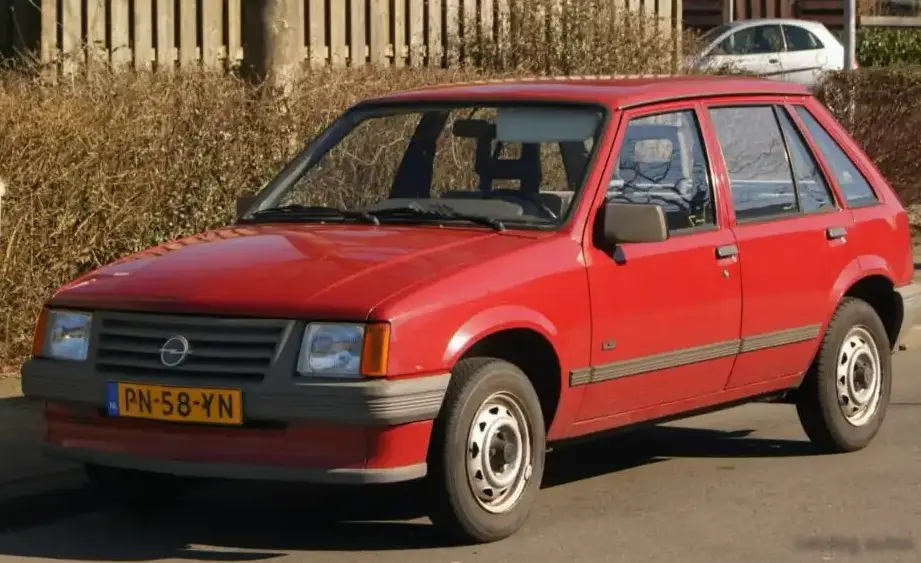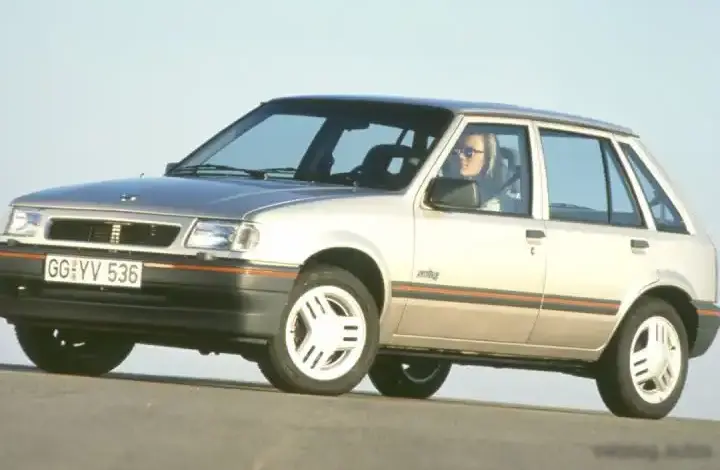
The Opel Corsa A (facelifted in 1987) 1.5 D represents a significant entry point into the first generation of the Corsa, a supermini designed to replace the aging Opel Kadett. Introduced in 1982, the Corsa A aimed to provide an affordable and practical vehicle for European drivers. The 1.5 D variant, produced from 1987 to 1990, was specifically tailored for markets prioritizing fuel economy and low running costs. It occupied the base trim level within the Corsa A range, positioned below the gasoline-powered models and offering a more economical alternative to the 1.2 and 1.4 liter engines. This diesel version was particularly popular in countries with higher diesel fuel taxes or incentives.
Technical Specifications
| Brand | Opel |
| Model | Corsa |
| Generation | Corsa A (facelift 1987) |
| Type (Engine) | 1.5 D (50 Hp) |
| Start of production | 1987 |
| End of production | 1990 |
| Powertrain Architecture | Internal Combustion engine |
| Body type | Hatchback |
| Seats | 5 |
| Doors | 3-5 |
| Fuel consumption (urban) | 6 l/100 km (39.2 US mpg, 47.1 UK mpg, 16.7 km/l) |
| Fuel consumption (extra urban) | 4 l/100 km (58.8 US mpg, 70.6 UK mpg, 25 km/l) |
| Fuel consumption (combined) | 5.7 l/100 km (41.3 US mpg, 49.6 UK mpg, 17.5 km/l) |
| Fuel Type | Diesel |
| Acceleration 0 – 100 km/h | 17.5 sec |
| Acceleration 0 – 62 mph | 17.5 sec |
| Acceleration 0 – 60 mph | 16.6 sec |
| Maximum speed | 151 km/h (93.83 mph) |
| Weight-to-power ratio | 16.8 kg/Hp, 59.5 Hp/tonne |
| Weight-to-torque ratio | 9.3 kg/Nm, 107.1 Nm/tonne |
| Power | 50 Hp @ 4800 rpm |
| Power per litre | 33.6 Hp/l |
| Torque | 90 Nm @ 3000 rpm (66.38 lb.-ft. @ 3000 rpm) |
| Engine layout | Front, Transverse |
| Engine Model/Code | 15D, 4EC1 |
| Engine displacement | 1488 cm3 (90.8 cu. in.) |
| Number of cylinders | 4 |
| Engine configuration | Inline |
| Cylinder Bore | 76 mm (2.99 in.) |
| Piston Stroke | 82 mm (3.23 in.) |
| Compression ratio | 23:1 |
| Number of valves per cylinder | 2 |
| Fuel injection system | Precombustion chamber injection |
| Engine aspiration | Naturally aspirated engine |
| Valvetrain | SOHC |
| Engine oil capacity | 3.75 l (3.96 US qt | 3.3 UK qt) |
| Coolant capacity | 6.4 l (6.76 US qt | 5.63 UK qt) |
| Kerb Weight | 840 kg (1851.88 lbs.) |
| Max. weight | 1315 kg (2899.08 lbs.) |
| Max load | 475 kg (1047.2 lbs.) |
| Trunk (boot) space – minimum | 270 l (9.53 cu. ft.) |
| Trunk (boot) space – maximum | 1060 l (37.43 cu. ft.) |
| Fuel tank capacity | 42 l (11.1 US gal | 9.24 UK gal) |
| Length | 3622 mm (142.6 in.) |
| Width | 1532 mm (60.31 in.) |
| Height | 1365 mm (53.74 in.) |
| Wheelbase | 2343 mm (92.24 in.) |
| Front track | 1320 mm (51.97 in.) |
| Rear track | 1307 mm (51.46 in.) |
| Ride height (ground clearance) | 140 mm (5.51 in.) |
| Drag coefficient (Cd) | 0.36 |
| Minimum turning circle | 10 m (32.81 ft.) |
| Drivetrain Architecture | Front wheel drive |
| Number of gears | 5 gears, manual transmission |
| Front suspension | Coil spring |
| Rear suspension | Coil spring |
| Front brakes | Disc |
| Rear brakes | Disc |
| Assisting systems | ABS (Anti-lock braking system) |
| Steering type | Steering rack and pinion |
| Tires size | 165/65 R14 |
| Wheel rims size | 5J x 14 |
Powertrain & Engine Architecture
The Corsa A 1.5 D was powered by the Opel 15D engine, a naturally aspirated, inline-four cylinder diesel engine. This engine, also known by its VM Motori code 4EC1 (VM Motori being the Italian manufacturer who supplied the engine to Opel), utilized a precombustion chamber injection system. This system, common in diesel engines of the era, involved injecting fuel into a small pre-chamber within the cylinder head, where it partially combusted before igniting the main charge. This design aided in smoother combustion and reduced engine noise compared to direct injection systems. The engine featured a single overhead camshaft (SOHC) valvetrain operating two valves per cylinder. The 1488cc displacement produced 50 horsepower at 4800 rpm and 90 Nm (66.38 lb-ft) of torque at 3000 rpm. The engine was transversely mounted in the front of the vehicle, driving the front wheels through a five-speed manual transmission. The transmission was chosen for its efficiency and affordability, aligning with the overall cost-conscious nature of this Corsa variant.
Driving Characteristics
The 1.5 D Corsa A was not designed for performance. Its 0-60 mph time of around 16.6 seconds and a top speed of 93.83 mph reflect its focus on fuel economy rather than outright speed. The engine’s torque delivery was relatively low-end focused, providing adequate pulling power for everyday driving but lacking the responsiveness of the gasoline-powered Corsas. The five-speed manual transmission helped to keep the engine within its optimal operating range, but frequent gear changes were often necessary, especially when climbing hills or overtaking. Compared to the 1.2 or 1.4 liter gasoline versions, the 1.5 D offered significantly lower running costs but at the expense of acceleration and overall refinement. The diesel engine was noticeably louder and produced more vibration than its gasoline counterparts.
Equipment & Trim Levels
The 1.5 D Corsa A typically came with a basic level of equipment. Standard features included cloth upholstery, a simple dashboard layout, and manual windows and door locks. Power steering was not typically included as standard equipment on this base model. Optional extras included a sunroof, upgraded stereo systems, and more comfortable seating. The interior trim was generally functional and durable, prioritizing practicality over luxury. The exterior styling was consistent with other Corsa A models, featuring a boxy, angular design typical of the 1980s. The 1.5 D often featured steel wheels with hubcaps, and body-colored bumpers were sometimes an optional extra.
Chassis & Braking
The Corsa A 1.5 D utilized a relatively simple chassis design. Both the front and rear suspension employed coil springs and a basic damper setup. The front brakes were disc brakes, providing adequate stopping power, while the rear brakes were typically drum brakes, a cost-saving measure for the base model. A steering rack and pinion system provided reasonable steering precision. The car’s relatively light weight (840 kg / 1851.88 lbs) helped to mitigate the effects of the engine’s limited power. The suspension was tuned for comfort rather than sporty handling, providing a reasonably compliant ride on most road surfaces.
Market Reception & Comparison
The Corsa A 1.5 D was generally well-received in markets where fuel economy was a primary concern. Critics praised its low running costs and reliability, but noted its lack of performance and refinement. Compared to the gasoline-powered Corsas, the 1.5 D offered significantly better fuel economy – around 41.3 US mpg combined – but was considerably slower. It also provided a more affordable entry point into Corsa ownership. Against competitors like the Fiat Uno Diesel and the Renault 5 Diesel, the Corsa A 1.5 D offered a comparable level of fuel efficiency and practicality, with Opel’s reputation for build quality being a key selling point.
Legacy
The 1.5 D engine, while not known for its longevity in the same way as some of Opel’s gasoline engines, proved to be reasonably durable with proper maintenance. The Corsa A 1.5 D has become a relatively rare sight on the roads today, with many examples having been scrapped or exported. However, a small but dedicated following of enthusiasts continues to keep these cars running. The 1.5 D powertrain is generally considered to be relatively simple to maintain, making it an attractive option for those looking for a classic, affordable, and fuel-efficient vehicle. Parts availability can be a challenge, but many components are still available through specialist suppliers or can be sourced from other Opel/Vauxhall models.