
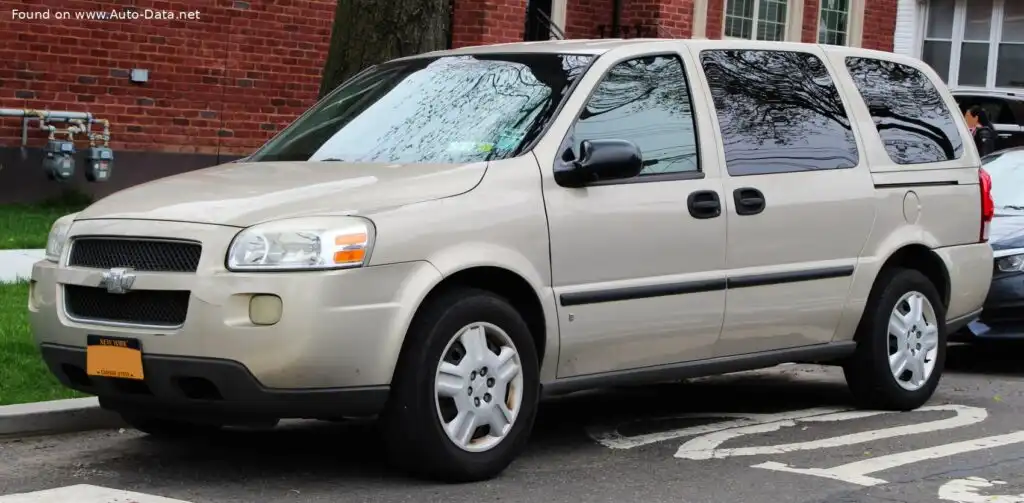
The Chevrolet Uplander 3.5i V6 AWD, produced from 2004 to 2008, represented Chevrolet’s entry into the minivan segment, aiming to compete with established players like the Dodge Caravan and Toyota Sienna. Positioned as a more affordable alternative, the Uplander was based on the Venture platform, itself a derivative of the U-body architecture shared with other GM minivans. The 3.5i V6 AWD variant, equipped with the LX9 engine and a four-speed automatic transmission, was a mid-range offering, providing all-wheel drive capability and a respectable level of power for family hauling and light-duty tasks. It served as a practical, if not particularly sporty, option for American families needing space and versatility.
Technical Specifications
| Brand | Chevrolet |
| Model | Uplander |
| Generation | Uplander |
| Type (Engine) | 3.5 i V6 AWD (203 Hp) |
| Start of production | 2004 |
| End of production | 2008 |
| Powertrain Architecture | Internal Combustion engine |
| Body type | Minivan |
| Seats | 7 |
| Doors | 5 |
| Fuel consumption (urban) | 13.8 l/100 km (17 US mpg, 20.5 UK mpg) |
| Fuel consumption (extra urban) | 9.5 l/100 km (24.8 US mpg, 29.7 UK mpg) |
| Fuel consumption (combined) | 11.9 l/100 km (19.8 US mpg, 23.7 UK mpg) |
| Fuel Type | Petrol (Gasoline) |
| Weight-to-power ratio | 10.3 kg/Hp (97.1 Hp/tonne) |
| Weight-to-torque ratio | 7 kg/Nm (142.6 Nm/tonne) |
| Power | 203 Hp @ 5400 rpm |
| Power per litre | 58 Hp/l |
| Torque | 298 Nm @ 3200 rpm (219.79 lb.-ft. @ 3200 rpm) |
| Engine layout | Front, Transverse |
| Engine Model/Code | LX9 |
| Engine displacement | 3498 cm3 (213.46 cu. in.) |
| Number of cylinders | 6 |
| Engine configuration | V-engine |
| Cylinder Bore | 94 mm (3.7 in.) |
| Piston Stroke | 84 mm (3.31 in.) |
| Compression ratio | 9.8:1 |
| Number of valves per cylinder | 2 |
| Fuel injection system | Multi-port manifold injection |
| Engine aspiration | Naturally aspirated engine |
| Valvetrain | DOHC |
| Engine oil capacity | 4.3 l (4.54 US qt | 3.78 UK qt) |
| Coolant capacity | 10.7 l (11.31 US qt | 9.41 UK qt) |
| Kerb Weight | 2090 kg (4607.66 lbs.) |
| Trunk (boot) space – minimum | 762 l (26.91 cu. ft.) |
| Trunk (boot) space – maximum | 3865 l (136.49 cu. ft.) |
| Fuel tank capacity | 95 l (25.1 US gal | 20.9 UK gal) |
| Length | 5191 mm (204.37 in.) |
| Width | 1830 mm (72.05 in.) |
| Height | 1830 mm (72.05 in.) |
| Wheelbase | 3077 mm (121.14 in.) |
| Front track | 1586 mm (62.44 in.) |
| Rear track | 1598 mm (62.91 in.) |
| Drive wheel | All wheel drive (4×4) |
| Number of gears | 4 |
| Gearbox type | Automatic transmission |
| Front suspension | Spring Strut |
| Rear suspension | Transverse stabilizer |
| Front brakes | Disc |
| Rear brakes | Disc |
| Assisting systems | ABS (Anti-lock braking system) |
| Steering type | Steering rack and pinion |
| Tires size | 225/60 R17 |
| Wheel rims size | 6.5J x 17 |
Powertrain & Engine Architecture
The heart of the Uplander 3.5i AWD was the 3.5-liter LX9 V6 engine. This engine, a member of GM’s L-series family, featured a 60-degree V-angle and a cast iron block with aluminum cylinder heads. It utilized multi-port fuel injection and a double overhead camshaft (DOHC) valvetrain with two valves per cylinder. The LX9 produced 203 horsepower at 5400 rpm and 298 Nm (219.79 lb-ft) of torque at 3200 rpm. The engine’s design prioritized smooth operation and adequate power delivery over outright performance. Paired with the LX9 was a four-speed automatic transmission (4T65E), chosen for its reliability and suitability for the vehicle’s intended purpose. This transmission, while not offering the efficiency of more modern gearboxes, provided smooth shifts and adequate responsiveness for everyday driving.
Driving Characteristics
The Uplander 3.5i AWD, with its 203 hp and four-speed automatic, offered adequate, but not exhilarating, performance. Acceleration was sufficient for merging onto highways and passing slower traffic, but it wasn’t a particularly quick vehicle. The automatic transmission’s gear ratios were tuned for fuel economy and smooth cruising rather than aggressive acceleration. Compared to the base 3.5L front-wheel drive Uplander, the AWD version experienced a slight performance penalty due to the added weight and drivetrain losses. The AWD system itself provided enhanced traction in inclement weather, making it a more confident choice for drivers in regions with snow or rain. However, the handling was typical of a large minivan – comfortable but not sporty. The suspension was tuned for ride comfort, absorbing bumps and imperfections in the road reasonably well.
Equipment & Trim Levels
The 3.5i AWD Uplander typically came standard with features such as air conditioning, power windows and locks, a CD player, and cloth upholstery. Higher trim levels, such as the LT, added features like alloy wheels, upgraded audio systems, leather upholstery, and power-adjustable front seats. Optional extras included a DVD entertainment system, sunroof, and remote keyless entry. The interior design was functional and family-oriented, with ample storage compartments and a spacious cabin. The seven-passenger seating configuration offered flexibility for carrying passengers and cargo.
Chassis & Braking
The Uplander’s chassis utilized a traditional body-on-frame construction, providing a robust and durable platform. The front suspension consisted of independent spring struts, while the rear suspension employed a solid axle with coil springs and a transverse stabilizer bar. Braking duties were handled by disc brakes on all four wheels, supplemented by an anti-lock braking system (ABS). The braking performance was adequate for the vehicle’s weight and intended use, but it wasn’t particularly strong. The steering system was a rack-and-pinion setup, providing reasonably precise steering feel.
Market Reception & Comparison
The Chevrolet Uplander, and specifically the 3.5i AWD variant, received mixed reviews from automotive critics. While praised for its spacious interior and available all-wheel drive, it was often criticized for its dated design, uninspired driving dynamics, and relatively poor fuel economy. Compared to the front-wheel drive Uplander, the AWD version offered improved traction but at the cost of slightly reduced fuel efficiency. The 3.5i AWD was positioned between the base 3.5L models and the more expensive, fully-loaded trims. Competitors like the Dodge Grand Caravan and Toyota Sienna offered more refined interiors and more engaging driving experiences, but often at a higher price point.
Legacy
The Chevrolet Uplander, while not a standout performer in the minivan segment, served as a practical and affordable option for families. The LX9 3.5L V6 engine, when properly maintained, proved to be relatively reliable, although it was known to exhibit occasional oil consumption issues. The 4T65E automatic transmission was also generally dependable, but required regular fluid changes to prevent premature wear. On the used car market, Uplander 3.5i AWD models are typically found at very affordable prices, making them an attractive option for budget-conscious buyers. However, potential buyers should be aware of the vehicle’s age and potential maintenance needs. The Uplander represents a transitional period in minivan design, bridging the gap between older, body-on-frame designs and more modern, unibody constructions.
