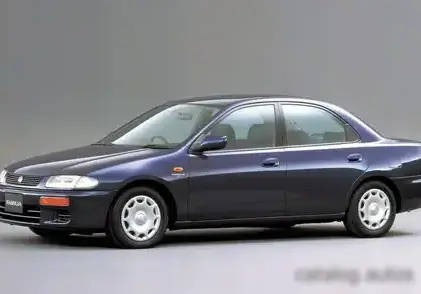
The Mazda Familia 1.5 i (91 hp) was a variant of the Mazda Familia, produced between 1989 and 1994. This model represented a key offering within the broader Familia range, particularly in markets where compact, fuel-efficient sedans were highly valued. The Familia, known as the 323 in many export markets, occupied a crucial position in Mazda’s lineup, bridging the gap between smaller, more economical cars and larger, more luxurious offerings. The 1.5 i trim, with its 91 horsepower engine, was generally positioned as an entry-level to mid-range option, appealing to buyers seeking a balance of affordability and practicality.
Technical Specifications
| Brand | Mazda |
| Model | Familia |
| Generation | Familia |
| Type (Engine) | 1.5 i (91 Hp) |
| Start of production | 1989 |
| End of production | 1994 |
| Powertrain Architecture | Internal Combustion engine |
| Body type | Sedan |
| Seats | 5 |
| Doors | 4 |
| Fuel Type | Petrol (Gasoline) |
| Power | 91 Hp @ 6500 rpm |
| Power per litre | 60.7 Hp/l |
| Torque | 122 Nm @ 4000 rpm |
| Torque (lb.-ft.) | 89.98 lb.-ft. @ 4000 rpm |
| Engine layout | Front, Transverse |
| Engine Model/Code | B5 |
| Engine displacement | 1498 cm3 |
| Engine displacement (cu. in.) | 91.41 cu. in. |
| Number of cylinders | 4 |
| Engine configuration | Inline |
| Cylinder Bore | 78 mm |
| Cylinder Bore (in.) | 3.07 in. |
| Piston Stroke | 78.6 mm |
| Piston Stroke (in.) | 3.09 in. |
| Compression ratio | 9:1 |
| Number of valves per cylinder | 4 |
| Fuel injection system | Multi-port manifold injection |
| Engine aspiration | Naturally aspirated engine |
| Valvetrain | DOHC |
| Fuel tank capacity | 50 l |
| Fuel tank capacity (US gal) | 13.21 US gal |
| Fuel tank capacity (UK gal) | 11 UK gal |
| Length | 4215 mm |
| Length (in.) | 165.94 in. |
| Width | 1675 mm |
| Width (in.) | 65.94 in. |
| Height | 1375 mm |
| Height (in.) | 54.13 in. |
| Wheelbase | 2500 mm |
| Wheelbase (in.) | 98.43 in. |
| Minimum turning circle | 9.6 m |
| Minimum turning circle (ft.) | 31.5 ft. |
| Drivetrain | Front wheel drive |
| Front brakes | Ventilated discs |
| Rear brakes | Drum |
Powertrain & Engine Architecture
The heart of the Familia 1.5 i was the B5 engine, a 1.5-liter inline-four cylinder gasoline engine. This engine utilized a multi-port fuel injection system, a common feature for the time, which improved fuel efficiency and responsiveness compared to earlier carburetor-based systems. The engine featured a double overhead camshaft (DOHC) valvetrain, operating four valves per cylinder. This configuration contributed to improved breathing and higher-end power output. The 9:1 compression ratio was a typical value for naturally aspirated engines of this era, balancing performance and fuel economy. The engine was transversely mounted in the front of the vehicle, driving the front wheels. While specific transmission details varied by market, the 1.5 i was commonly offered with a four-speed automatic transmission. This automatic was chosen for its ease of use and suitability for urban driving conditions, a key consideration for the target demographic.
Driving Characteristics
The Familia 1.5 i, equipped with the automatic transmission, offered a comfortable and predictable driving experience. With 91 horsepower and 122 Nm (89.98 lb-ft) of torque, acceleration was adequate for everyday driving, but not particularly sporty. The automatic transmission, while convenient, did result in some power loss compared to the available manual transmission options. Gear ratios were tuned for fuel efficiency and smooth cruising, rather than aggressive acceleration. Compared to higher-spec Familia models equipped with larger engines (such as the 1.6 or 1.8-liter variants), the 1.5 i felt noticeably less powerful, especially when fully loaded or tackling steep inclines. However, the lighter engine weight contributed to better handling balance and reduced understeer compared to its more powerful siblings.
Equipment & Trim Levels
The 1.5 i trim level typically included basic amenities such as cloth upholstery, a simple dashboard layout, and manual windows and door locks. Air conditioning was often an optional extra, as were features like a radio/cassette player. The interior design prioritized functionality and durability over luxury. Higher trim levels within the Familia range offered upgrades such as power windows, central locking, upgraded audio systems, and more refined interior materials. The 1.5 i served as a solid base model, providing essential features at an affordable price point. Exterior features generally included steel wheels with hubcaps, color-coded bumpers, and basic exterior trim.
Chassis & Braking
The Familia 1.5 i utilized a relatively simple chassis design, featuring a MacPherson strut front suspension and a torsion beam rear suspension. This setup provided a reasonable balance of ride comfort and handling. The front brakes were ventilated discs, offering adequate stopping power for the vehicle’s weight and performance. However, the rear brakes were typically drum brakes, which were less effective than disc brakes, particularly under heavy braking. Stabilizer bars were often included, helping to reduce body roll during cornering. The suspension tuning was geared towards comfort and everyday usability, rather than sporty handling.
Market Reception & Comparison
The Mazda Familia 1.5 i was generally well-received as a practical and affordable compact sedan. Critics praised its fuel efficiency and reliability, but noted its modest performance. Compared to other trims in the Familia lineup, the 1.5 i offered the most accessible price point, making it attractive to budget-conscious buyers. The 1.6 and 1.8-liter models provided significantly more power and performance, but at a higher cost. The 1.5 i also competed with other compact sedans from Japanese manufacturers, such as the Toyota Corolla and Honda Civic, offering a similar level of practicality and affordability. Fuel economy was a key selling point, and the 1.5 i generally achieved competitive figures for its class.
Legacy
The Mazda Familia 1.5 i, while not a particularly high-performance variant, has proven to be a reliable and durable vehicle. Many examples are still on the road today, testament to the quality of its engineering and construction. The B5 engine is known for its longevity, provided it receives regular maintenance. In the used car market, the 1.5 i represents an affordable entry point into Mazda ownership. Its simplicity and relatively low running costs make it an attractive option for first-time car buyers or those seeking a dependable and economical vehicle. While parts availability may be becoming more challenging as the car ages, many common components are still readily available, ensuring that these vehicles can be kept running for years to come.