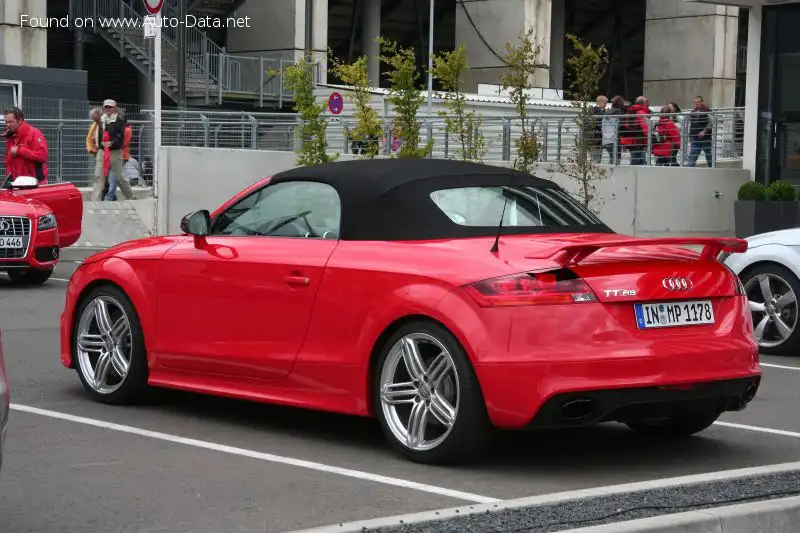
The Audi TT RS Roadster (8J) 2.5 TFSI, produced from March 2009 to 2010, represents the high-performance, open-top variant of the second-generation TT. Positioned as the flagship Roadster within the 8J TT lineup, it combined the iconic TT design with a potent turbocharged five-cylinder engine and Audi’s quattro all-wheel-drive system. This model was built on the Volkswagen Group’s PQ35 platform, also known as the A5/1HX0 platform, shared with the Golf Mk5, Audi A3, and other vehicles. The TT RS Roadster aimed to deliver a thrilling driving experience, blending sports car agility with the freedom of a convertible.
Technical Specifications
| Brand | Audi |
| Model | TT |
| Generation | TT RS Roadster (8J) |
| Type (Engine) | 2.5 TFSI (340 Hp) |
| Start of production | March, 2009 |
| End of production | 2010 |
| Powertrain Architecture | Internal Combustion engine |
| Body type | Roadster |
| Seats | 2 |
| Doors | 2 |
| Fuel consumption (urban) | 13.3 l/100 km (17.7 US mpg, 21.2 UK mpg, 7.5 km/l) |
| Fuel consumption (extra urban) | 7.2 l/100 km (32.7 US mpg, 39.2 UK mpg, 13.9 km/l) |
| Fuel consumption (combined) | 9.5 l/100 km (24.8 US mpg, 29.7 UK mpg, 10.5 km/l) |
| CO2 emissions | 221 g/km |
| Fuel Type | Petrol (Gasoline) |
| Acceleration 0 – 100 km/h | 4.7 sec |
| Acceleration 0 – 62 mph | 4.7 sec |
| Acceleration 0 – 60 mph | 4.5 sec |
| Maximum speed | 250 km/h (155.34 mph) |
| Emission standard | Euro 5 |
| Weight-to-power ratio | 4.4 kg/Hp, 225.2 Hp/tonne |
| Weight-to-torque ratio | 3.4 kg/Nm, 298 Nm/tonne |
| Power | 340 Hp @ 5400-6500 rpm |
| Power per litre | 137.1 Hp/l |
| Torque | 450 Nm @ 1600-6500 rpm (331.9 lb.-ft. @ 1600-6500 rpm) |
| Engine layout | Front, Transverse |
| Engine Model/Code | CEPA |
| Engine displacement | 2480 cm3 (151.34 cu. in.) |
| Number of cylinders | 5 |
| Engine configuration | Inline |
| Cylinder Bore | 82.5 mm (3.25 in.) |
| Piston Stroke | 92.8 mm (3.65 in.) |
| Compression ratio | 10:1 |
| Number of valves per cylinder | 4 |
| Fuel injection system | Direct injection |
| Engine aspiration | Turbocharger, Intercooler |
| Valvetrain | DOHC |
| Engine oil capacity | 5.7 l (6.02 US qt | 5.02 UK qt) |
| Coolant | 10 l (10.57 US qt | 8.8 UK qt) |
| Kerb Weight | 1510 kg (3328.98 lbs.) |
| Max. weight | 1830 kg (4034.46 lbs.) |
| Max load | 320 kg (705.48 lbs.) |
| Trunk (boot) space – minimum | 250 l (8.83 cu. ft.) |
| Fuel tank capacity | 60 l (15.85 US gal | 13.2 UK gal) |
| Length | 4198 mm (165.28 in.) |
| Width | 1842 mm (72.52 in.) |
| Width including mirrors | 1952 mm (76.85 in.) |
| Height | 1348 mm (53.07 in.) |
| Wheelbase | 2468 mm (97.17 in.) |
| Front track | 1555 mm (61.22 in.) |
| Rear (Back) track | 1546 mm (60.87 in.) |
| Drag coefficient (Cd) | 0.34 |
| Minimum turning circle | 10.7 m (35.1 ft.) |
| Drive wheel | All wheel drive (4×4) |
| Number of gears and type of gearbox | 6 gears, manual transmission |
| Front suspension | Independent, type McPherson with coil spring and anti-roll bar |
| Rear suspension | Independent multi-link spring suspension with stabilizer |
| Front brakes | Ventilated discs |
| Rear brakes | Disc |
| Assisting systems | ABS (Anti-lock braking system) |
| Steering type | Steering rack and pinion |
| Power steering | Electric Steering |
| Tires size | 245/40 R18 |
| Wheel rims size | 9J x 18 |
Powertrain & Engine Architecture
The heart of the TT RS Roadster is the 2.5-liter inline-five cylinder engine, designated as the CEPA engine code. This engine is a highly-regarded unit within the Volkswagen Group, known for its unique firing order (1-2-4-5-3) which contributes to a distinctive exhaust note. The engine utilizes direct fuel injection (FSI) and a BorgWarner K16 turbocharger with an intercooler to deliver 340 horsepower and 331.9 lb-ft of torque. The turbocharger provides significant boost across a broad RPM range, resulting in strong acceleration. The engine features a dual overhead camshaft (DOHC) valvetrain with four valves per cylinder. The sole transmission option was a six-speed manual gearbox, optimized for quick shifts and direct power delivery. The quattro all-wheel-drive system, utilizing a multi-plate clutch, distributes power between the front and rear axles as needed, enhancing traction and stability.
Driving Characteristics
The 2.5 TFSI engine in the TT RS Roadster delivers exhilarating performance. Acceleration from 0 to 60 mph takes approximately 4.5 seconds, and it reaches a top speed of 155.34 mph (electronically limited). The manual transmission provides precise control, and the quattro all-wheel-drive system ensures excellent grip in various conditions. Compared to the standard TT models with their four-cylinder engines, the RS Roadster offers a significantly more powerful and responsive driving experience. While the 1.8 TFSI and 2.0 TFSI variants focused on fuel efficiency and everyday usability, the RS model prioritized performance. The gear ratios are closely spaced, allowing the driver to stay within the engine’s powerband for optimal acceleration. The exhaust note is particularly distinctive, a raspy growl that sets it apart from other sports cars.
Equipment & Trim Levels
The TT RS Roadster came generously equipped as standard. Interior features included sport seats upholstered in Nappa leather with embossed RS logos, a flat-bottomed steering wheel, aluminum pedal caps, and unique RS-specific interior trim. Exterior features included a distinctive RS front bumper with large air intakes, a rear diffuser, a rear spoiler, and 18-inch alloy wheels. Optional extras included Bang & Olufsen sound system, navigation system, and parking sensors. The overall interior design emphasized a sporty and driver-focused environment.
Chassis & Braking
The TT RS Roadster features a fully independent suspension system. The front utilizes McPherson struts with coil springs and an anti-roll bar, while the rear employs a multi-link setup with a stabilizer bar. This suspension configuration provides a balance between sporty handling and ride comfort. Braking duties are handled by ventilated discs on all four wheels, providing ample stopping power. The ABS (Anti-lock Braking System) is standard. The chassis was specifically tuned to handle the increased power output of the 2.5 TFSI engine, offering improved stability and control.
Market Reception & Comparison
The Audi TT RS Roadster was well-received by automotive critics, praised for its performance, handling, and distinctive engine. It was often compared to rivals such as the Porsche Boxster and BMW Z4. While the TT RS Roadster offered comparable performance to these competitors, it often stood out due to its unique five-cylinder engine and all-wheel-drive system. Fuel economy, at 24.8 US mpg combined, was reasonable for a high-performance sports car, but lower than the base TT models. Reliability has generally been good, although preventative maintenance, particularly regarding the turbocharger and oil changes, is crucial.
Legacy
The Audi TT RS Roadster (8J) 2.5 TFSI has become a sought-after vehicle in the used car market. Its combination of performance, style, and relative rarity has made it a collectible item. The 2.5 TFSI engine is known for its durability when properly maintained, but regular servicing is essential to prevent issues with the turbocharger and fuel system. The car represents a high point in the TT lineage, offering a unique and engaging driving experience that continues to appeal to enthusiasts today. The distinctive sound of the inline-five engine and the capable all-wheel-drive system have cemented its place as a modern classic.