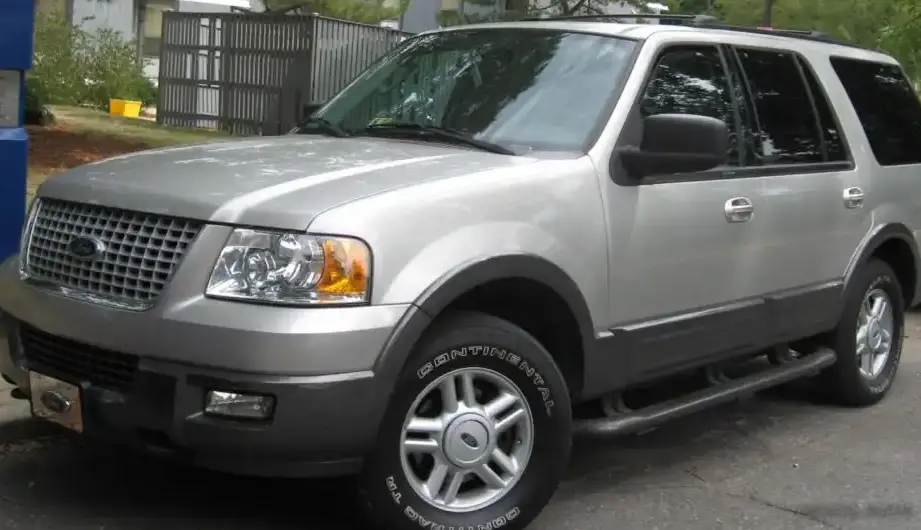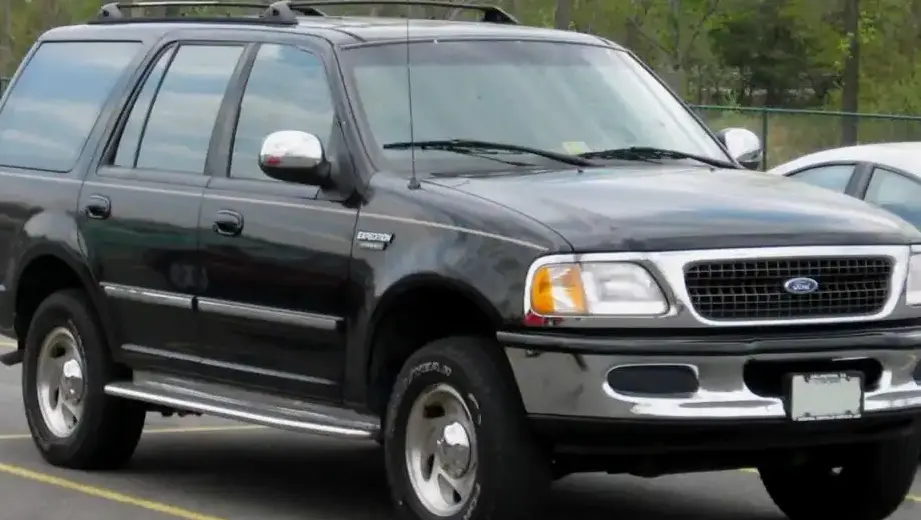
The Ford Expedition, introduced in 1997 as a 1997 model, represented Ford’s entry into the burgeoning full-size SUV market, directly challenging the Chevrolet Tahoe and GMC Yukon. Replacing the Ford Bronco and the larger, truck-based Ford Explorer, the Expedition aimed to provide a more comfortable and spacious alternative for families and those needing substantial towing capacity. The first generation, designated the U173, spanned from the 1997 to 2003 model years. Within this generation, the 4.6L V8 XLT trim, producing 243 horsepower, occupied a significant middle ground in the lineup, offering a balance of power, features, and affordability. This variant was particularly popular with buyers seeking a capable SUV without the higher price tag of the more powerful, and often 4×4 equipped, models.
Technical Specifications
| Brand | Ford |
| Model | Expedition |
| Generation | Expedition I (U173) |
| Type (Engine) | 4.6 i V8 16V XLT (243 Hp) |
| Start of production | 1996 year |
| End of production | 2003 year |
| Powertrain Architecture | Internal Combustion engine |
| Body type | SUV |
| Seats | 5 |
| Doors | 5 |
| Fuel consumption (urban) | 16.8 l/100 km (14 US mpg, 16.8 UK mpg) |
| Fuel consumption (extra urban) | 12.4 l/100 km (19 US mpg, 22.8 UK mpg) |
| Fuel Type | Petrol (Gasoline) |
| Acceleration 0 – 100 km/h | 11 sec |
| Acceleration 0 – 62 mph | 11 sec |
| Acceleration 0 – 60 mph | 10.5 sec |
| Maximum speed | 170 km/h (105.63 mph) |
| Weight-to-power ratio | 9.4 kg/Hp |
| Weight-to-torque ratio | 5.7 kg/Nm |
| Power | 243 Hp @ 4750 rpm |
| Torque | 397 Nm @ 3500 rpm (292.81 lb.-ft. @ 3500 rpm) |
| Engine layout | Front, Longitudinal |
| Engine Model/Code | Triton |
| Engine displacement | 4601 cm3 (280.77 cu. in.) |
| Number of cylinders | 8 |
| Engine configuration | V-engine |
| Cylinder Bore | 90.2 mm (3.55 in.) |
| Piston Stroke | 90 mm (3.54 in.) |
| Compression ratio | 9:1 |
| Number of valves per cylinder | 2 |
| Fuel injection system | Multi-port manifold injection |
| Engine aspiration | Naturally aspirated engine |
| Valvetrain | OHC |
| Engine oil capacity | 5.7 l (6.02 US qt | 5.02 UK qt) |
| Coolant capacity | 17.9 l (18.91 US qt | 15.75 UK qt) |
| Kerb Weight | 2280 kg (5026.54 lbs.) |
| Max. weight | 3150 kg (6944.56 lbs.) |
| Max load | 870 kg (1918.02 lbs.) |
| Trunk (boot) space – minimum | 1770 l (62.51 cu. ft.) |
| Trunk (boot) space – maximum | 3350 l (118.3 cu. ft.) |
| Fuel tank capacity | 98 l (25.89 US gal | 21.56 UK gal) |
| Length | 5197 mm (204.61 in.) |
| Width | 1996 mm (78.58 in.) |
| Height | 1887 mm (74.29 in.) |
| Wheelbase | 3025 mm (119.09 in.) |
| Front track | 1661 mm (65.39 in.) |
| Rear (Back) track | 1664 mm (65.51 in.) |
| Drivetrain Architecture | Rear wheel drive |
| Number of gears | 4 |
| Gearbox type | Automatic transmission |
| Front suspension | Torsion |
| Rear suspension | Rigid axle suspension |
| Front brakes | Ventilated discs |
| Rear brakes | Disc |
| Assisting systems | ABS (Anti-lock braking system), Hydraulic Power Steering |
| Tires size | 255/70 R16 |
Powertrain & Engine Architecture
The heart of the Expedition XLT was the 4.6-liter Triton V8 engine. This engine, part of Ford’s modular engine family, featured a cast-iron block with aluminum cylinder heads. The “Triton” name denoted Ford’s overhead cam (OHC) V8 engine series. The 4.6L engine utilized a multi-port fuel injection system, delivering fuel directly to each intake port for improved efficiency and power delivery. The engine produced 243 horsepower at 4750 rpm and 293 lb-ft of torque at 3500 rpm. The engine’s 9:1 compression ratio was a compromise between performance and the ability to run on regular unleaded gasoline. Paired with the 4.6L engine was a four-speed automatic transmission, specifically the 4R70W. This transmission was known for its durability and smooth shifting characteristics, although it wasn’t particularly fuel-efficient by modern standards. The rear-wheel-drive configuration was standard, with four-wheel drive available as an option.
Driving Characteristics
The 1997-2003 Ford Expedition 4.6L V8 with the automatic transmission offered a comfortable and capable driving experience, but wasn’t known for being particularly sporty. Acceleration from 0-60 mph took around 10.5 seconds, which was adequate for everyday driving but noticeably slower than the higher-output 5.4L V8 versions. The automatic transmission’s gear ratios were tuned for towing and cruising, prioritizing smooth operation over quick acceleration. The 4R70W transmission generally shifted smoothly, but could sometimes feel hesitant during quick downshifts. The rear-wheel-drive setup provided a stable feel on paved roads, but traction could be limited in slippery conditions. Compared to the manual transmission equipped Expeditions (which were rare), the automatic offered greater convenience, especially in city driving, but at the expense of some fuel economy and driver engagement.
Equipment & Trim Levels
The XLT trim level positioned the 4.6L Expedition as a mid-range offering. Standard features typically included air conditioning, power windows and locks, a CD player, and cloth upholstery. Optional extras included leather upholstery, a power sunroof, upgraded sound systems, and rear-seat entertainment systems. The interior design was functional and spacious, with seating for up to eight passengers depending on the configuration. The XLT trim also included features like a tilt steering wheel and cruise control as standard equipment. The dashboard layout was straightforward and easy to use, with clearly labeled controls.
Chassis & Braking
The Expedition utilized a body-on-frame construction, providing a robust and durable platform. The front suspension consisted of an independent torsion bar setup, while the rear suspension employed a solid axle with leaf springs. This configuration was designed to handle heavy loads and provide a comfortable ride. Braking duties were handled by ventilated disc brakes at the front and solid disc brakes at the rear. Anti-lock brakes (ABS) were standard, enhancing safety and control during emergency braking situations. The hydraulic power steering provided relatively light and responsive steering feel. The tires were typically 255/70R16, offering a good balance of ride comfort and traction.
Market Reception & Comparison
The Ford Expedition was generally well-received by critics and consumers alike. The 4.6L V8/automatic combination was praised for its smooth operation and adequate power for most drivers. However, some reviewers noted that the fuel economy was relatively poor compared to other SUVs in its class. Compared to the 5.4L V8 Expedition, the 4.6L offered lower performance and towing capacity, but it was also more affordable to purchase and operate. The 4.6L version was often seen as a good choice for families who didn’t need the extra power of the 5.4L engine. Reliability was generally good, although some owners reported issues with the automatic transmission and the cooling system.
Legacy
The first-generation Ford Expedition established the model as a major player in the full-size SUV segment. The 4.6L Triton V8 engine, while not the most powerful option, proved to be a reliable and durable powertrain. Today, these Expeditions are relatively affordable on the used car market, making them a popular choice for budget-minded buyers. However, potential buyers should be aware of potential maintenance issues, such as transmission problems and cooling system leaks. Despite its age, the Expedition remains a capable and spacious SUV, offering a comfortable ride and ample cargo space. The 4.6L engine, while not known for its fuel efficiency, continues to provide adequate power for everyday driving and light towing duties.