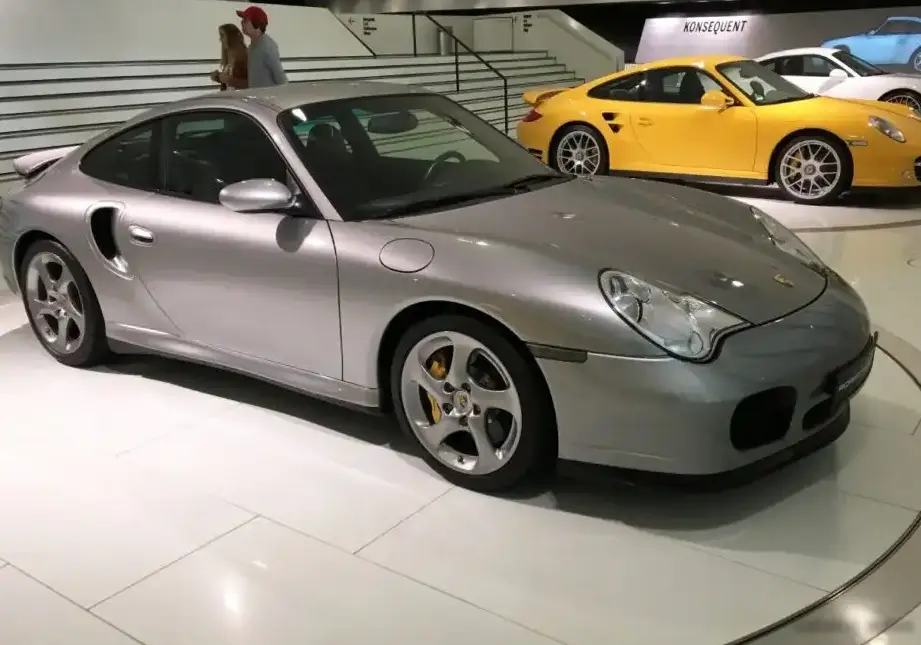
The Porsche 911 Turbo (996, facelifted in 2001) with the 3.6-liter twin-turbocharged engine and Tiptronic S automatic transmission represents a significant evolution in the iconic 911 lineage. Produced from 2000 to 2005, this variant bridged the gap between the traditional, driver-focused 911 experience and the increasing demand for more accessible performance. It sat at the top of the 996.1 and 996.2 range, offering blistering speed and advanced technology, but with the convenience of an automatic gearbox. The facelifted 996, introduced in 2001, addressed some criticisms of the earlier 996 models, notably with revised headlights and interior refinements.
Technical Specifications
| Brand | Porsche |
| Model | 911 |
| Generation | 911 (996, facelift 2001) |
| Type (Engine) | Turbo 3.6 (420 Hp) Tiptronic S |
| Start of production | 2000 |
| End of production | 2005 |
| Powertrain Architecture | Internal Combustion engine |
| Body type | Coupe |
| Seats | 4 |
| Doors | 2 |
| Fuel consumption (economy) – urban | 18.8 l/100 km (12.5 US mpg, 15 UK mpg, 5.3 km/l) |
| Fuel consumption (economy) – extra urban | 12.8 l/100 km (18.4 US mpg, 22.1 UK mpg, 7.8 km/l) |
| Fuel Type | Petrol (Gasoline) |
| Acceleration 0 – 100 km/h | 4.8 sec |
| Acceleration 0 – 62 mph | 4.8 sec |
| Acceleration 0 – 60 mph | 4.6 sec |
| Maximum speed | 296 km/h (183.93 mph) |
| Weight-to-power ratio | 3.7 kg/Hp, 272.7 Hp/tonne |
| Weight-to-torque ratio | 2.8 kg/Nm, 363.6 Nm/tonne |
| Power | 420 Hp @ 6000 rpm |
| Power per litre | 116.7 Hp/l |
| Torque | 560 Nm @ 2700-4600 rpm (413.03 lb.-ft. @ 2700-4600 rpm) |
| Engine layout | Rear, Longitudinal |
| Engine Model/Code | M96.70 |
| Engine displacement | 3600 cm3 (219.69 cu. in.) |
| Number of cylinders | 6 |
| Engine configuration | Boxer |
| Cylinder Bore | 100 mm (3.94 in.) |
| Piston Stroke | 76.4 mm (3.01 in.) |
| Compression ratio | 9.4:1 |
| Number of valves per cylinder | 4 |
| Fuel injection system | Multi-port manifold injection |
| Engine aspiration | Twin-Turbo, Intercooler |
| Engine oil capacity | 8 l (8.45 US qt, 7.04 UK qt) |
| Coolant | 28 l (29.59 US qt, 24.64 UK qt) |
| Kerb Weight | 1540 kg (3395.12 lbs.) |
| Max. weight | 1885 kg (4155.71 lbs.) |
| Max load | 345 kg (760.59 lbs.) |
| Trunk (boot) space – maximum | 100 l (3.53 cu. ft.) |
| Fuel tank capacity | 63 l (16.64 US gal, 13.86 UK gal) |
| Length | 4465 mm (175.79 in.) |
| Width | 1830 mm (72.05 in.) |
| Height | 1295 mm (50.98 in.) |
| Wheelbase | 2350 mm (92.52 in.) |
| Front track | 1472 mm (57.95 in.) |
| Rear (Back) track | 1528 mm (60.16 in.) |
| Drive wheel | All wheel drive (4×4) |
| Number of gears and type of gearbox | 5 gears, automatic transmission |
| Front suspension | Independent type McPherson |
| Rear suspension | Independent multi-link suspension |
| Front brakes | Ventilated discs |
| Rear brakes | Ventilated discs |
| Assisting systems | ABS (Anti-lock braking system) |
| Steering type | Steering rack and pinion |
| Power steering | Hydraulic Steering |
| Tires size | 225/40 R18; 295/30 R18 |
| Wheel rims size | 8J x 18; 11J x 18 |
Powertrain & Engine Architecture
The heart of the 996 Turbo is the M96.70 engine, a 3.6-liter flat-six (boxer) engine. This engine is distinguished by its twin turbochargers with intercoolers, a significant upgrade over naturally aspirated 911s. The engine utilizes multi-port fuel injection and features a relatively conservative 9.4:1 compression ratio to accommodate the forced induction. The engine produces 420 horsepower at 6000 rpm and a substantial 560 Nm (413 lb-ft) of torque between 2700 and 4600 rpm. The Tiptronic S transmission is a five-speed automatic with manual shift capability. It features adaptive shift programming, adjusting shift points based on driving style. Unlike a traditional torque converter automatic, Tiptronic S offers quicker shifts and a more direct feel.
Driving Characteristics
The 996 Turbo Tiptronic S delivers a remarkably potent driving experience. While purists often favor the manual transmission for its greater driver involvement, the Tiptronic S offers a compelling blend of performance and convenience. Acceleration is brutal, with 0-60 mph times consistently in the 4.6-4.8 second range. The broad torque curve ensures strong acceleration in any gear. The Tiptronic S transmission, while not as lightning-fast as a dual-clutch gearbox, provides smooth and relatively quick shifts. The all-wheel-drive system provides excellent traction, particularly when launching from a standstill. Compared to the naturally aspirated 911 Carrera models, the Turbo offers a significantly more powerful and refined experience. The higher output versions, like the GT2, were even more focused on track performance, sacrificing some everyday usability.
Equipment & Trim Levels
The 996 Turbo came generously equipped, reflecting its flagship status. Standard features included leather upholstery, power-adjustable seats, a Bose sound system, automatic climate control, and Xenon headlights. Optional extras were plentiful, including sport seats, a navigation system, and various interior trim options. The interior design, while updated in the 2001 facelift, retained a functional and somewhat spartan aesthetic typical of Porsche at the time. The Tiptronic S models often featured a unique shift knob and steering wheel design compared to their manual counterparts.
Chassis & Braking
The 996 Turbo’s chassis was specifically tuned to handle the increased power output. It features a fully independent suspension with McPherson struts at the front and a multi-link setup at the rear. The suspension geometry and damping rates were optimized for both performance and comfort. Braking duties are handled by ventilated discs at all four corners, providing ample stopping power. The ABS system is standard, enhancing stability during hard braking. The Turbo models also received larger stabilizer bars compared to the Carrera models, further reducing body roll.
Market Reception & Comparison
The 996 Turbo was widely praised by automotive journalists for its exceptional performance and technological advancements. Critics noted the impressive acceleration, capable handling, and refined driving experience. The Tiptronic S transmission received mixed reviews, with some praising its convenience and smoothness, while others lamented its lack of engagement compared to the manual gearbox. Fuel economy, unsurprisingly, was not a strong point, with combined fuel consumption around 15 mpg. Compared to other high-performance sports cars of the era, such as the Ferrari 360 Modena, the 996 Turbo offered a compelling combination of speed, practicality, and all-weather capability.
Legacy
The 996 Turbo, particularly the facelifted models, have become increasingly sought-after by collectors and enthusiasts. The M96 engine, while robust, is known to require regular maintenance, including periodic cylinder sleeve inspection. The Tiptronic S transmission, while generally reliable, can be expensive to repair if issues arise. Despite these potential maintenance concerns, the 996 Turbo remains a highly capable and rewarding sports car. Its blend of performance, technology, and iconic Porsche design ensures its continued appeal in the used car market. It represents a pivotal moment in the 911’s evolution, paving the way for the even more advanced 997 generation.