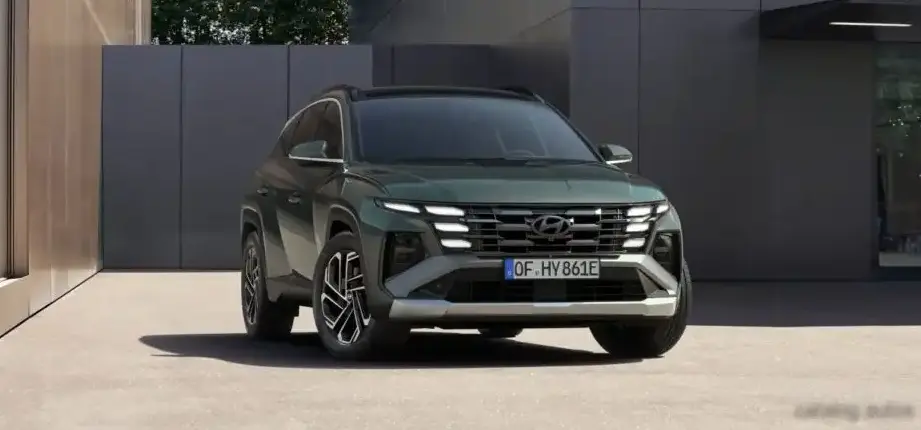
The Hyundai Tucson IV (facelift, introduced in May 2024) 1.6T 160 hp Mild Hybrid DCT represents a key offering within Hyundai’s popular compact SUV lineup. Positioned as a mid-range option, this variant balances fuel efficiency with adequate performance for everyday driving. The facelift brought updated styling and enhanced technology to the already successful fourth-generation Tucson, which debuted on the 1HX0 platform. Production of this specific configuration is expected to continue through September 2025, catering primarily to the European and Asian markets, with increasing availability in North America as Hyundai expands its hybrid offerings.
Technical Specifications
| Brand | Hyundai |
| Model | Tucson |
| Generation | Tucson IV (facelift 2024) |
| Type (Engine) | 1.6T (160 Hp) Mild Hybrid DCT |
| Start of production | May, 2024 |
| End of production | September, 2025 |
| Powertrain Architecture | MHEV (Mild Hybrid Electric Vehicle) |
| Body type | SUV |
| Seats | 5 |
| Doors | 5 |
| Fuel consumption at Low speed (WLTP) | 7.6-7.7 l/100 km (30.9 – 30.5 US mpg) |
| Fuel consumption at Medium speed (WLTP) | 5.8-5.9 l/100 km (40.6 – 39.9 US mpg) |
| Fuel consumption at high speed (WLTP) | 5.4-5.6 l/100 km (43.6 – 42 US mpg) |
| Fuel consumption at very high speed (WLTP) | 6.7-6.9 l/100 km (35.1 – 34.1 US mpg) |
| Combined fuel consumption (WLTP) | 6.3-6.4 l/100 km (37.3 – 36.8 US mpg) |
| CO2 emissions (WLTP) | 142-145 g/km |
| Fuel Type | Petrol (Gasoline) |
| Acceleration 0 – 100 km/h | 9.4 sec |
| Acceleration 0 – 62 mph | 9.4 sec |
| Acceleration 0 – 60 mph | 8.9 sec |
| Maximum speed | 192 km/h (119.3 mph) |
| Emission standard | Euro 6e |
| Weight-to-power ratio | 10.1 kg/Hp |
| Weight-to-torque ratio | 6.1 kg/Nm |
| Battery voltage | 48 V |
| Power | 160 Hp @ 5500 rpm |
| Torque | 265 Nm @ 1500-4500 rpm (195.45 lb.-ft. @ 1500-4500 rpm) |
| Engine layout | Front, Transverse |
| Engine Model/Code | G4FU |
| Engine displacement | 1598 cm3 (97.52 cu. in.) |
| Number of cylinders | 4 |
| Engine configuration | Inline |
| Cylinder Bore | 75.6 mm (2.98 in.) |
| Piston Stroke | 89 mm (3.5 in.) |
| Compression ratio | 10.5:1 |
| Number of valves per cylinder | 4 |
| Fuel injection system | Direct injection |
| Engine aspiration | Turbocharger, Intercooler |
| Valvetrain | DOHC |
| Engine oil capacity | 4.8 l (5.07 US qt | 4.22 UK qt) |
| Coolant | 8 l (8.45 US qt | 7.04 UK qt) |
| Kerb Weight | 1618 kg (3567.08 lbs.) |
| Max. weight | 2095 kg (4618.68 lbs.) |
| Max load | 477 kg (1051.6 lbs.) |
| Trunk (boot) space – minimum | 577 l (20.38 cu. ft.) |
| Trunk (boot) space – maximum | 1756 l (62.01 cu. ft.) |
| Fuel tank capacity | 54 l (14.27 US gal | 11.88 UK gal) |
| Max. roof load | 100 kg (220.46 lbs.) |
| Permitted trailer load with brakes (12%) | 1510 kg (3328.98 lbs.) |
| Permitted trailer load without brakes | 750 kg (1653.47 lbs.) |
| Length | 4510 mm (177.56 in.) |
| Width | 1865 mm (73.43 in.) |
| Height | 1650-1653 mm (64.96 – 65.08 in.) |
| Wheelbase | 2680 mm (105.51 in.) |
| Front track | 1615-1630 mm (63.58 – 64.17 in.) |
| Rear (Back) track | 1622-1637 mm (63.86 – 64.45 in.) |
| Minimum turning circle | 11 m (36.09 ft.) |
| Drivetrain Architecture | Front wheel drive, MHEV |
| Number of gears and type of gearbox | 7 gears, automatic transmission DCT |
| Front suspension | Independent type McPherson |
| Rear suspension | Independent multi-link suspension |
| Front brakes | Ventilated discs |
| Rear brakes | Disc |
| Assisting systems | ABS (Anti-lock braking system) |
| Steering type | Steering rack and pinion |
| Power steering | Electric Steering |
| Tires size | 215/65 R17; 235/55 R18; 235/50 R19 |
| Wheel rims size | 7.0J x 17; 7.5J x 18; 7.5J x 19 |
INTRODUCTION
The Hyundai Tucson IV facelift 1.6T Mild Hybrid DCT, launched in May 2024, builds upon the success of the fourth-generation Tucson. This variant is designed to appeal to buyers seeking a balance between fuel economy, reasonable performance, and modern features. The “Mild Hybrid” designation indicates a 48V system that assists the gasoline engine, providing a small boost in power and improving fuel efficiency. The dual-clutch transmission (DCT) offers quicker and smoother gear changes compared to a traditional automatic. This trim level typically sits in the middle of the Tucson range, offering more features than the base models but remaining more affordable than the fully hybrid or higher-trim gasoline versions.
Powertrain & Engine Architecture
At the heart of this Tucson variant lies the Hyundai-Kia G4FU 1.6-liter turbocharged inline-four cylinder engine. This engine utilizes direct fuel injection and a twin-scroll turbocharger to deliver 160 horsepower at 5500 rpm and 265 Nm (195.45 lb.-ft.) of torque between 1500 and 4500 rpm. The mild hybrid system incorporates a 48V battery and a belt-driven starter generator (BSG). The BSG allows for extended stop/start functionality, regenerative braking to recapture energy, and a small electric boost during acceleration. The 7-speed dual-clutch transmission (DCT) is a key component, offering fast and precise shifts. Unlike traditional torque converter automatics, DCTs use two clutches to pre-select the next gear, resulting in quicker response and improved efficiency. The engine’s architecture is designed for optimal thermal management and reduced friction to maximize fuel economy.
Driving Characteristics
The 1.6T Mild Hybrid DCT Tucson delivers a comfortable and refined driving experience. While not a performance-oriented model, the 160 hp engine provides adequate power for everyday driving situations, including highway merging and overtaking. The DCT transmission contributes to smooth acceleration and responsive gear changes. Compared to the base engine options, the turbocharger provides a noticeable increase in low-end torque. However, it doesn’t offer the same level of punch as the more powerful gasoline engines or the fully hybrid variants. The mild hybrid system is largely transparent to the driver, providing a subtle boost during acceleration and enabling a smoother stop/start experience. The DCT’s gear ratios are tuned for fuel efficiency, prioritizing comfortable cruising over aggressive acceleration.
Equipment & Trim Levels
The 1.6T Mild Hybrid DCT trim typically includes a comprehensive suite of standard features. These generally include automatic climate control, a touchscreen infotainment system with Apple CarPlay and Android Auto compatibility, a rearview camera, and a range of safety features such as lane keeping assist, forward collision avoidance assist, and automatic emergency braking. Interior upholstery is typically cloth or a combination of cloth and leatherette, depending on optional packages. Higher trim levels within the 1.6T range may add features like a panoramic sunroof, leather seats, a premium audio system, and advanced driver-assistance systems like adaptive cruise control and blind-spot monitoring.
Chassis & Braking
The Tucson IV utilizes a front-wheel-drive platform with independent suspension on all four wheels. The front suspension employs a McPherson strut design, while the rear features a multi-link setup. This configuration provides a good balance between ride comfort and handling. The 1.6T variant typically features ventilated disc brakes at the front and solid disc brakes at the rear. ABS (Anti-lock Braking System) is standard, along with electronic stability control and traction control. The steering system is an electric power-assisted rack and pinion, providing light and precise steering feel.
Market Reception & Comparison
The Hyundai Tucson IV has been well-received by critics and consumers alike, praised for its stylish design, spacious interior, and value for money. The 1.6T Mild Hybrid DCT variant offers a compelling alternative to traditional gasoline engines, providing improved fuel economy without sacrificing too much performance. Compared to the base engine options, the 1.6T offers a more refined and enjoyable driving experience. Against competitors like the Toyota RAV4, Honda CR-V, and Nissan Rogue, the Tucson 1.6T Mild Hybrid DCT stands out with its modern design, generous warranty, and competitive pricing. Fuel economy figures are generally competitive within its class, and the mild hybrid system contributes to lower CO2 emissions.
Legacy
The G4FU 1.6T engine, coupled with the 7-speed DCT, has proven to be a reliable powertrain in other Hyundai and Kia models. While long-term reliability data for the facelifted 2024 Tucson is still emerging, the underlying technology has a solid track record. The mild hybrid system is expected to enhance the powertrain’s longevity by reducing stress on the engine. On the used car market, the Tucson IV 1.6T Mild Hybrid DCT is expected to hold its value well, particularly as demand for fuel-efficient vehicles continues to grow. Regular maintenance, including oil changes and DCT fluid replacements, will be crucial to ensuring the powertrain’s long-term health.