
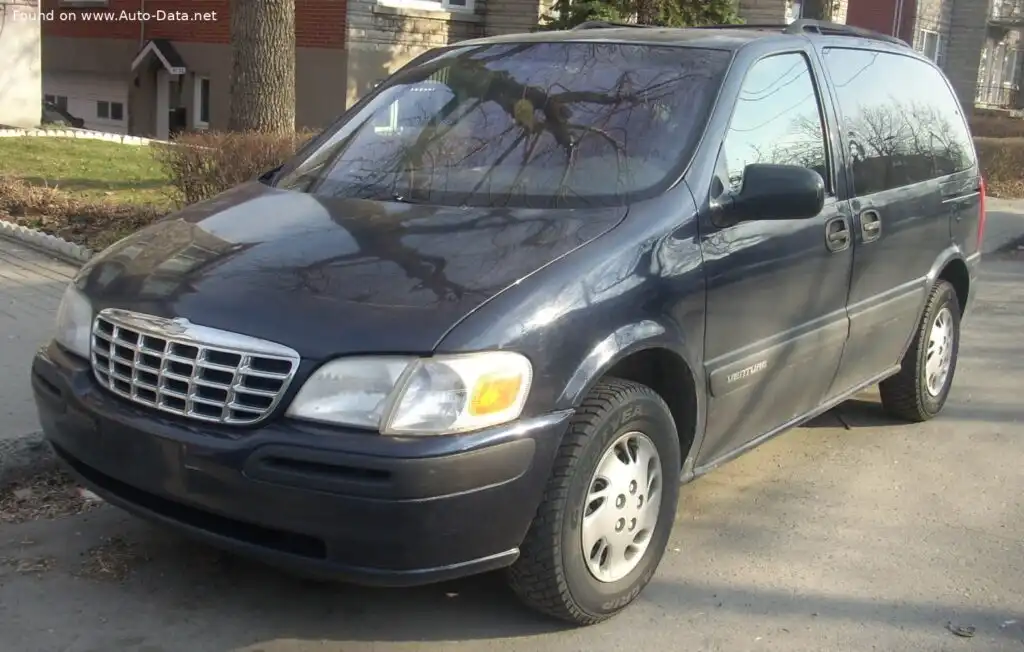
The Chevrolet Venture (U) 3.4i V6 Long, produced from 2001 to 2005, represented Chevrolet’s entry into the increasingly popular minivan segment. Part of the U-body platform shared with the Pontiac Montana, Oldsmobile Silhouette, and Buick Terraza, the Venture aimed to provide American families with a spacious, comfortable, and practical transportation solution. This particular variant, equipped with the 3.4-liter V6 engine and a four-speed automatic transmission, was positioned as a mid-range offering within the Venture lineup, balancing performance with affordability. It served as a direct competitor to the Dodge Caravan, Chrysler Town & Country, and Honda Odyssey.
Technical Specifications
| Brand | Chevrolet |
| Model | Venture |
| Generation | Venture (U) |
| Type (Engine) | 3.4 i V6 Long (187 Hp) |
| Start of production | 2001 |
| End of production | 2005 |
| Powertrain Architecture | Internal Combustion engine |
| Body type | Minivan |
| Seats | 7 |
| Doors | 4 |
| Fuel consumption (urban) | 12.4 l/100 km (19 US mpg) |
| Fuel consumption (extra urban) | 9.1 l/100 km (25.8 US mpg) |
| Fuel Type | Petrol (Gasoline) |
| Acceleration 0 – 100 km/h | 10.4 sec |
| Acceleration 0 – 62 mph | 10.4 sec |
| Acceleration 0 – 60 mph | 9.9 sec |
| Maximum speed | 177 km/h (109.98 mph) |
| Weight-to-power ratio | 9.6 kg/Hp |
| Weight-to-torque ratio | 6.4 kg/Nm |
| Power | 187 Hp @ 5200 rpm |
| Torque | 282 Nm @ 4000 rpm (207.99 lb.-ft. @ 4000 rpm) |
| Engine layout | Front, Transverse |
| Engine Model/Code | LA1 |
| Engine displacement | 3350 cm3 (204.43 cu. in.) |
| Number of cylinders | 6 |
| Engine configuration | V-engine |
| Cylinder Bore | 92 mm (3.62 in.) |
| Piston Stroke | 84 mm (3.31 in.) |
| Compression ratio | 9.5:1 |
| Number of valves per cylinder | 3 |
| Fuel injection system | Multi-port manifold injection |
| Engine aspiration | Naturally aspirated engine |
| Engine oil capacity | 4.25 l (4.49 US qt | 3.74 UK qt) |
| Coolant capacity | 9.1 l (9.62 US qt | 8.01 UK qt) |
| Kerb Weight | 1795 kg (3957.3 lbs.) |
| Max. weight | 2430 kg (5357.23 lbs.) |
| Max load | 635 kg (1399.94 lbs.) |
| Trunk (boot) space – minimum | 892 l (31.5 cu. ft.) |
| Trunk (boot) space – maximum | 3984 l (140.69 cu. ft.) |
| Fuel tank capacity | 95 l (25.1 US gal | 20.9 UK gal) |
| Length | 5103 mm (200.91 in.) |
| Width | 1829 mm (72.01 in.) |
| Height | 1712 mm (67.4 in.) |
| Wheelbase | 3038 mm (119.61 in.) |
| Front track | 1562 mm (61.5 in.) |
| Rear track | 1607 mm (63.27 in.) |
| Drivetrain Architecture | Front wheel drive |
| Number of gears | 4 |
| Gearbox type | Automatic transmission |
| Front suspension | Spring Strut |
| Rear suspension | Coil spring |
| Front brakes | Disc |
| Rear brakes | Drum |
| Assisting systems | ABS (Anti-lock braking system) |
| Steering type | Steering rack and pinion |
| Power steering | Hydraulic Steering |
| Tires size | 215/70 R15 |
Powertrain & Engine Architecture
The heart of the Venture 3.4i was the LA1 3.4-liter (3350 cc) 60-degree V6 engine. This engine, a member of Chevrolet’s “3800” family, utilized a cast iron block with aluminum cylinder heads. It featured a multi-port fuel injection system, delivering fuel directly to each intake port for improved efficiency and power delivery. The engine employed a single overhead camshaft (SOHC) design with three valves per cylinder (two intake, one exhaust). This configuration aimed to balance simplicity with adequate performance. The four-speed 4T65E automatic transmission was the sole transmission option for this variant. This transmission was known for its smooth shifting characteristics, but was sometimes criticized for its conservative gear ratios, prioritizing fuel economy over outright acceleration.
Driving Characteristics
The 187 horsepower and 208 lb-ft of torque produced by the 3.4L V6 provided adequate, but not exhilarating, performance for the Venture. Acceleration from 0-60 mph took approximately 9.9 seconds, making it competitive with other minivans of the era. The automatic transmission, while smooth, contributed to a somewhat leisurely driving experience. The gear ratios were tuned for fuel efficiency, meaning the engine often felt strained during quick acceleration or when fully loaded with passengers and cargo. Compared to the higher-output 3.8L V6 offered in some Venture trims, the 3.4L felt noticeably less powerful. However, the 3.4L offered a smoother, more refined driving experience than the available turbocharged four-cylinder engine.
Equipment & Trim Levels
The Venture 3.4i typically came standard with features such as air conditioning, power windows and locks, an AM/FM stereo with CD player, and cloth upholstery. Safety features included dual front airbags and ABS brakes. Optional extras included leather upholstery, a premium sound system, power sliding doors, and a rear entertainment system. The 3.4i trim generally fell in the middle of the Venture lineup, offering a good balance of features and affordability. It was positioned above the base model, which typically featured a smaller engine and fewer standard amenities, and below the higher-end trims that offered more luxurious features and the more powerful V6 engine.
Chassis & Braking
The Chevrolet Venture utilized a front-wheel-drive layout with an independent front suspension featuring coil springs and a multi-link rear suspension. The front suspension employed a MacPherson strut design, while the rear suspension aimed to provide a comfortable ride and stable handling. Braking duties were handled by disc brakes at the front and drum brakes at the rear. ABS was standard, providing enhanced braking control in emergency situations. The suspension tuning was geared towards comfort, prioritizing a smooth ride over sporty handling. Stabilizer bars were included to reduce body roll during cornering, but the Venture was not designed for aggressive driving.
Market Reception & Comparison
The Chevrolet Venture, including the 3.4i variant, received mixed reviews from automotive critics. While praised for its spacious interior and comfortable ride, it was often criticized for its bland styling and somewhat uninspired driving dynamics. Fuel economy was considered average for the class. Compared to the Dodge Caravan and Chrysler Town & Country, the Venture was often seen as less refined and less feature-rich. However, it offered a competitive price point and a reputation for reliability. The 3.4L engine was generally considered reliable, but the 4T65E automatic transmission was known to have some potential issues, particularly with overheating if subjected to heavy towing or frequent stop-and-go driving.
Legacy
Today, the Chevrolet Venture 3.4i is a relatively affordable and readily available used minivan. While not known for its performance or cutting-edge technology, it remains a practical and spacious option for families on a budget. The 3.4L V6 engine is generally considered durable and reliable, provided it has been properly maintained. However, potential buyers should be aware of the potential for transmission issues and should have the vehicle inspected by a qualified mechanic before purchase. The Venture, while not a standout in its class, played a significant role in Chevrolet’s minivan offerings and continues to provide reliable transportation for many years after its production ended.
